
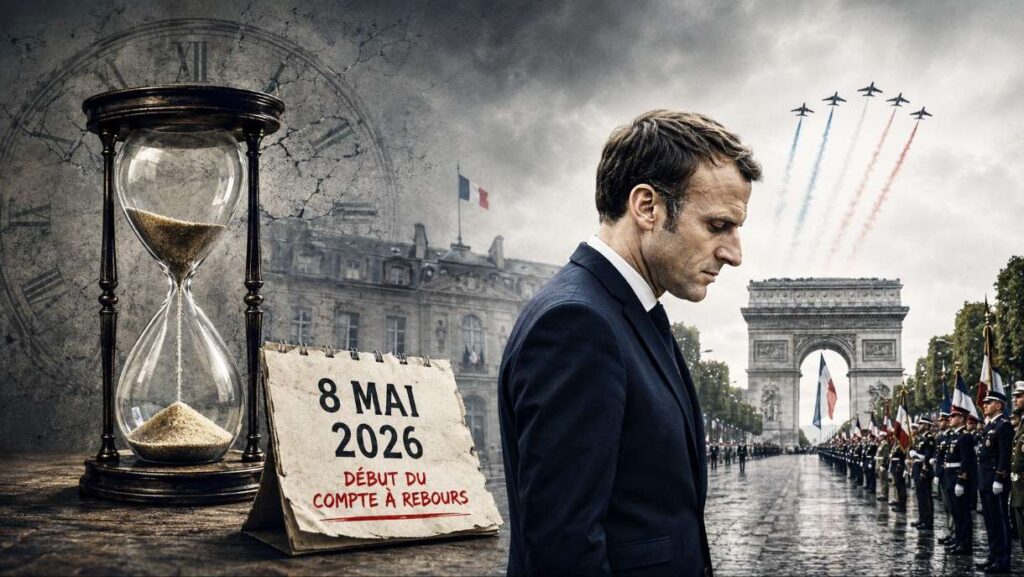
There is an almost monarchical cruelty in French politics: The president is never simply president. He is a bearer of hope, Jupiter, commander, Sun King—until the day the court begins counting his steps like the final tolls of an old cathedral. And that is exactly what is now happening to Emmanuel Macron.
May 8, 2026, this day of remembrance of victory, sacrifice and liberation, suddenly becomes something far more mundane and far more brutal for France’s president: a gigantic political hourglass. Officially, Macron stands before the flags of the Republic, under the gaze of the veterans, flanked by the Republican Guard, immaculately groomed as if in a state painting. But in reality, he stands there like a man whose power is already being viewed in the rear-view mirror.
One more year.
Twelve more months as president.
365 more days in which the Republic politely pretends that its master of the house remains unchallenged.
France has mastered this art of polite cruelty perfectly. People applaud the president—and at the same time are already discussing his funeral as a political figure. The successors shuffle their feet impatiently. Ministers discreetly begin writing their memoirs. Party friends suddenly start having ideas of their own. And the opponents? The opponents smell the end as wolves smell the first snow.
Macron always wanted to be more than an ordinary president. Not merely an administrator of the nation, but the architect of a new era. He wanted to modernize, Europeanize, digitize, liberalize, militarize France, and save it in the process. A president straight out of a McKinsey management consultancy PowerPoint presentation: dynamic, disruptive, boundlessly convinced of himself.
Now the end of this presidency begins, of all things, to the rhythm of a memorial ceremony.
It is almost literary.
The man who once walked through the Louvre courtyard like a child prodigy, accompanied by the “Ode to Joy,” is now moving slowly toward political twilight. Back then, Macron seemed like the answer to an exhausted republic. Today, he sometimes seems like its symptom: brilliant, restless, technocratic, distant, and incapable of understanding that a country cannot be run like a start-up.
The tragedy of his presidency is not that he wanted nothing. Rather, it is that he actually wanted too much—and forgot in the process that democracy does not consist of speed, but of trust.
He reformed against the unions, against the streets, against the weariness of a country that first places its presidents on a pedestal and then takes them apart with relish. The Yellow Vests were not just a protest movement, but a people’s court. Pension reform became the symbol of that vertical power Macron had always embodied: decide, push through, move on. Preferably without stopping, because stopping might mean thinking. Or listening.
And now? Now the same president is trying to “govern until the last day.” What a heroic sentence. What a desperate sentence.
Of course he wants to shape things until the very end. Presidents cannot do otherwise. Power is not a function; power is a state of the nervous system. Anyone who wakes up every morning with nuclear codes for years can hardly imagine eventually doing nothing more than writing columns about Europe or moderating conferences in Davos.
But the Republic knows no sentimental transitions.
It has long since begun to archive Macron.
That is the real harshness of this final phase of the presidency: not the loss of power itself, but the slow realization that the political present moves on without you. The headlines are already about 2027. About Le Pen. About Bardella. About Mélenchon and all the others. About the disintegrating center. About the possible major shift to the right. About everything—just no longer really about Macron.
He is still standing at the center of the stage, but the audience is already looking past him.
Perhaps this also explains the president’s almost feverish activism. Europe, defense, Ukraine, industrial sovereignty, strategic autonomy – Macron now speaks like a man governing against the clock. As if he had to wrest a legacy from history before the door of the Élysée Palace closes on him for good.
And perhaps this is precisely where his true tragedy lies: Emmanuel Macron may ultimately be remembered as a president who was often right – but rarely created a sense of closeness. One who recognized Europe’s dangers earlier than many others, but emotionally lost his own country. Who analyzed, explained, lectured – and in doing so forgot that politics is not a TED Talk stage.
May 8 reminds France of its victory over barbarism. For Macron, this day now marks something more prosaic: the beginning of the final round of a political system that always treats its presidents with the same coldness in the end.
François Hollande was mocked.
Nicolas Sarkozy was hounded.
Jacques Chirac was nostalgically idealized after having been ridiculed for years beforehand.
And Macron? He risks becoming simultaneously too young for nostalgia and too old for hope.
This is perhaps the cruelest of all democratic realizations: A president can change his country – but can never prevent the public countdown to his own expiration date.
A commentary by P. Tiko