
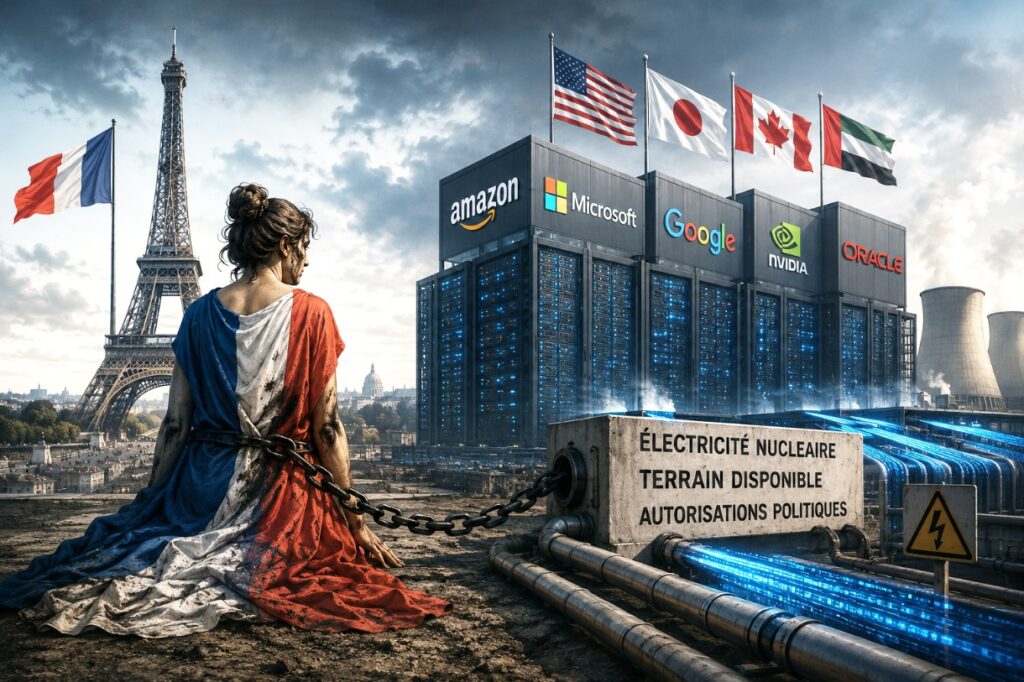
France celebrates itself. Once again. President Emmanuel Macron presents billion-euro investments in artificial intelligence as a triumph of national sovereignty. The message is that the Republic is marching to the forefront of the digital future. Cameras click, the press applauds, investors smile. Vive la France.
But behind the record sums lies an uncomfortable question: Who actually owns this future?
France provides the power. France provides the land. France provides the permits. In short: France provides the ground on which others build their digital dominance. The billions often come from the United States, Canada, Japan, or the Emirates. The crucial chips come from elsewhere. The cloud belongs to others. The AI models are developed elsewhere. The value creation, power, and control lie beyond French reach.
What is emerging here resembles less a breakthrough toward technological sovereignty and more a modern form of economic tenancy. In the past, colonies supplied raw materials for foreign empires. Today, they supply cheap energy and computing capacity for global digital corporations.
One could also put it more kindly: France is becoming the host of the AI revolution. Hosts, however, are those who prepare the hall while others stand on stage and collect the entrance fees.
Particularly remarkable is the political narrative. Under the banner of “sovereignty,” a model is being sold that deepens central dependencies rather than reducing them. The word sovereignty nowadays seems to be going the same way as sustainability or reform: It often means the exact opposite of what it originally intended.
Of course, Europe needs investments. Of course, France needs data centers. But a nation does not become digitally sovereign simply by allowing foreign companies to set up their servers on its territory. Sovereignty emerges where technologies are developed, controlled, and strategically managed.
The crucial question is therefore not how many billions flow to France. The crucial question is: Who will write the rules tomorrow? Who owns the algorithms? Who controls the infrastructure? And who ultimately collects the profits?
If France does not find its own answers to these questions, the grand AI dream may turn out to be an expensive illusion. Then, the Republic would be the location of a digital revolution — but not its master, only its electricity supplier.
A commentary by Andreas M. Brucker