
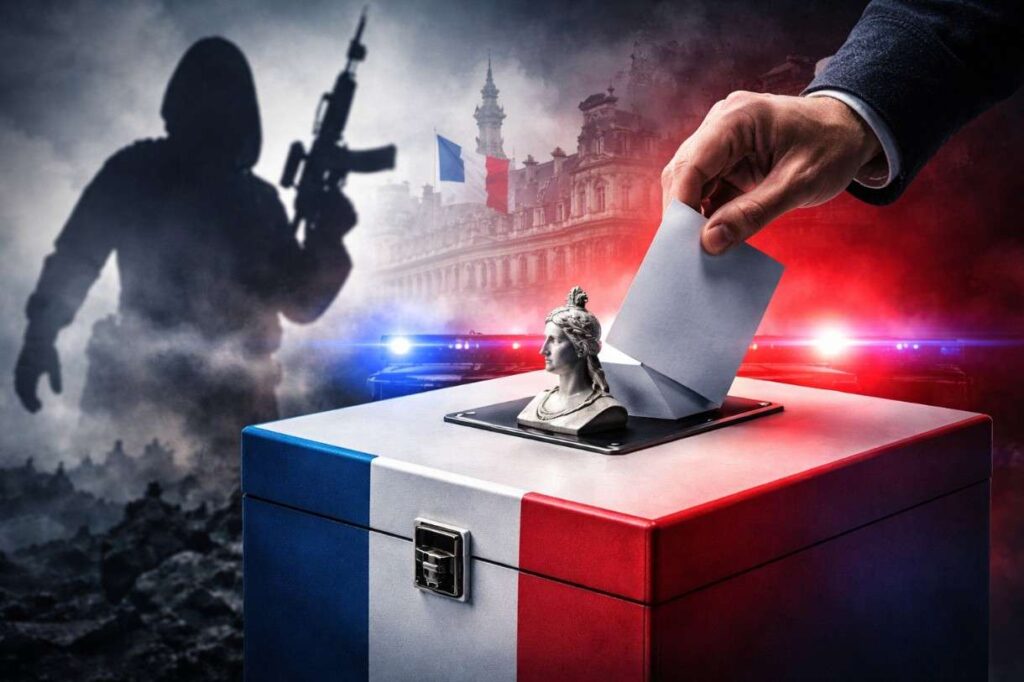
France knows these headlines.
Unfortunately.
Two brothers. Twenty and twenty-two years old.
An engineering student and an unemployed young man.
In the car: a loaded pistol, chemicals, symbols of the so-called Islamic State. Along with digital traces full of jihadist propaganda. And the dream of martyrdom: that grotesque glorification of murder that terrorists like to sell as a story of religious heroes.
The French anti-terrorism prosecutor’s office speaks of a “deadly and antisemitic” plot.
An attack intended to claim as many victims as possible.
You read these words and immediately feel the old, familiar shiver: the memory of the Bataclan, Charlie Hebdo, Nice. Of all those places where terrorists tried to tear apart open society like an old tablecloth.
Apparently, the security authorities arrested the brothers in time.
Good.
But while the justice system does its work, another kind of political exploitation begins elsewhere.
Because as soon as a case like this emerges, a familiar spectacle begins. Megaphones are brought out in the political marketplace. Some parties are already rubbing their hands—not out of concern for security, but out of delight at having a new election campaign issue.
Fear is, after all, an extremely profitable political resource.
And France is in the midst of a local election campaign.
It is one of the bitter ironies of contemporary Europe that terrorism and right-wing populism exist in a sinister interaction. Terrorism produces fear. Fear produces votes. And votes produce power.
A macabre political cycle.
Of course, the threat is real. No sane person would downplay it. France has lived for years with a terrorist threat that has changed: fewer large networks, but more small groups, sometimes even individuals, radicalized in front of screens, in dark corners of the internet.
The pattern is familiar.
Young people who lose themselves in virtual parallel worlds. Propaganda that convinces them that murder is a religious duty. The fantasy of the heroic victim: a grotesque mixture of religious fanaticism and adolescent megalomania.
And suddenly, a chat room becomes a plan of action.
All of this is real.
All of this is dangerous.
But equally real is the political temptation to turn each of these stories into a simple slogan.
“Look!” the loudspeakers of the far right then cry. “The republic is weak. Immigration is to blame. The solution is a firm hand.”
As if politics were a sledgehammer.
These slogans ignore a crucial fact: the French security authorities have prevented the attack. Investigators, judges, intelligence agencies: they work. They observe, analyze, intervene.
The state acts.
But in the political theater of fear, this reality counts for little. Success sells poorly. Fear sells very well.
And so a political narrative emerges that has about as much nuance as graffiti in a train station bathroom.
“Migration equals terror.”
Fact.
However, the case of the two brothers tells a much more complicated story. A story about online radicalization, failed biographies, ideological seduction in digital echo chambers.
And about antisemitic hatred, which has risen again in Europe – coming from various political and religious spheres.
But nuanced analyses have a problem: they do not fit on election posters.
So reality is shortened.
Until it fits into a slogan.
That works surprisingly well. Fear is a political turbocharger. Those who fuel it gain attention – and sometimes elections too.
The far right in France knows this. It has been playing this game for years with the precision of a watchmaker.
And every averted terror story is immediately folded into the same political narrative: the state is too soft, democracy too naïve, the solution lies in authoritarian strength.
As if Europe had not already experienced where such political fantasies lead.
Of course, terrorism requires determined responses. Police, intelligence services, international cooperation: all of this remains necessary.
But anyone who believes that the answer to terror is to undermine democratic principles or place entire populations under general suspicion has not understood the core of the problem.
Terrorism aims at fear.
And populism feeds on fear.
In that sense, they are unwitting allies.
One tries to shake society through violence.
The other uses the impact to gain political advantage.
In the end, there is a democracy that must defend itself not only against bombs but also against political oversimplification.
The true strength of an open society does not lie in its toughness. Rather, it lies in its ability to remain vigilant and free at the same time.
That sounds complicated.
It is.
Democracy is not a sledgehammer.
It is more like a clockwork mechanism: delicate, sensitive, precise. And precisely for that reason vulnerable to those who want to smash it with crude slogans.
The thwarted attack plan in the Pas-de-Calais serves as a reminder that terrorism still exists. But it also reminds us of something else: the responsibility of politics.
Fear explains almost everything.
It justifies nothing.
Those who want to fight terror must not at the same time damage the democratic culture they claim to defend.
Otherwise, in the end two forces triumph simultaneously:
the fanatics with their bomb fantasies – and the populists with their simple answers.
And to put it in non-academic terms, that would be really very bad news for Europe.
A commentary by Andreas M. Brucker