
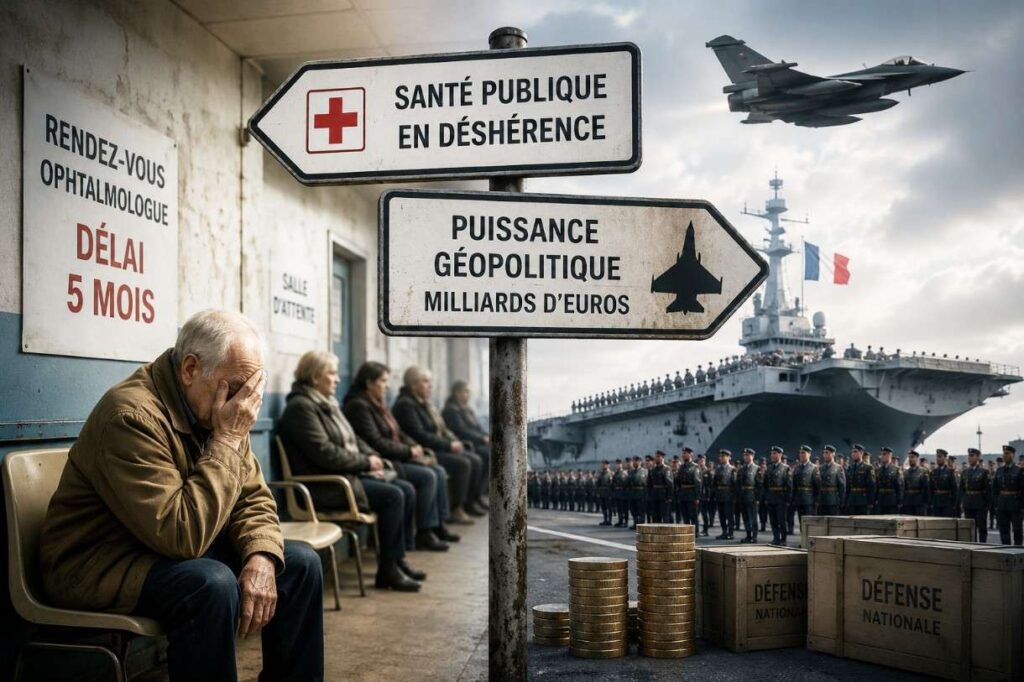
France can do many things. It can organize nuclear deterrence. Finance aircraft carriers. Announce billion-dollar programs for strategic sovereignty. It can intervene in Africa, lecture in Brussels, and react offended in Washington if the Grande Nation is not taken seriously enough.
What France clearly can no longer do: secure an appointment with an eye specialist for a 62-year-old retiree from Creuse within five months.
This is the real state crisis of this country. Not the deficit rate. Not the debt burden. Not even the political fragmentation. But this daily, silent collapse of normality.
Imagine the scene: A citizen has been waiting half a year for a specialist appointment. His wife drives eighty kilometers to the nearest gynecologist. The son cannot find a general practitioner anymore. But on TV, a prime minister solemnly declares that France must now rearm geopolitically, invest strategically, and at the same time consolidate the budget.
In other words: There is money for missiles. Unfortunately, not for retinal examinations.
It is this grotesque imbalance that currently makes France so politically explosive. The French state has by no means become small. On the contrary. It is monumentally expensive, majestically bureaucratic, and rhetorically omnipresent. It regulates, plans, reforms, and holds conferences incessantly. Only the citizen experiences this state less and less where it is actually needed.
The famous “déserts médicaux” are therefore much more than a health problem. They are the symbol of a country that still presents itself as a social protector, while the public reality tells a very different story.
In the past, Republic meant: school, hospital, train station, post office—everywhere. Today, Republic often means: online form, waiting line, and the notice that the next specialist is unfortunately located two departments away.
And while presidents talk about European sovereignty, millions of French people are losing sovereignty over their everyday lives.
The political danger behind this is enormous. France traditionally accepts high taxes, high contributions, and a powerful central state only on one condition: that the state functions. That it visibly protects. That the republican return service exists.
But this very social contract is beginning to tear.
A country that presents itself as a world power but can no longer guarantee its citizens basic medical care eventually appears not strong but exhausted.
Perhaps therein lies the true tragedy of the Grande Nation: It modernizes its nuclear weapons—and at the same time loses contact with its own population.