
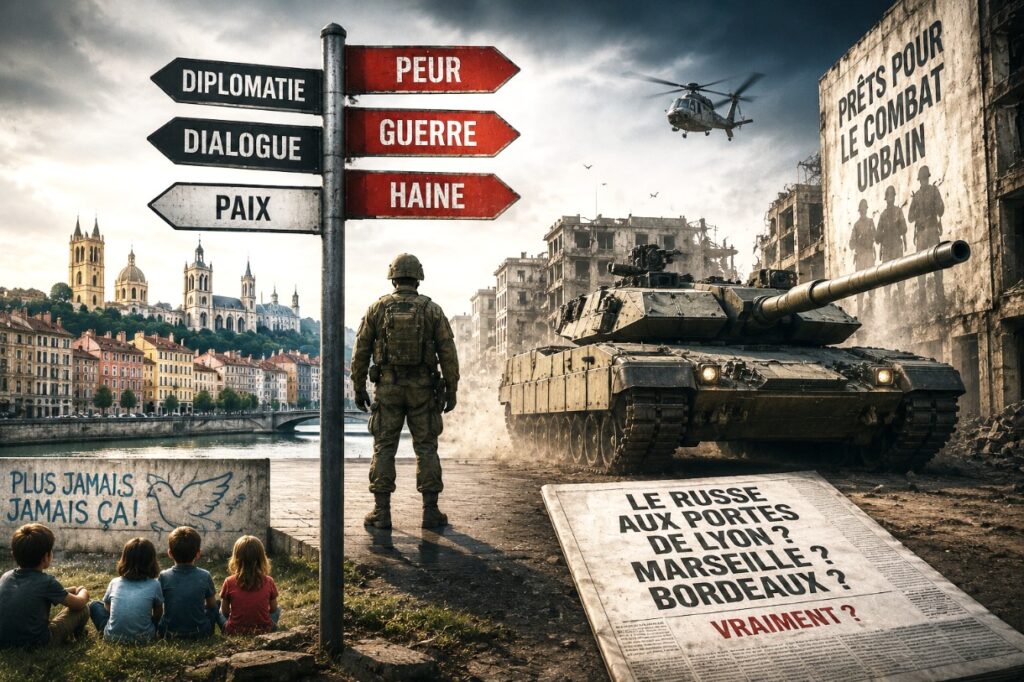
One might think that tomorrow morning, Russian tanks will cross Place Bellecour in Lyon, stop for a café au lait in Bordeaux, and then turn toward the Old Port in Marseille. At least, that is the impression given by certain political speeches and military stagings when one listens to them closely.
For years, the population has been led to understand that Europe stands on the threshold of a new era of permanent threat. Almost every day, there is talk of rearmament, readiness for war, and high-intensity conflicts. The army now even trains for urban combat in reconstructed cities—and the message seems clear: prepare yourselves.
But for what, exactly?
Should the French population really believe that Russian soldiers will one day march through the streets of Lyon, Marseille, or Bordeaux? That the next major war will be decided precisely in French residential neighborhoods? Or is the main aim to create a politically useful feeling: the permanent expectation of an existential threat?
Just a few decades ago, the political promise made after the catastrophes of the twentieth century was: “Never again war.” Europe was meant to become a continent of mutual understanding. The European Union even received the Nobel Peace Prize for its contribution to overcoming centuries-old hostilities.
Today, the tone seems to have changed. “Never again war” is increasingly becoming “Be prepared for the next war.” Peace policy is turning into security rhetoric. Diplomacy is becoming deterrence. And anyone who asks critical questions quickly risks being labeled naive or irresponsible in matters of security.
Of course, it would be just as naive to ignore existing threats. The war in Ukraine strikingly shows that military violence in Europe is by no means a thing of the past. States must organize their defense and prepare their armed forces for a wide range of scenarios. That is part of every government’s responsibilities.
But that is precisely why the public debate must remain honest.
There is a considerable difference between professional military preparedness and accustoming a society to the idea of inevitable war. Those who constantly speak of the next escalation change the way a society thinks. Fear becomes a permanent political companion. States of emergency suddenly seem normal.
Perhaps one should ask a simple question: does every martial staging really serve the country’s security, or does it also contribute to creating a climate in which rearmament, increased defense spending, and military thinking increasingly appear inevitable?
Anyone who wants to preserve peace needs credible defense. But they also need diplomacy, dialogue, and the ability to assess threats calmly instead of constantly dramatizing them.
Because one thing should still apply today: the real goal must never be to master urban combat perfectly in French cities. The real goal must remain to do everything possible to ensure that such combat never takes place.
Andreas M. Brucker