
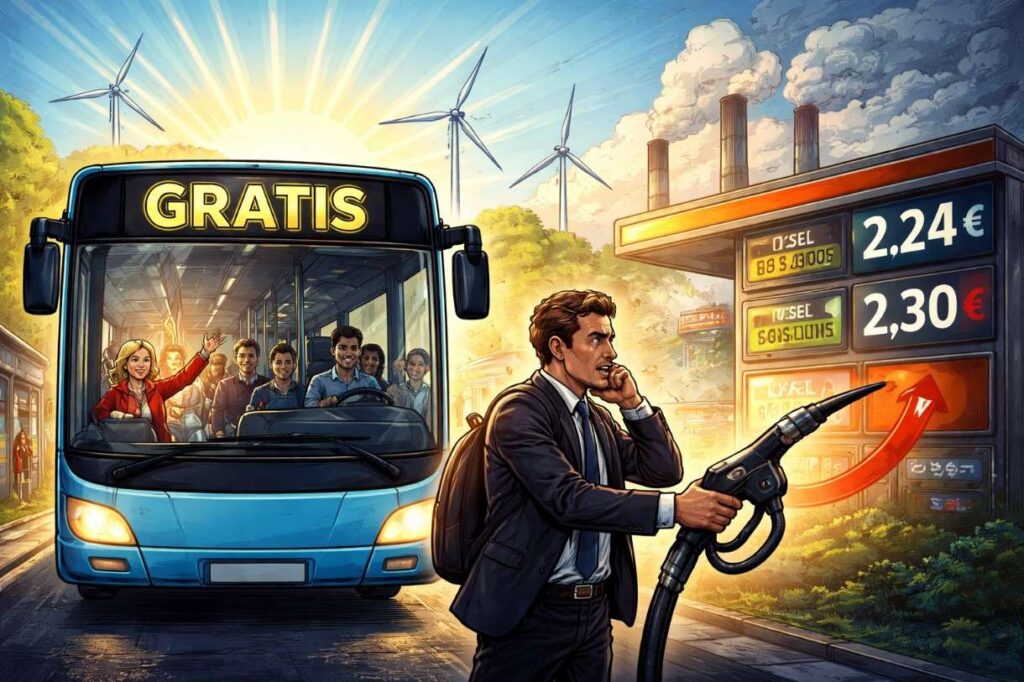
These are strange scenes that keep repeating these days. At petrol stations, the numbers flicker upward cent by cent, like the quiet thermometer of a society that has grown accustomed to something being wrong. And what about politics? They debate caps, discounts and compensation, but it feels like trying to put out a fire with a glass of water.
In fact, the solution is already on the streets. No, more precisely, it is in the bus lanes.
What if we turned things around? No longer trying to keep driving artificially cheap, but finally strengthening what is most obvious – public transport. Free. Accessible. As a matter of course.
As in Hundek.
There, they understood what mobility really means. Not the freedom to buy expensive fuel, but the freedom to move without fear of the next bill. Not something you constantly have to consider, whether to travel today or not.
This is a matter of dignity.
And yes, it is also a matter of fairness.
At the petrol pump, while profits continue to flow into the pockets of the oil giants, people pay twice: first when refuelling, and then through taxes for half-hearted relief measures. It is an absurd system. Almost cynical. Because it amounts to forcibly maintaining infrastructure that is increasingly working against its own people.
Why?
Why not boldly change direction?
Free public transport is not a gift. It is a decision. A political stance. A rejection of the logic that mobility should be a luxury. And a clear message: cities belong to everyone, not just those with full tanks.
Of course it costs money. Everything costs money. Roads cost money too. Subsidies cost money too. Congestion costs the most. But what is more expensive—a functioning bus system or a society that is increasingly unable to move?
You only need to ask this question honestly once.
And you immediately realise how misguided the current debate is.
Because it is no longer simply a matter of transport policy. It is about the image a country has of itself. Will we continue to watch social division deepen at petrol stations? Or will we take a step towards mobility that connects people rather than dividing them?
Dunkirk provides an answer. Quietly, unremarkably, but effectively.
The buses run. People get on. No tickets, no barriers. And suddenly, what previously seemed complicated begins to work. Just like that.
Perhaps that is the real scandal: that it is possible. That it is already working. And that elsewhere, there is still hesitation to implement it.
It could also be put differently – somewhat exaggerated, somewhat impatiently: we already know what is right. We simply do not yet have the courage to put it into practice consistently.
But how much longer will we wait?
A commentary by C. Hatty