
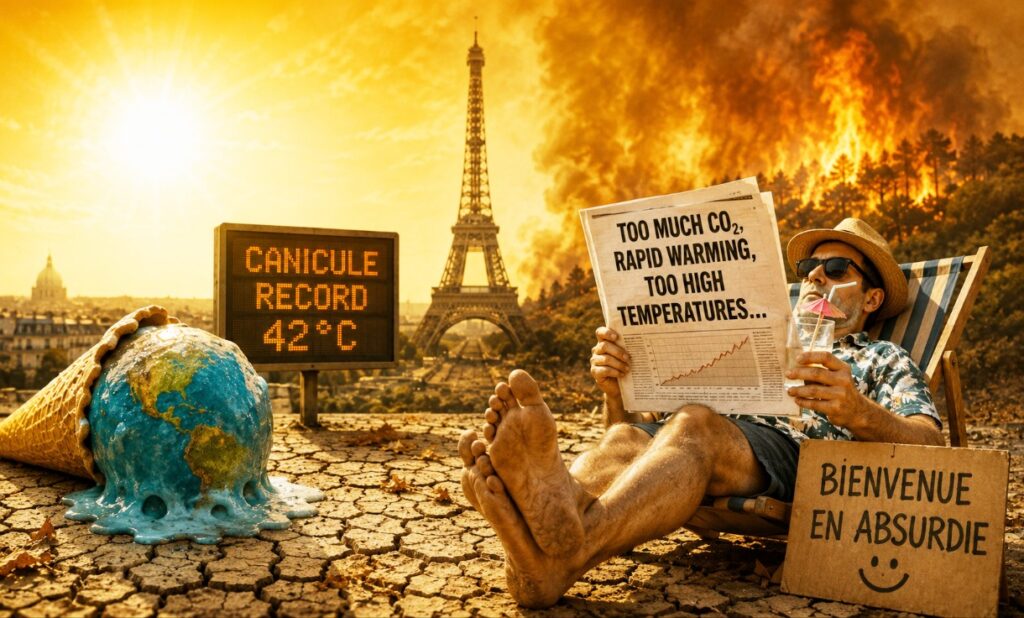
When does a country actually become uninhabitable?
At 35 degrees? At 40? Or only when the asphalt melts, the forests burn, and walking the dog becomes a medical emergency?
There we are. Year after year, the same headline. Record heat. Drought of the century. Fire of the millennium. And amazingly, we still manage to be surprised every single time. Almost touching.
Of course, there used to be summers too. There were hot days back then as well. By now, that has become the favorite argument of all those who would claim even at 45 degrees that the thermometer is part of an international conspiracy. Everything used to be normal—except perhaps for the fact that you could still sleep at night, rivers had water, and firefighters did not have to battle major fires every day.
France is now activating national disaster response due to extreme heat. Cooling centers are being set up, elderly people are being located, fireworks are being canceled because a single spark is enough to set entire landscapes ablaze. You might think these are measures for a crisis zone. In fact, it is a perfectly normal July.
And yet people keep talking about whether it is really all that bad.
Perhaps we should end the debate. Nature has long since stopped conducting it with words, but with temperatures.
It is remarkable how adaptable humans are. In the past, an air-conditioned shopping center was considered a luxury. Nowadays, it is becoming a public shelter. In the past, people sought the sun in summer. Now they desperately seek the last square meter of shade.
But there are still people who claim that higher temperatures are wonderful after all. Finally, a Mediterranean climate. How lovely. Olive trees in Brittany, palm trees on the North Sea, and wildfires as a new summer custom. The only thing missing is promoting camels as a sustainable alternative to the family car.
The irony is bitter: for decades, there have been warnings that precisely this development could occur. Scientists published studies. Meteorologists explained connections. International organizations presented reports. Politicians gave speeches. Climate conferences adopted declarations.
And CO₂ emissions?
They kept rising.
The atmosphere does not negotiate. It knows no election dates or coalition agreements. It does not care about party platforms or talk shows. Physics remains physics.
Of course, no one will claim that France or Europe will be uninhabitable tomorrow. That is not how change works. Livability rarely disappears overnight. It erodes slowly. First, summer days become unbearable. Then health risks increase. Agriculture struggles with crop failures. Insurers raise premiums or withdraw. Water becomes scarcer. Nature changes. Eventually, the extraordinary becomes the new normal.
Perhaps that is precisely the greatest danger: not the heat itself, but our ability to get used to it.
We are constantly shifting the boundary of what we still perceive as normal. 30 degrees? A heatwave in the past. Now pleasant. 38 degrees? Stressful. 42 degrees? “It happens sometimes.” And at some point, we seriously debate whether 46 degrees is really exceptional.
You can get used to a lot. Traffic jams. Inflation. Political crises.
But do you really have to get used to the fact that summer is becoming a period of disaster?
A country does not lose its livability only when people have to flee. It begins much earlier: when children can no longer play outside, when older people do not leave their homes during the day, when fireworks have to be cancelled because the sky itself has become a fuse.
Perhaps the crucial question is therefore not, from when a country is no longer livable.
But why it takes us so long to acknowledge that livability means far more than economic growth, air conditioning, and the hope that next year will be better.
Because hope does not replace policy. And sarcasm does not cool cities.
A commentary by C. Hatty