
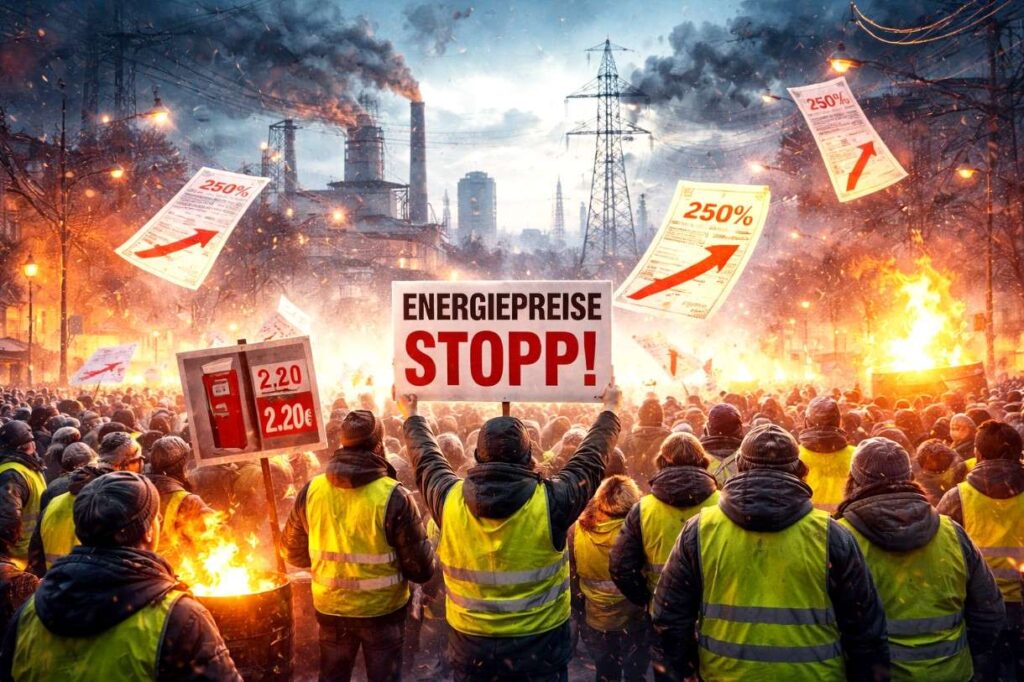
In fact, everyone knew.
Really.
And yet here we are, looking at heating bills that seem like a bad joke, collectively pretending that all of this is somehow… surprising. Rising gas and heating oil prices – who could have imagined it? Oh right, almost everyone who paid attention to energy policy for more than five minutes.
And now?
Now it’s burning.
Not only in the boilers, but in the social fabric.
Cost of living crisis – or: how to turn energy into a political powder keg
It always starts innocently.
A few cents more per liter of gasoline.
An extra charge on the gas bill.
A slightly increased advance payment.
“It’ll be fine,” people think.
Until it isn’t.
Suddenly, something shifts. And not only in people’s wallets, but in their sense of fairness. Because energy is not a luxury product. No one sits there in winter thinking: “Today I’ll treat myself to 21 degrees in the living room.” Energy is a basic necessity. Full stop.
And that is precisely where the fuse lies.
Because when basic needs become expensive, the mood changes. Not slowly. Not elegantly. But with force.
France felt it early.
The Yellow Vests – a symbol that rising fuel prices are not merely an economic indicator, but an emotional trigger. People took to the streets not because they suddenly wanted to become politically active, but because they simply felt cheated.
And honestly: can anyone blame them?
Anyone who has to commute every day, has no alternative, and is then told that higher prices are “environmentally reasonable” eventually thinks: fine in theory – but I still have to get to work.
And Germany?
Tried to smother it all with money.
Relief packages. Price caps. Transfers. A financial bandage on a structural wound.
Does that work?
Perhaps in the short term.
In the long term, it feels like trying to plug a leak with duct tape while the water is already knee-deep in the boat.
The Great Illusion of Control
What irritates me most about this whole situation – and yes, also makes me angry – is this political staging of control.
As if everything were under control.
As if it were just a phase.
As if a few measures could suspend reality.
Spoiler: they cannot.
The truth is actually quite uncomfortable.
For decades, Europe has made itself dependent on a simple assumption: energy remains cheap.
And this assumption was – surprise – wrong.
Or perhaps not wrong, simply naïve.
Because fossil energy was never really cheap. It was only cheap by externalizing the costs. The real costs – climate damage, environmental destruction, geopolitical dependencies – were conveniently hidden.
And now?
They are resurfacing. Like a bill that has been ignored for far too long.
With interest.
Germany: industrial powerhouse hit by the energy shock
In this drama, Germany resembles a high-performance engine that suddenly finds itself running out of fuel.
For decades, economic success rested on a simple formula: strong industry plus relatively cheap energy.
Chemicals, steel, glass – all these sectors depend on stable energy prices. When they suddenly soar, entire business models begin to falter.
And that is exactly what is happening right now.
Companies are cutting production. Relocations abroad are increasing. Investments are being postponed.
And then we stand there wondering: how could this have happened?
Perhaps because we relied for too long on the system eventually working on its own.
And it did work.
Until the day it no longer did.
France: the seemingly stable counter-model
From the outside, France appears almost enviably stable.
Thanks to nuclear power.
While Germany has phased out nuclear power, France continues to rely on it – and thus seeks to ensure a certain degree of price stability.
At first glance, this looks like a strategic advantage.
And it is. In part.
But here, too, a second look is warranted.
Because French reactors are aging. They require a great deal of maintenance. Expensive to maintain. And building new facilities takes – surprise – longer than a weekend.
Nevertheless, the model appears more robust.
Why?
Because it at least shows an attempt at long-term planning.
And that is precisely what is often lacking in the German debate: a clear, coherent line.
Instead, there are changes of direction, compromises, temporary solutions.
A bit of this, a bit of that – and in the end the hope that everything will somehow settle down.
But that is not the case.
Energy poverty – the silent drama
While politics and business discuss billions, an entirely different drama is unfolding in the everyday lives of many people.
A silent drama.
Energy poverty.
A term that sounds weighty but describes a brutal reality: people who can no longer heat their homes properly. Who save electricity where there is hardly anything left to save. Who have to make decisions like: a warm apartment or a full refrigerator compartment?
It is no longer a marginal phenomenon.
It has reached the heart of society.
And it does not affect everyone in the same way.
Of course not.
Those who earn well complain about higher costs.
Those who have little face existential pressure.
And it is precisely here that the extent to which energy issues are linked to social justice becomes apparent.
Because what happens if the transformation toward a climate-neutral society hits hardest those who are already struggling?
Then it loses acceptance.
And without acceptance?
No chance.
The pressure of transformation – finally or unfortunately?
One could now say: at least high prices accelerate the transition to renewable energy.
And yes, that is true.
Suddenly, investments previously considered “too expensive” become worthwhile. Suddenly, efficiency becomes attractive. Suddenly, there is serious talk of hydrogen, grid expansion, and storage technologies.
So everything is fine?
Not quite.
Because this transformation is not the result of a calm strategic process, but of pressure. Crises. Necessity.
And that makes it more chaotic.
More expensive.
Less consistent.
One could almost ask sarcastically: Did it really have to come to this?
Could we not have acted earlier, in a more planned and fairer way?
The answer is actually known to everyone.
Energy as a question of power – and us in the middle
What is often underestimated: energy is not just an economic or environmental issue.
It is power.
Whoever controls energy controls dependencies.
Germany learned this the hard way. The break with Russia showed how risky one-sided dependencies are.
Suddenly, everything had to happen quickly: new suppliers, LNG terminals, new infrastructure.
And at a pace that would not even have been imagined before.
France, on the other hand, is benefiting from its position by presenting itself as a stable player.
A bit like the neighbor who insulated their house in time while we were still wondering whether it was worth it.
The real crisis – and why it affects us so much
To be honest, it is not just about energy prices.
It is about trust.
Trust in political decisions.
Trust in economic stability.
Trust in the future.
And it is precisely this trust that is beginning to crack.
Because many people feel that the big promises—cheap energy, stable prices, growing prosperity—no longer hold true without reservation.
This creates uncertainty.
And uncertainty is the perfect breeding ground for frustration.
And frustration?
It eventually finds an outlet.
A little hope – despite everything
As bleak as all this may seem—and yes, sometimes it really feels like quite a mess—there is also another perspective.
The current crisis is forcing us to change things that have been overdue for a long time.
Renewable energies are gaining momentum.
Technologies are evolving faster.
Awareness of interconnections is growing.
And perhaps – just perhaps – something better will come of it.
A cleaner energy supply. More stable. Fairer.
But technology alone is not enough.
Social solutions are also needed.
After all, what good is the best climate policy if it collapses socially?
And now?
Perhaps we should stop pretending to be surprised.
Perhaps we should discuss more honestly what is at stake.
And perhaps – a somewhat crazy idea – we should think long-term instead of stumbling from crisis to crisis.
Because one thing is certain:
Energy prices have long since ceased to be a marginal issue.
They determine how we live.
The fairness of our society.
And the stability of our democracy.
Or to put it another way – a bit provocatively, but well, it works:
Those who underestimate energy policy are playing with social peace.
And that is a game we really cannot afford.
Or do we really want to react only when the streets are burning again?