
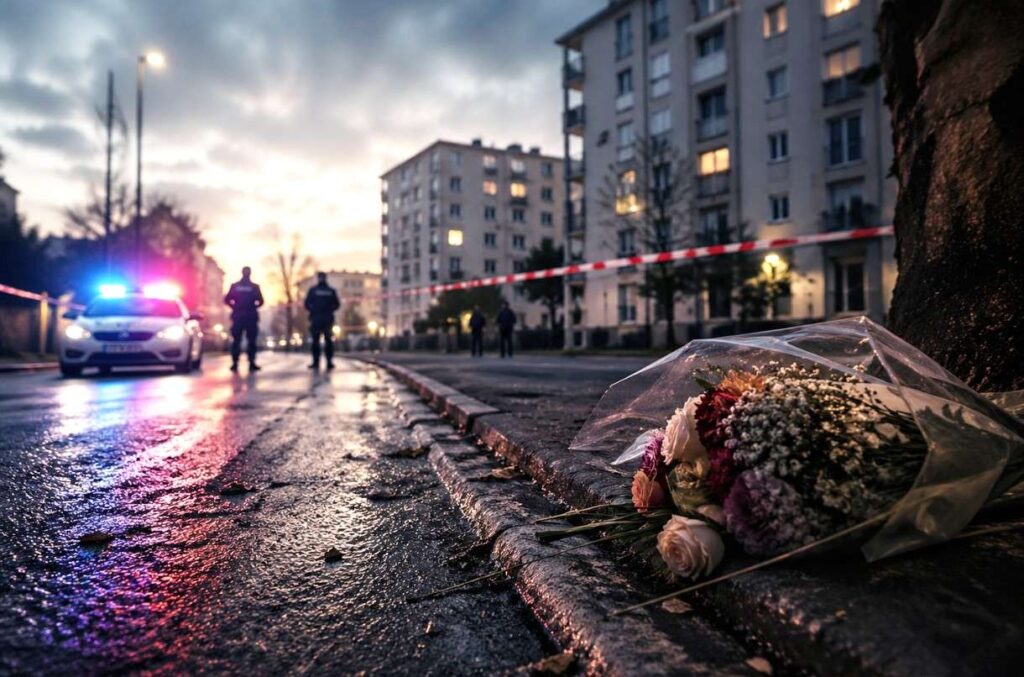
Oh, how reassuringly the modern city of today functions.
You bring the children home, maybe still think about dinner, about school tomorrow, about the little worries of everyday life – and suddenly a bullet whistles through the street. Welcome to Décines-Charpieu, where coincidence apparently now belongs to the municipal security strategy.
Stray bullets – they sound so harmless, almost cute, as if they just briefly lost their way. But nothing here is mistaken. Here a state is lost that has been convincing itself for years that urban decay can be managed with press conferences, rituals of concern, and occasional police sirens. The bullets have long found their target themselves – right in the middle of the lives of the innocent.
Of course, the usual show follows. Additional forces. Determined words. Demands for special units. This choreography is familiar. It has become as integral to the French security crisis as the seas of candles after attacks. Politics reacts with the eagerness of a firefighter who only looks for water after the roof has already collapsed.
And in the meantime, citizens are supposed to continue to have trust.
Trust in what exactly?
That drug networks might shoot more politely soon? That children will learn to duck better on their way home? Or that problematic neighborhoods can simply be called “sensitive” long enough until reality seems linguistically softened?
The bitter truth is unpleasant: the state often no longer acts like a sovereign, but like a late visitor in neighborhoods whose order has long been taken over by others. It is not mayors who rule there at night, but fear, money, and violence.
What is truly shocking, however, is not just the brutality of the perpetrators. It is the habituation to it. When residents begin to incorporate gunshots into their evening routine, when mothers calculate the way home as a security risk, more than public order is falling apart. The republic is breaking down on a small scale.
One cannot save cities with emergency vehicles alone.
Social decay must be fought, parallel economies dismantled, justice strengthened, and political cowardice overcome. But exactly that requires endurance, willingness to confront conflict, and truthfulness – virtues that in the hectic pace of modern crisis management rather seem like nostalgic luxuries.
Décines-Charpieu is therefore not an isolated case.
It is a menacing sign.
A warning signal that echoes loudly through France’s suburbs and asks how much loss of control a society still wants to disguise as normality. Those who continue to respond only with symbolic politics should not be surprised if eventually not only individual neighborhoods but the trust of entire generations of citizens is lost.
The stray bullet is in the end not the biggest problem.
The real danger is a state that becomes accustomed to merely watching it.
A commentary by Ch. Macha