
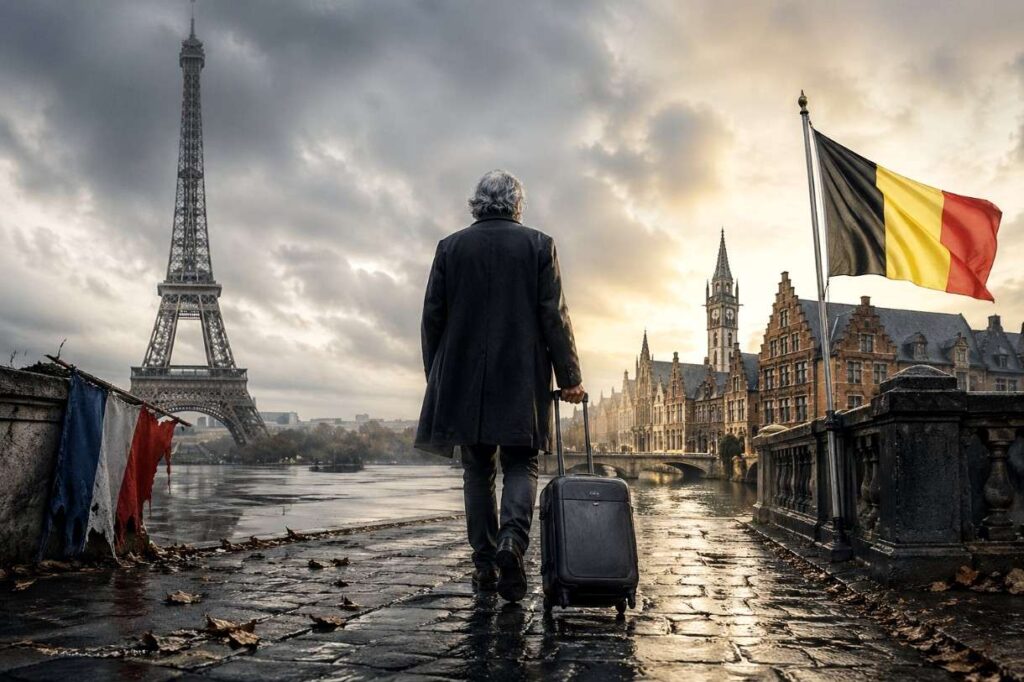
It is not the loud ones who truly shake a country.
Not the market criers, not the outrage professionals, not the political poseurs who haunt talk shows and social networks daily like traveling merchants of excitement.
It is the quiet ones.
The thinkers.
The writers.
Those who stay even though they doubt. Those who admonish even though they know that admonitions rarely receive applause. Those who fight against coarseness with language as others fight storm surges with bare hands.
When such people leave, it is not simply a citizen who leaves their country.
Then a piece of intellectual breath leaves.
Boualem Sansal’s statement that France is over for him carries exactly this weight. No shrill accusation, no hatred, no spectacle. But that exhausted pain that arises when a person who believed in the idea of a country loses faith in its courage.
That weighs heavier than any protest.
Because intellectuals are not decoration for democratic societies. They are their early warning system. Their skepticism, their contradictions, their discomfort form the moral seismograph network of a republic. Whoever loses them, loses direction.
France – this great country of enlightenment, revolution, human rights, passionate debate – has lived for centuries on the power of its debates. From Voltaire to Camus, from Sartre to Aron, the struggle for truth was never comfortable but necessary.
But what happens when spaces for debate become narrower?
When moral labels replace arguments?
When differentiation is considered betrayal and doubt a danger?
Then no democratic progress occurs.
Then intellectual narrowness grows.
And narrowness is the oxygen deficiency of freedom.
Sansal’s withdrawal therefore seems like a Menetekel – not only for France but for Europe as a whole. Because everywhere discourse hardens, where political camps entrench themselves in self-righteous hostility, the same erosion begins: the expulsion of the free spirit not by prison walls but by exhaustion.
How bitter.
Not censorship drives the thinker away.
But fatigue.
The fatigue of having to resist reflexive outrage, ideological templates, the permanent simplification of the complex.
A country that no longer tolerates its intellectuals loses more than brilliant minds.
It loses its self-examination.
Its inner vigilance.
Its ability to defend itself against its own error.
Of course, Sansal’s decision must not be blown up into a state crisis. People move, seek peace, perspective, distance.
But symbols have power.
And this symbol is uncomfortable.
Because it reminds us that freedom is not guaranteed by laws alone, but by climate. By atmosphere. By the willingness to not only tolerate dissent but to endure it.
Democracies rarely die from open attacks alone.
Sometimes they wither from intellectual exhaustion.
When wise voices fall silent or leave, what often remains is a noise that simulates debate but no longer produces insight.
Then thinking grows quieter.
And more dangerous for freedom.
Boualem Sansal’s quiet farewell is therefore more than a private decision. It is a melancholic warning call.
A country should take notice when its sharpest critics no longer fight but leave.
Because perhaps the true loss of a nation does not begin at its borders.
But at its desks.
A commentary by Andreas M. Brucker