
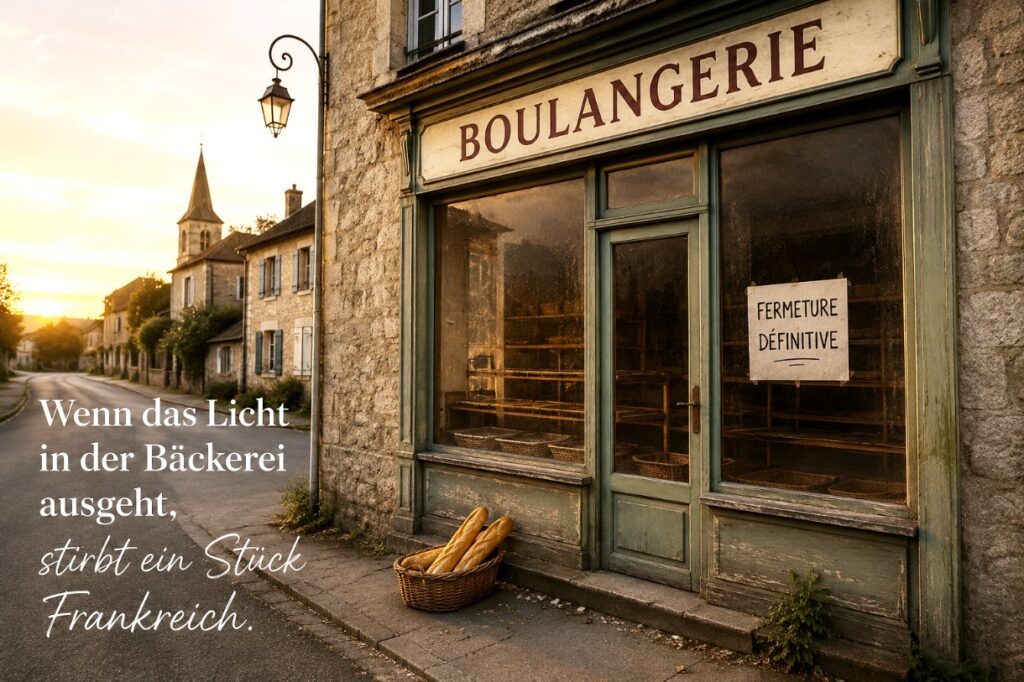
It often starts very inconspicuously.
A handwritten note on the door. “Fermeture définitive.” Permanently closed. No big ceremony, no TV crews, no headlines. Just an empty shop space behind fogged glass — and suddenly something is missing in the village that had seemed self-evident for years.
The village bakery.
Those who have never lived in a French village may not understand what is actually lost. A boulangerie doesn’t just sell bread. It is a meeting place, an exchange of news, social glue. People meet there who otherwise hardly come together anywhere. The retiree with his newspaper. The mother on her way to school. The farmer before sunrise. A brief greeting, two sentences about the weather, a smile across the counter — perhaps banal. But community consists precisely of such little things.
And now these places are disappearing.
Quietly. One after another.
France is thus losing not just a shop. The country is losing a part of its soul. Because the baguette was never just food. It belonged to the rhythm of the day like the ringing of church bells or the smell of coffee in the early morning. You didn’t buy bread just between detergents and frozen pizza. You fetched it fresh, daily, almost like a ritual. This ritual is now crumbling.
Of course, everyone knows the economic reasons. Electricity prices are exploding, raw materials are getting more expensive, there is a lack of successors. Who nowadays still wants to knead dough at three in the morning while others are sleeping? The craft demands toughness, discipline, and passion. Lots of work, little free time — and often a life on the edge of profitability. Many young people say: no thank you. You can hardly blame them.
But precisely in that lies the tragedy.
A society often only realizes what it has lost when the shutters stay down. Only when the village looks dark in the morning. Only when people have to drive twenty kilometers just to buy decent bread. Only then do you recognize: the bakery was infrastructure. Human infrastructure.
The contrast is especially bitter in France. Precisely in the country of the baguette, “bread deserts” are emerging. That sounds almost absurd. As if Italy were without coffee or Provence without lavender. And yet exactly that is happening — slowly, silently, almost creeping.
Of course, replacement solutions arise in many places. Vending machines, baking stations, delivery services. Practical. Efficient. But hand on heart: a reheated industrial bread roll does not replace a real baker. It does not replace the smell of a warm bakery, not the crackling paper under the arm, not the feeling of being part of a lively village.
Maybe our time underestimates such places because they don’t promise quick profits. Because you cannot measure community in quarterly figures. But precisely there, between bags of flour and oven, something emerged over decades that modern politics is increasingly losing sight of: proximity.
And when that proximity disappears, more remains than just a vacant storefront.
Silence remains.
Andreas M. Brucker