
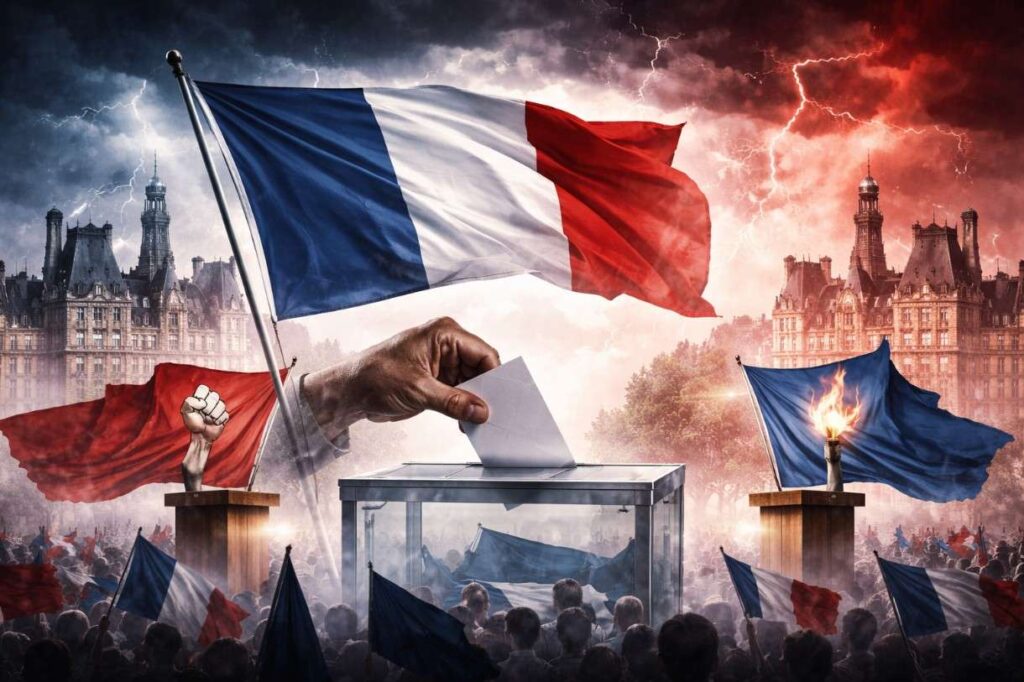
It is in the quiet hours before the decision that it becomes clear how strong a political community really is. This weekend, France is not only facing a decisive local election. It is facing a question greater than any city council majority: Will civic reason hold – or will the country continue to slip into comfortable radicalism?
The 2026 French local elections are not an ordinary test of local democracy. They are a seismograph. And what they measure is not a mere mood, but a tectonic shift in the political self-understanding of the Republic.
The Exhaustion of the Center
The political center in France appears tired. It has governed, reformed, moderated – and in the process lost part of its own persuasive power. What was once seen as a responsible balance now appears to many voters as powerless administration.
The consequence is a dangerous dynamic: The extremes benefit not despite, but because of this exhaustion. They offer simple answers in an increasingly complex world. They promise clarity where the center allows doubt. And they stage determination where democratic processes necessarily hesitate.
This is the real tragedy of these elections: It is not the strength of the extremes that is the problem – but the weakness of those who should oppose them.
The New Normality of the Unlikely
What was considered politically unthinkable just a few years ago is now part of strategic reality. Alliances that were once excluded are suddenly being discussed. Borders that were once clear are blurring.
In some cities, the conservative right faces the temptation to allow itself to be tolerated by the extreme right – or at least no longer to decisively distance itself from it. It is a dangerous game with political hygiene. Because whoever believes extremism can be instrumentalized often ends up being instrumentalized by it themselves.
On the other hand, the left struggles with its own fragmentation. The price of unity is high: programmatic vagueness, ideological tensions, fragile compromises. Here too it applies: the voter senses whether an alliance is formed out of conviction – or out of fear of the opponent.
The Republic as Prey
These days it is about more than town halls, more than mandates, more than local prestige projects. It is about the question of who owns the republic – and who claims it for themselves.
The extremes, right and left, have one thing in common: they do not see institutions only as tools, but as prey. Their rhetoric is aimed not at compromise, but at victory. Not at integration, but at exclusion.
This is not a moral accusation, but a sober diagnosis. Democracies live from compromise. Whoever systematically delegitimizes it attacks the foundation on which they themselves stand.
The Voter as the Last Instance
In the end – as so often – the responsibility remains with the voter. It is the voter who decides whether the republic remains a realm of reason or becomes a testing ground for radicalism.
But this decision has become more difficult. Because the clarity of earlier political camps has disappeared. What remains is a confusing field of tactical alliances, contradictory programs, and emotionally charged campaigns.
Today, the voter has to do more than before: He must distinguish, classify, weigh options. He must resist the temptation to choose the politically loudest out of frustration.
The Last Hour of Responsibility
The last day of an election campaign is always a moment of truth. Not for the candidates – they have spoken, campaigned, promised. But for society itself.
France faces a decision that comes quietly but will have a loud impact. It is the decision between patience and impatience, between complexity and simplification, between democratic effort and populist shortcuts.
Perhaps this is the real test of this election: whether a society is still willing to endure the demands of democracy.
Because democracy is exhausting. It requires dissent, compromise, ambivalence. The extremes promise the opposite: clarity, speed, strength.
It is precisely in this that their danger lies.
A commentary by Andreas M. Brucker