
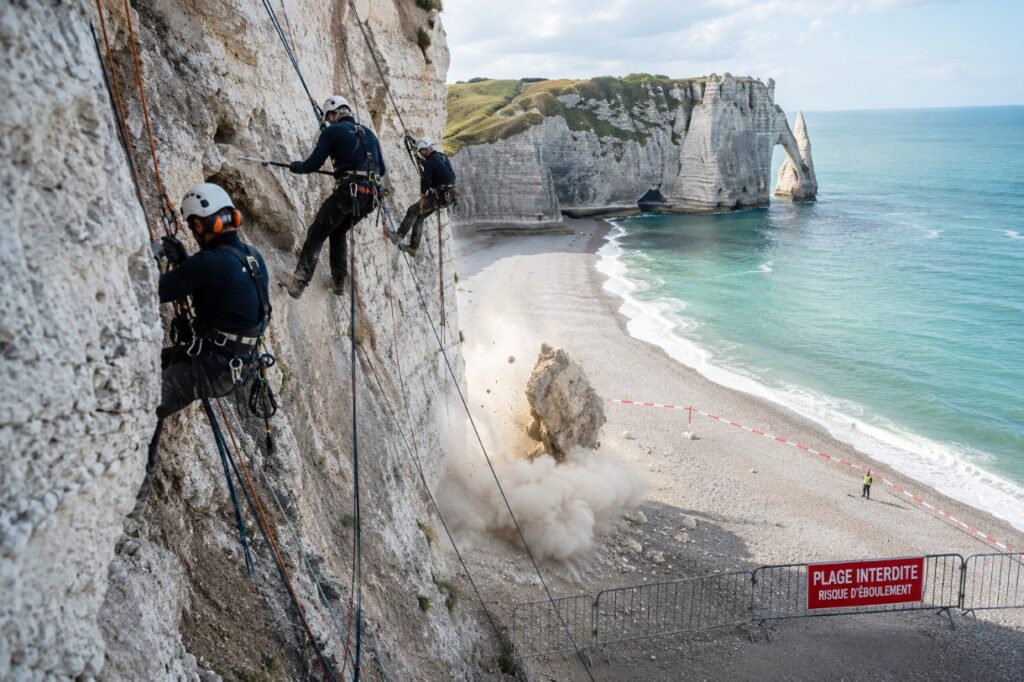
It looks like a scene from an adventure film. Three men hang from ropes above an almost vertical chalk cliff, with Étretat’s famous pebble beach below them. Every movement is precise, every glance focused on the fragile rock. Their goal initially sounds contradictory: they want to trigger a rockfall in order to prevent exactly that. Crazy? Only at first glance.
At the Falaise d’Aval, one of France’s best-known cliff coasts, specialists deliberately dislodged a rock block weighing around 400 kilograms from the cliff face. The rock fell onto the beach, which had been closed off beforehand, and broke into numerous pieces. The actual work took only a few minutes. However, the spectacular operation was preceded by careful preparation, as the block was considered to be at immediate risk of collapse.
During a routine inspection, experts had discovered numerous cracks. The rock was located around one hundred metres from the Trou à l’Homme, a popular passage through the cliffs. The damage led to only one conclusion: sooner or later, the block would come loose. But when? That was precisely the question that could not be answered.
Those in charge did not want to take any risks.
On the morning of 22 July, the town completely closed the affected section between 7 a.m. and 2 p.m. Walkers, beachgoers and photographers had to stay out. Only once no one could be endangered did the rope-access workers from the company Ouest Acro descend over the cliff edge.
Using long crowbars, they worked on the loose block of rock. Then everything suddenly happened very quickly. After only a few minutes, the rock lost its hold and plunged into the depths. A cloud of dust rose up, the echo reverberated between the white cliffs – and the dangerous boulder was history.
Images like these are impressive.
But they also show that the world-famous chalk cliffs are anything but immovable natural monuments. Wind, rain, frost and surf work tirelessly on the coast. Water penetrates the tiniest cracks, enlarging them over months and years and loosening the porous rock. At some point, a rock block loses its hold. Sometimes this happens entirely without warning.
It was precisely this natural process that shaped Étretat’s impressive arches over thousands of years. Porte d’Aval, Porte d’Amont and the mighty Manneporte owe their distinctive forms to the same erosion that causes safety problems today. The landscape is constantly changing. What appears timeless in a holiday photograph is, in reality, in permanent motion.
And that is exactly where its appeal lies.
Every year, millions of people travel to Étretat to experience this natural spectacle with their own eyes. Many enjoy the view from the hiking trails or spend a relaxing day on the beach. Others seek a special thrill. They leave the marked paths, step right up to the cliff edge or stand directly beneath the steep walls – all for the perfect photo. Is that risk really worth it?
For years, the authorities have been trying to protect visitors more effectively. Since April 2025, stricter access restrictions have been in force in several areas. Hazardous sections remain closed, warning signs alert people to falling rocks, and specialists inspect the cliffs regularly. If they discover particularly unstable sections, they intervene in a targeted manner – as they have now at the Falaise d’Aval.
Nevertheless, fully securing the coast is not an option. Concrete, nets or massive anchors would destroy the landscape’s unique character and would, at best, merely delay its natural transformation. The chalk cliffs owe their vitality precisely to their change. They tell a story that has continued for millions of years and is being written further day by day.
The controlled rockfall therefore strikingly demonstrates how challenging it has become to manage this natural wonder. The municipality protects visitors while preserving one of France’s best-known landmarks, and accepts that nature cannot be permanently tamed. Perhaps that is Étretat’s true fascination: the landscape never stands still – and that is precisely why it continues to captivate people from all over the world.
An article by M. Legrand