
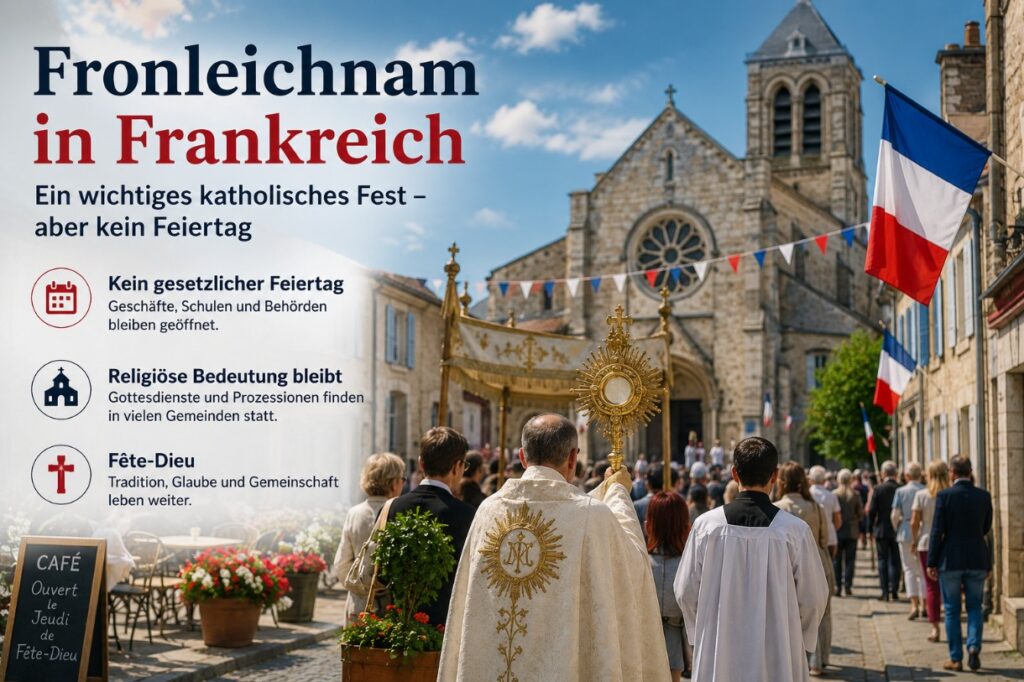
While in numerous German federal states bells are ringing and processions pass through decorated streets, public life in France goes on as usual. Corpus Christi, in French “Fête-Dieu,” is certainly one of the important festivals of the Catholic Church, but it is not one of the national holidays of the country. Schools hold classes regularly, shops are open as usual, and most workers spend the day at their workplace.
The feast is traditionally celebrated on the second Thursday after Pentecost. In France, however, many Catholic parishes have moved the celebrations to the following Sunday to allow broader participation of the faithful. This way, the religious meaning is preserved without requiring an additional day off from work.
Corpus Christi is one of the main feasts of the Eucharist in the Catholic liturgical calendar. The focus of the celebration is the veneration of the Eucharist, that is, the body and blood of Christ. The feast dates back to the 13th century and was established by the Catholic Church to particularly emphasize the importance of the Eucharist. Over the centuries, it has developed into one of the most splendid festivals of the liturgical year.
Also in France, Corpus Christi once held great significance. Especially in rural areas, solemn processions would pass through villages and towns. The streets were decorated, flower carpets were laid out, and entire communities were involved in the preparations. The processions were regarded by many as a social highlight of the year, combining religious tradition with local community life.
With the growing secularization of France, many of these customs have lost their importance. The French state places great value on the separation of church and state, and only a few religious holidays have retained their status as public holidays to this day. Corpus Christi is not among them.
However, the feast has not completely disappeared. Special masses are still celebrated in numerous Catholic parishes. Especially in traditionally Catholic regions, processions are still organized, sometimes even as outdoor celebrations. In these places, a piece of religious and cultural heritage lives on that has disappeared from public consciousness elsewhere.
Thus, Corpus Christi in France represents an example of social change: what was once a widely visible celebration now plays a role primarily within church communities. For believing Catholics, the “Fête-Dieu” remains an important day of faith – even as the country around continues its everyday life normally.
Author: C.H.