
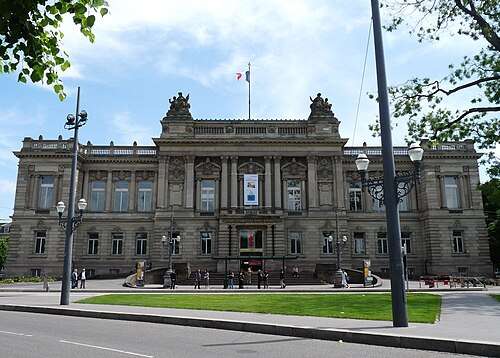
The political debate around the 2027 presidential election has reached France’s cultural scene. In unusually clear terms, the director of the Théâtre national de Strasbourg (TNS), Caroline Guiela Nguyen, has warned of a possible electoral victory of the Rassemblement National (RN). When presenting the new season, she described a government takeover by the party as a “catastrophe” and spoke of the danger of “seeing the worst happen.”
The statement attracted attention far beyond Strasbourg. Because it did not come from an opposition politician or activist, but from the head of one of France’s most important cultural institutions. The TNS holds a unique position within the French theater landscape. It is the only national theater outside Paris and is directly subordinate to the Ministry of Culture. Consequently, every political statement made by its leadership is also perceived as a statement from an institution of national significance.
More Than Just a Theater
Since taking office in September 2023, Caroline Guiela Nguyen has consistently positioned the house as a place of social diversity. The director, whose works often address questions of migration, identity, and social change, represents a theatrical understanding that explicitly promotes cultural diversity and international perspectives.
In the new season, the TNS continues on this path. Multilingual productions, European collaborations, and stories from milieus that often receive little attention in classical theater shape the program. Thus, the house embodies a cultural policy that has been an important part of French self-understanding for decades: culture should not only entertain but also make social realities visible and stimulate public debates.
Against this backdrop, the director’s warning takes on greater significance. It is not only about party-political preferences but about different ideas regarding the role that state-funded culture should play in the future.
The Long Shadow of the Rassemblement National
The Rassemblement National has presented itself in recent years as significantly more moderate than in the days of Jean-Marie Le Pen. Under the leadership of Marine Le Pen and party chairman Jordan Bardella, the party is striving for governmental viability and increasingly appeals to voters from the political center.
At the same time, its cultural policy program remains controversial. RN representatives have criticized for years what they see as an ideologically influenced cultural system dominated by left-wing and progressive elites. According to the party’s argument, public funding should more strongly serve the mediation of national history, traditions, and cultural identity.
This position is met with skepticism by many cultural workers. They fear that increased political influence on funding decisions could, in the long term, restrict the programmatic freedom of theaters, museums, or cultural centers. Institutions dealing with migration, minorities, or social conflicts especially see themselves as potential targets of cultural-political reorientation.
A Dispute About the Republic
The controversy touches on a core area of the French Republic. Since the cultural reforms of the post-war period, the state has seen itself not only as a promoter of art but also as a guarantor of broad cultural access. Cultural policy is traditionally regarded in France as a strategic state task.
Therefore, the current debate ultimately concerns a fundamental question: Should public culture primarily promote social diversity and critical perspectives, or should it be more oriented towards national identity and cultural continuity?
This dispute is no longer fought only in theaters. It shapes discussions about schools, media, memory policy, and national identity. The statement from Strasbourg makes it clear that many cultural institutions are already preparing for a possible political shift.
Whether the Rassemblement National will actually take power in 2027 remains open. What is certain, however, is that the cultural conflict Caroline Guiela Nguyen speaks of has already begun. The real question is not only who will govern France in the future. It is also: Who will define what French culture is going forward—and which voices will be heard on the public stages of the country?
C. Hatty