
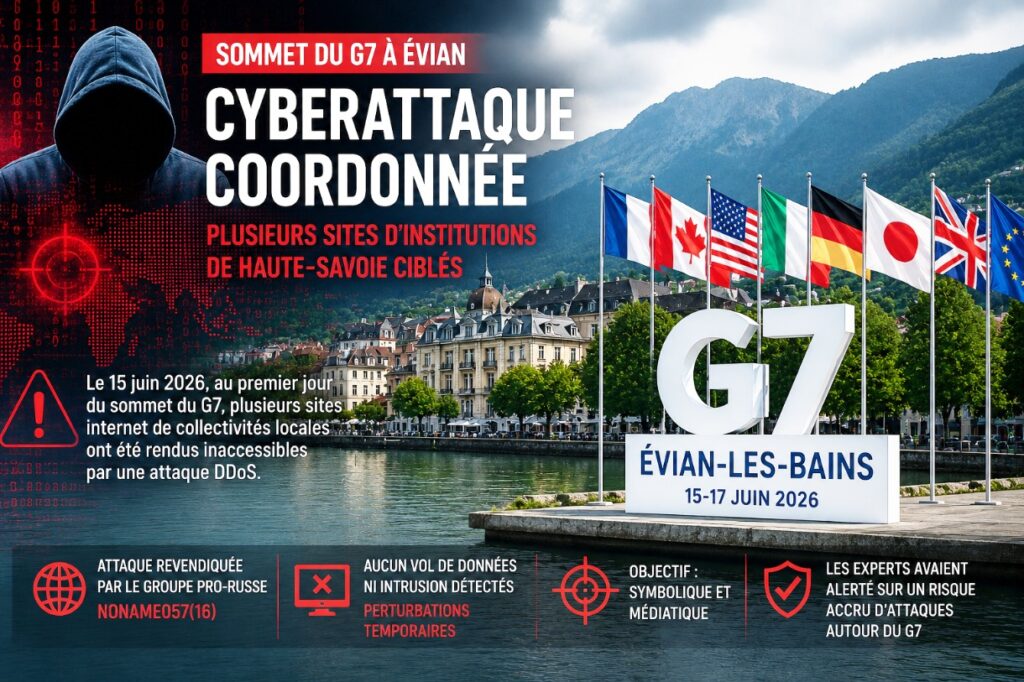
As soon as the G7 summit in Évian-les-Bains began, the region became the target of a coordinated cyberattack. Several websites of municipalities and public institutions in Haute-Savoie were temporarily only partially accessible or intermittently down on June 15. Among those affected were Annecy, Thonon-les-Bains, Évian-les-Bains, and Saint-Gingolph. The incidents underscore once again that international summits are no longer fought solely on diplomatic and security-political levels but also in the digital realm.
The pro-Russian hacker group NoName057(16), which has repeatedly appeared with attacks on state institutions and public infrastructures in Western countries since the beginning of Russia’s war of aggression against Ukraine, claimed responsibility for the attack. The group primarily uses so-called DDoS attacks. In such attacks, servers are overwhelmed with an enormous number of requests until websites or online services become inaccessible. Unlike classic hacking attacks, the focus is not on data theft but on deliberately disrupting the availability of digital services.
According to current findings, the impact in Haute-Savoie remained limited. There are no indications so far of data breaches, manipulations, or intrusions into internal information systems. The attack apparently had primarily symbolic character. The attackers used the international attention surrounding the G7 summit to demonstrate their capabilities and generate media coverage.
That the region around Lake Geneva was targeted comes as little surprise to security experts. Large political events have been favored targets for cyberattacks for years. Although such actions often cause only limited technical damage, they have significant political and communicative effects. They aim to create uncertainty, occupy security authorities, and convey the impression that state institutions are vulnerable.
The development marks a fundamental shift in modern geopolitical conflicts. Digital attacks are now an integral part of international power projection. While protests or demonstrations used to shape public perception of summits, virtual attacks have increasingly come to the forefront. Hacktivist groups often operate at the intersection of political messaging and technical sabotage.
The incident in Haute-Savoie is likely to be remembered less for its immediate consequences and more as another example of the growing intertwining of global politics and cyberspace. International summits will in the future have to be protected not only by police forces and intelligence agencies but also by digital security specialists who fend off invisible attacks on critical infrastructures.
Andreas M. Brucker