
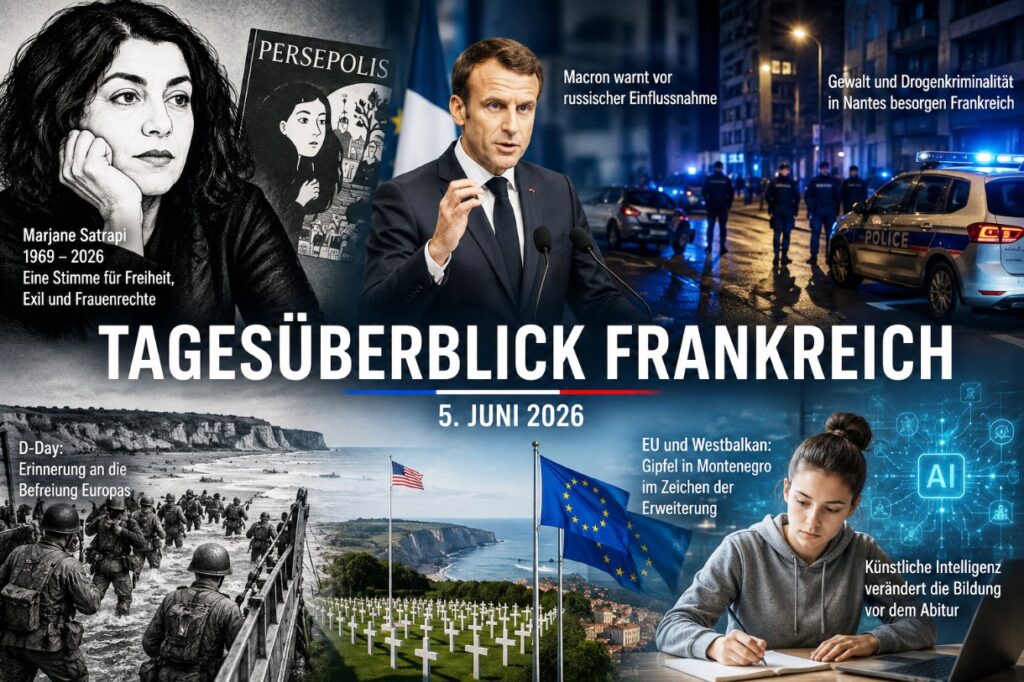
The French news agenda today is shaped by an unusually broad range of topics. Instead of partisan political disputes, issues of national security, memory culture, international order, as well as social and technological developments dominate the coverage. The headlines paint a picture of a country caught between historical self-reflection and the challenges of an increasingly uncertain world.
The Death of Marjane Satrapi Moves France
The unexpected death of the Franco-Iranian author and filmmaker Marjane Satrapi shapes today’s cultural reporting. The creator of the internationally renowned work Persepolis was 56 years old.
Special attention is given to the statement from her relatives, saying that after the loss of her husband last year, she “died of grief.” In numerous obituaries, Satrapi is honored as an important voice of the Iranian exile, an advocate for women’s rights, and a mediator between French and Iranian culture. Her work is regarded by many commentators as a symbol of freedom, identity, and cultural dialogue.
Macron Hardens Tone Against Russian Influence
Foreign and security policy issues are also in focus. President Emmanuel Macron reiterated his criticism of Russian attempts at influence in Europe. In connection with the debate about the former RT-France head Xenia Fedorova, he recalled his assessment made years ago that RT France functioned as an instrument of Russian state propaganda.
Many observers see this as a signal that the French government intends to take stronger action against foreign influence with regard to the 2027 presidential election. The discussion fits into the Europe-wide debate on disinformation, digital manipulation, and hybrid threats.
Violence and Drug Crime in Nantes
After another fatal shooting, the security situation in Nantes has come back into focus. Investigators suspect connections to the drug scene and rival criminal networks.
The recent wave of violence has sparked a nationwide debate about combating organized crime. Commentators note that similar developments had so far mainly been associated with Marseille. That Nantes is now also affected is regarded by many as a sign of geographical expansion of drug-related crime.
D-Day Commemoration in Normandy
One day before the 82nd anniversary of the Allied landing in Normandy, numerous communities are preparing for the traditional remembrance events. The arrival of the last surviving veterans gives the celebrations special significance.
Around Omaha Beach, Pointe du Hoc, and the American cemetery, ceremonies recall the events of June 6, 1944. Many leading articles emphasize that memory of World War II has gained new political and social relevance in light of the ongoing war in Ukraine.
Europe, Ukraine, and the Western Balkans
On the international stage, attention is focused on the meeting between the European Union and the countries of the Western Balkans. France plays an important role in discussions about the future enlargement of the EU and the long-term stabilization of the region.
Simultaneously, the war in Ukraine remains one of the dominant foreign policy topics. French media are extensively covering European defense issues, support for Kyiv, and the future security architecture of the continent.
Artificial Intelligence Changes Education
Shortly before the start of the final high school exams, numerous reports are dealing with the impact of artificial intelligence on schools and education. The debate has clearly evolved: while earlier it mainly focused on risks and misuse, the emphasis now increasingly lies on the meaningful integration of AI tools into everyday learning.
Teachers, education experts, and politicians are discussing how students can productively use AI without neglecting fundamental skills. The topic connects educational policy questions with the broader challenges of digital transformation.
France is experiencing a news day without a single dominating event. Instead, several developments shape the public debate simultaneously: the death of an important cultural figure, concerns about foreign influence, rising crime in some cities, the remembrance of Europe’s liberation, the geopolitical challenges at the EU’s borders, and the effects of artificial intelligence on society. Together, these topics reflect the tensions in which France finds itself in 2026 – between past, present, and future.