
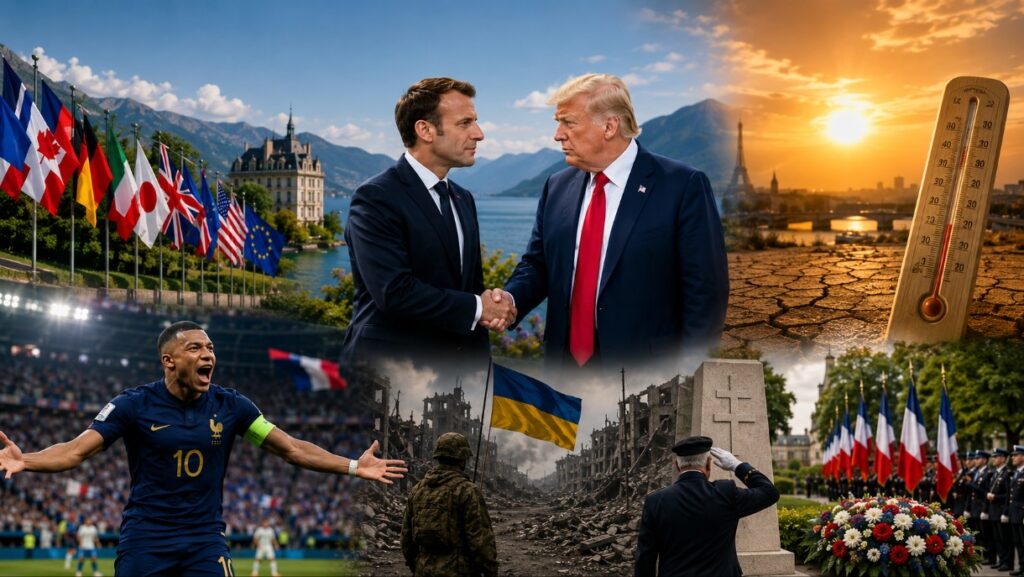
Today’s news day in France is marked by major foreign policy developments, growing climatic challenges, and a historic commemoration deeply rooted in national identity. The aftermath of the G7 summit in Évian dominates political reporting, while at the same time the impending heatwave and the football World Cup attract the population’s attention. Additionally, there is the remembrance of the Appeal of June 18, 1940, which still stands as a symbol of resistance and national self-assertion.
Diplomacy After the G7 Summit: Paris Seeks Influence
Almost immediately after the G7 summit in Évian concluded, France’s leading media are focusing on its political consequences. At the center is the surprising rapprochement between the United States and Iran. The framework agreement announced by Washington is regarded by many observers as a significant diplomatic breakthrough. After months of military tensions in the Persian Gulf, this opens up for the first time again the prospect of a political solution.
The role of France is being discussed particularly intensely. President Emmanuel Macron had deliberately used the summit to keep international channels of communication open and to include Europe in the negotiations. French commentators are now asking whether Paris was truly able to influence the negotiation process or whether Europe once again remains merely a spectator of U.S.-dominated diplomacy.
At the same time, skepticism remains. The exact contents of the agreement are not yet fully known. Many experts point out that decisive issues—especially the Iranian nuclear program and the future security architecture in the Middle East—remain unresolved. Nevertheless, the current development is seen as an important step toward easing tensions in a region whose stability has immediate impacts on the global economy.
Ukraine Remains a Strategic Core Topic
Alongside the Middle East, the war in Ukraine continues to be at the center of foreign policy analysis. French media report on the difficult military situation and the long-term consequences for the European security order.
The debate has clearly shifted. While previous years focused mainly on arms deliveries and financial support for Kyiv, the question of how Europe should organize its defense in the future is now coming increasingly to the fore. The G7 summit and the upcoming NATO summit are regarded as milestones in this context.
In Paris, the conviction is growing that Europe must take greater responsibility for its own security. The discussion about joint armament projects, closer military cooperation, and the expansion of the European defense industry is gaining new momentum. France traditionally sees itself as the driving force behind this development.
The First Major Heatwave of the Summer
While foreign policy shapes the front pages, many French people are preoccupied with a much more tangible issue: the upcoming heatwave.
Meteorologists expect temperatures well above 35 degrees Celsius across large parts of the country. In some regions of southern France, values near the 40-degree mark could even be reached. Authorities are preparing for increased burdens on the healthcare system. Particularly vulnerable are the elderly, children, and chronically ill individuals.
The memory of the 2003 summer heat disaster remains vivid in France. At that time, an estimated 15,000 people died as a result of extreme temperatures. Since then, numerous warning systems and emergency plans have been developed.
However, the current weather situation once again triggers a fundamental debate. Increasingly, the question is being asked how France should deal with the long-term consequences of climate change. Agricultural yields, water reserves, and the adaptation of urban infrastructure have now become central political challenges for the country.
Football World Cup: Mbappé Sparks New Title Hopes
Away from politics and climate, the football World Cup in North America is causing excitement.
After the convincing opening victory of the French national team against Senegal, attention is focused particularly on Kylian Mbappé. The captain of the “Équipe Tricolore” has so far confirmed his role as an exceptional player and is considered by many commentators one of the most promising candidates for the title of best player of the tournament.
The French press is already outlining first scenarios for the further course of the tournament. The offensive strength of the team is especially highlighted. At the same time, former national players and coaches urge caution. The World Cup is still young, and numerous favorites have already shown their strength.
Great attention is also given to Lionel Messi, who despite his advanced football age still counts among the defining figures of the tournament. Argentina is among the narrower circle of favorites, as are several top European teams.
For France, the World Cup this year also has societal significance. In economically and politically tense times, the tournament is seen by many as a rare event that can generate national euphoria and cohesion.
June 18: A Date with Special Weight
Today, the country’s gaze is also turned toward its history. France commemorates the anniversary of General Charles de Gaulle’s famous appeal from June 18, 1940.
At that time, de Gaulle called on the French from London to resist the German occupation and the Vichy regime. Although the speech was initially heard by only a few people, it has retrospectively become a founding myth of the Résistance.
In numerous cities today, wreath-laying ceremonies, memorial events, and commemorations are taking place. President Macron will traditionally attend the official celebrations.
Historical remembrance holds particular importance especially in a time of geopolitical uncertainties. Many commentators draw parallels between the questions of sovereignty, resilience, and national self-determination from that time and the current challenges facing Europe.
France is thus experiencing a news day that connects past and present. The diplomatic developments surrounding Iran and the G7 summit could have far-reaching international consequences. The heatwave reminds of the concrete impacts of climate change. The football World Cup provides moments of national enthusiasm. And June 18 evokes a historical legacy that has lost none of its symbolic power even 86 years later. The French press thus paints a picture of a country that simultaneously looks out to the world, wrestles with the challenges of the present, and does not forget its history.
Sources: International press reports on the G7 summit in Évian (June 2026), Le Monde (June 2026), Reuters (June 2026), Euronews (June 2026), French meteorological services and public announcements (June 2026), historical documentation on the Appeal of June 18, 1940.