
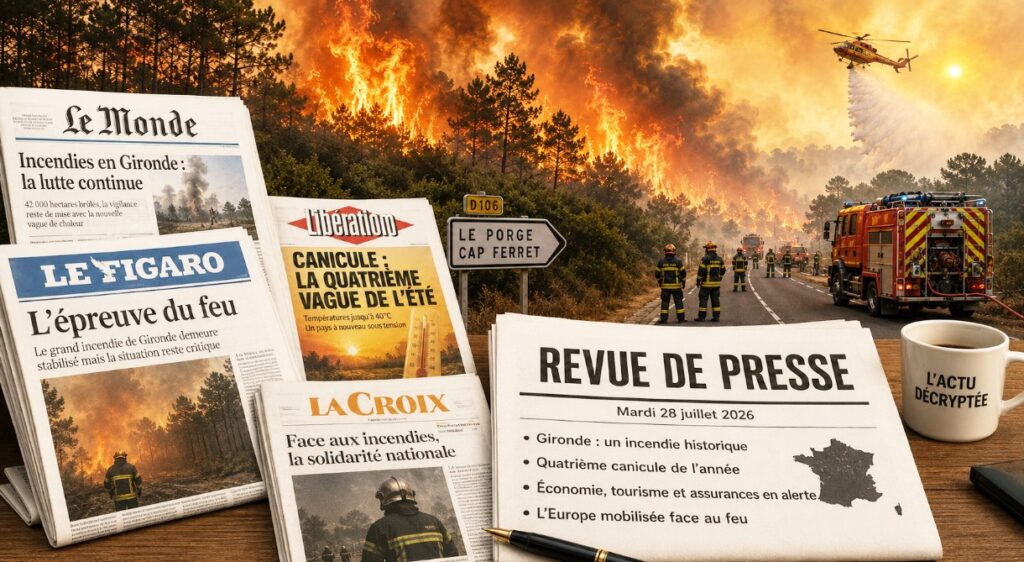
The French press is almost entirely focused this Tuesday, July 28, 2026, on the historic wildfire disaster in the southwest of the country. Although the past night in Gironde was comparatively calm, there is no all-clear. At the same time, the fourth major heatwave of the year is already affecting large parts of France, heightening fears of a renewed spread of the flames. Alongside the immediate firefighting effort, the economic consequences, political responsibility and long-term challenges of climate change are increasingly becoming the focus of coverage.
The Major Fire in Gironde Remains the Dominant Issue
The wildfire that has been raging west of Bordeaux since July 22 is still considered stabilized, but it has neither been fully extinguished nor brought under control. According to current estimates, around 42,000 hectares of forest and scrubland have been destroyed. During the night, firefighting crews once again had to tackle several fire hotspots north of Le Porge and on the Cap Ferret peninsula after smoldering areas reignited.
Emergency crews are working under enormous pressure. Thousands of firefighters, supported by the military, civil protection services and volunteers, continue to secure the fire perimeters while specialist teams search for hidden smoldering hotspots. The situation remains tense in the affected communities. Numerous residents are still unable to return to their homes, while evacuation centers remain open.
French daily newspapers are reporting extensively on the strain faced by emergency crews and vividly describing the situation in the crisis centers around Bordeaux. Particular emphasis is being placed on the enormous personnel and logistical effort required to prevent the flames from breaking out again.
The Fourth Heatwave Raises the Risk of New Fires
There is no sign of lasting relief for the time being. Temperatures are already set to rise significantly from Tuesday. Highs of around 33 degrees are initially expected in the greater Bordeaux area before the thermometer could climb as high as 37 degrees on Wednesday. Temperatures near the 40-degree mark are once again possible in other regions of France.
The combination of extreme drought, low humidity and strengthening winds creates ideal conditions for new forest and vegetation fires. Even areas where fires have already been contained can reignite at any time under these circumstances.
The French press is increasingly drawing a link between recurring heatwaves and the effects of climate change. In addition to the wildfire threat, water shortages, pressure on hospitals, crop failures and damage to infrastructure are coming into focus. Experts point out that France must increasingly prepare for exceptional weather conditions that were once considered rare.
Macron Calls for Unity as Criticism of Preparedness Grows
President Emmanuel Macron’s visit to the crisis area near Bordeaux has received considerable attention. The head of state described the current situation as France’s most severe wildfire crisis since the Second World War and explicitly thanked the emergency crews. Firefighters, the military, police, farmers and volunteers were exemplary of national unity in an extraordinary crisis, he said.
At the same time, political debate is intensifying. While part of the press sees the visit as an important signal of state support, other media outlets are raising questions about possible shortcomings in recent years. In particular, discussions concern the size and modernization of the firefighting aircraft fleet, the expansion of preventive forest protection measures, and the adaptation of civil protection systems to increasingly frequent extreme events.
The wildfires are thus increasingly becoming a test of political leadership for the government and authorities.
Economic Consequences Hit Tourism and Businesses
As individual fire sectors stabilize, attention is increasingly turning to the economic impact of the disaster. The tourism industry has been particularly hard hit. Hotels, campsites, holiday rentals and restaurants are reporting significant losses in revenue in the middle of peak season after numerous holidaymakers canceled their trips or cut them short.
Many smaller businesses are also suffering the consequences of the evacuations. Shops remain closed, production facilities are operating only on a limited basis, and many employees are unable to reach their workplaces. For craft businesses and service providers, every additional day of disruption represents a considerable financial burden.
Insurers are meanwhile preparing for a large number of claims. Beyond destroyed buildings and vehicles, the issues increasingly include business interruptions and lost income. Business associations warn that smaller companies in particular have scarcely any financial reserves left after several economically difficult years.
Industrial Facilities Come Under Greater Scrutiny
Special attention is now being paid to industrial facilities around the fire area. Several so-called Seveso sites are located in or near the affected communities. Hazardous or highly flammable substances are stored or processed there.
Authorities have introduced extensive protective measures to prevent the flames from reaching these facilities. Additional security personnel are monitoring the sites, while firefighting and civil protection services have special response plans in place.
Concern about a possible industrial accident adds another dimension to the wildfire disaster. If the flames were to reach such facilities, this could have significant consequences for people and the environment and further complicate an already complex operation.
Additional Fire Hotspots Keep Emergency Crews Busy
Gironde remains the center of France’s wildfire crisis, but other regions are still affected as well. In the Var department, numerous evacuees are still not allowed to return to their homes. Emergency crews there are continuing to work to fully secure the remaining fire hotspots.
The situation in the Landes department appears somewhat more relaxed. There, the first residents and holidaymakers have been able to return to Biscarrosse. However, authorities continue to urge caution. Due to the persistent drought, even a small spark is enough to trigger new fires.
The heavy burden on fire services therefore continues nationwide.
Europe Is Also Battling Large-Scale Wildfires
The attention of French media is increasingly extending beyond the country’s borders. Spain is also battling several serious wildfires, particularly in the province of Avila, where the flames have spread across an exceptionally large area. Parts of Italy and North Africa are likewise affected by numerous vegetation fires.
This is also placing European civil protection services under considerable pressure. Firefighting aircraft, helicopters and specialized response crews are needed in several countries at the same time. Mutual support within Europe is still functioning, but experts warn that available capacity could quickly reach its limits if the situation worsens further.
France thus represents a development that is increasingly affecting all of southern Europe.
Coverage on this day paints a picture of a country that must confront a new reality. Wildfires are no longer exclusively regional natural disasters; they affect the economy, infrastructure, health, agriculture and politics alike. While immediate firefighting remains the highest priority, public debate is increasingly focused on how France can better protect its forests, population and critical infrastructure from the consequences of extreme heat and prolonged drought in the future. The more frequently such events recur, the more urgent the challenge becomes of permanently reorienting civil protection and climate adaptation.