
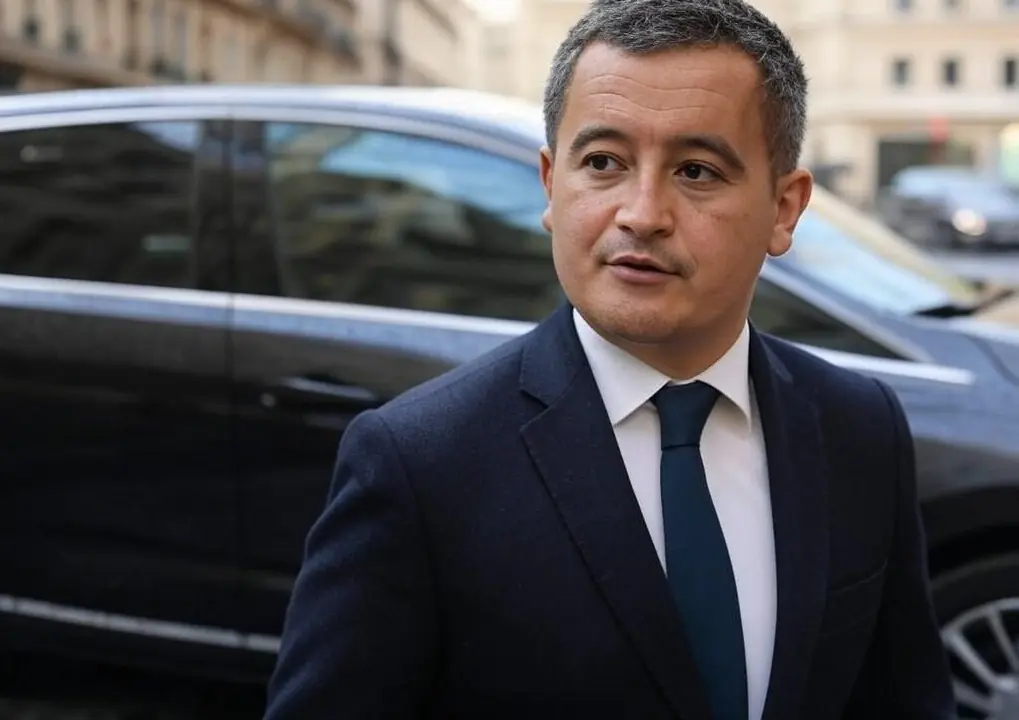
On the day of the visit of the French Minister of Justice Gérald Darmanin to Algeria, the political debate in Paris about the relationship with the North African neighbor is intensifying. While President Emmanuel Macron’s government is aiming for a cautious rapprochement, the Rassemblement National (RN) is calling for a radical change of course: abandoning diplomatic caution and adopting a tough policy with clear demands.
At the root of the new controversy are the statements of RN spokesperson Laurent Jacobelli, who harshly criticized France’s policy towards Algeria. France has been practicing a “diplomacy of bowing” for years, he stated on public radio and television. Macron’s strategy has not produced concrete results. According to him, each phase of rapprochement has been followed by new diplomatic tensions.
A relationship marked by historical weights
The relations between France and Algeria have been among the most complex in French foreign policy for decades. The Algerian War of 1954-1962 still marks the political and social relations between the two countries today. Issues of memory, migration, security cooperation, and economic collaboration constantly overlap.
Under the presidency of Emmanuel Macron, there have been various attempts at historical reconciliation. Macron had declared from the beginning that colonialism was a “crime against humanity” — a statement welcomed positively in Algeria but which sparked harsh criticism in some parts of France. However, his presidency has not succeeded in creating a stable foundation for bilateral relations.
Tensions regularly flare up over issues such as visas, repatriations, security cooperation, or historical statements by French politicians. In addition, there is the internal dimension: several million people of Algerian origin live in France, so every crisis between Paris and Algiers produces an immediate social resonance.
The RN calls for a break with Macron’s line
Laurent Jacobelli took advantage of Darmanin’s trip to directly attack the government. The RN accuses Macron of being too conciliatory towards President Abdelmadjid Tebboune. According to the right-wing party, France should defend its interests much more decisively.
At the center of the demands are in particular two points: firstly, the RN demands more consistent repatriations of Algerian citizens convicted in France or subject to expulsion. Secondly, the party calls for increased pressure on Algiers in the case of French journalist Christophe Gleizes, who is currently detained in Algeria.
The RN intentionally links these issues to the broader debate on migration. The party has long argued that France should use diplomatic and economic levers more decisively to persuade countries of origin to cooperate on repatriations. Algeria is considered a particularly difficult partner because the readmission procedures are often delayed or politically exploited.
With the term “Aplaventrisme” — essentially “servility” — the RN also tries to portray Macron as a weak head of state who would not vigorously defend France’s interests. This strategy fits into the party’s broader foreign positioning, which favors national sovereignty and demonstrative firmness.
Darmanin’s delicate mission in Algiers
Officially, Gérald Darmanin’s trip aims to restore judicial cooperation between the two states. In recent months, diplomatic relations had significantly deteriorated. Several political disputes and mutual accusations had heavily burdened cooperation.
Darmanin is now trying to at least reopen channels of dialogue on the technical level. Especially in the areas of criminal repression and legal cooperation, the two countries are mutually dependent. France needs Algeria’s cooperation, for example concerning extraditions and repatriations; Algeria, in turn, is interested in economic stability and exchange on security matters.
The minister’s mission is, however, politically very sensitive. On the one hand, Paris cannot create an internal perception of yielding to Algiers. On the other hand, a lasting deterioration of relations would be problematic for both countries.
Because Algeria plays a strategic role for France: in terms of energy, migration, and security. Especially since the beginning of the Russian war in Ukraine, Algeria has gained additional geopolitical weight as a gas supplier. Europe is indeed making greater efforts to find alternative energy partners in the Mediterranean basin.
French domestic politics intensifies the tone
The debate about Algeria has long been part of the internal power struggle in France. The RN uses the issue to put pressure on the government both on security and migration policy. The party inserts itself into a social climate in which questions of national identity and state authority are debated with increasing emotional intensity.
The government, however, seeks to strike a balance. Representatives of the presidential majority warn against defining relations with Algeria solely through symbols of domestic politics. A lasting diplomatic rupture would not only endanger economic interests but could also massively complicate cooperation on migrants and the fight against terrorism.
Even left-wing parties largely reject RN’s demands for a confrontational-hardline approach. They argue that historical sensitivity and pragmatic diplomacy are necessary to build lasting and stable relationships.
At the same time, however, impatience is also growing in the center over the often problematic cooperation with Algeria from the French perspective. Especially regarding the repatriation of people obliged to leave the territory, French authorities have complained for years about a lack of cooperation.
Between Pragmatism and Power Politics
Gérald Darmanin’s trip emblemizes how complex Franco-Algerian relations are. Paris faces a strategic dilemma: a tougher stance might be popular domestically but carries significant diplomatic risks. A policy of dialogue, on the other hand, is increasingly interpreted by the opposition as a sign of weakness.
Moreover, Algeria also politically exploits the tensions. President Tebboune willingly presents himself domestically as a defender of national sovereignty against the former colonial power. Every confrontation with France therefore also assumes symbolic value in Algerian internal politics.
It remains uncertain whether Darmanin’s visit will actually lead to a relaxation of tensions. More likely, in the initial phase, is a cautious stabilization of individual areas of cooperation. The underlying conflicts — migration, historical memory, and issues of political influence — will probably persist.
Thus, the policy towards Algeria remains a sensitive area for France, where foreign policy, history, and internal power struggles are inextricably linked.
P.T.