
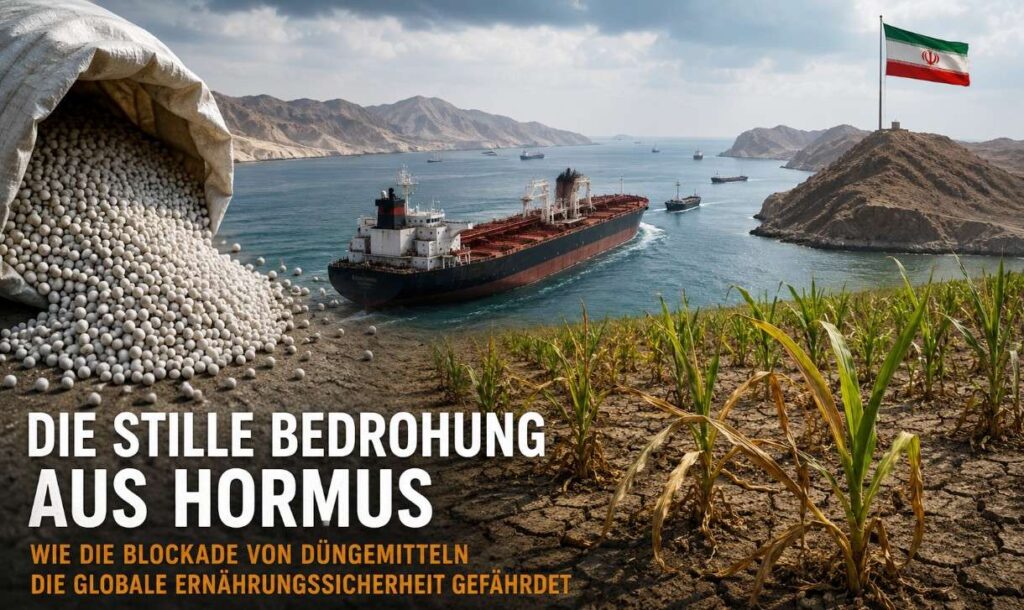
The Strait of Hormuz has been seen for decades as a nerve center of the world economy. Almost daily, oil tankers and liquefied gas pass through the narrow sea passage between Iran and Oman. Less well known, however, is its central importance for global agriculture. Since the Iranian blockade, as a result of the escalating Middle East conflict, not only energy markets are coming under pressure, but also the supply of fertilizer – with potentially dramatic consequences for billions of people.
International organizations are now warning of a development that could go far beyond just rising agricultural prices. Modern agriculture is heavily dependent on nitrogen-, phosphate-, and potassium-containing fertilizers. If a significant part of these supply chains fails, declining yields of staple foods such as rice, wheat, or corn threaten – especially in already fragile regions in Africa and Asia.
The Gulf as the center of the global fertilizer industry
The countries on the Persian Gulf are among the world’s leading producers of nitrogen-containing fertilizers. Qatar, Saudi Arabia, the United Arab Emirates, and Iran have large gas reserves, which serve as a central raw material for the production of ammonia and urea. Urea in particular is the most widely used nitrogen fertilizer worldwide.
According to estimates, about one third of the global sea trade in fertilizers comes from this region. The share in urea exports is particularly significant, ranging between 30 and 35 percent. Ammonia trade also largely takes place around the Gulf.
Due to the months-long blockade of the Strait of Hormuz, this infrastructure is now severely disrupted. Numerous cargo ships are stuck or avoid the region for safety reasons. At the same time, production sites have been damaged by air strikes. The Qatari industrial facility Ras Laffan is considered to be heavily affected.
Several countries in the region have scaled back or temporarily halted their production. This not only reduces export capacity but also causes a shortage of important raw materials for other fertilizer producers on the world market.
Why fertilizer has no strategic reserves
Unlike oil, there are hardly any coordinated international emergency stockpiles for fertilizer. Global agriculture works on tight schedules: sowing and fertilizing can only be delayed to a limited extent. If fertilizer arrives late, harvests often decline irreparably.
Moreover, production is energy-intensive. Natural gas is used not only as an energy source but also as a chemical raw material in the synthesis of ammonia. Rising gas prices therefore directly impact the entire supply chain.
The situation partly recalls the food crises of 2007/08 and the disruptions following the Russian attack on Ukraine in 2022. At that time too, fertilizer prices rose sharply within a few months. Many developing countries had to expand subsidies or limit their imports.
Today, the situation is even more acute in some regions. Many countries struggle with high national debt, weak currencies, and limited fiscal leeway. At the same time, the population is growing rapidly.
Africa particularly vulnerable
The crisis can hit numerous African countries the hardest. Many countries south of the Sahara import a significant portion of their fertilizer from the Gulf states. Sudan, Tanzania, Somalia, Kenya, and Mozambique are particularly severely affected.
The structural problem lies in the organization of agriculture itself. Large parts of African agricultural production rely on small-scale farms with minimal reserves. Rising costs for production inputs are hardly absorbable there.
Even moderate price increases mean that farmers use less fertilizer. In the short term, this does reduce production costs, but in the long term, yields sometimes drop significantly. Especially the production of maize and cereals reacts sensitively to nitrogen shortages.
For countries like Malawi, the situation is especially critical. Agriculture there depends almost entirely on imported fertilizer. At the same time, agriculture is the most important economic sector and the basis for food security.
The United Nations therefore warn of a possible expansion of famines. Millions of additional people could fall into acute food insecurity.
Risk for Asia: high population density and intensive agriculture
The situation in Asia is even more complex. Countries like India, Pakistan, Bangladesh, and Sri Lanka are among the largest consumers of artificial fertilizer in the world. Agriculture there is very intensive and dependent on regular nitrogen supply.
Rice production in particular requires large amounts of urea. Delays or price increases therefore have direct effects on yields and food prices.
India has been trying for decades through multi-billion programs to guarantee stable prices for farmers via subsidies. But even New Delhi is now reaching fiscal limits. Narendra Modi’s government is therefore increasingly focusing on more efficient fertilizer use and alternative cultivation methods.
Pakistan is also struggling with energy problems. Several fertilizer factories there have had to reduce production due to limited gas supply.
For densely populated Asian countries, the danger is especially great because rice, wheat, and maize form the central basis of the food supply. Even small production losses can lead to significant social and political tensions.
Brazil and the global agricultural markets
Latin America is also not escaping the crisis. Brazil, one of the main exporters of soy, sugar, and maize, imports about one fifth of its fertilizer from the Gulf region.
The significance of Brazil goes far beyond its own food supply. The country is a central supplier of animal feed and agricultural raw materials worldwide. Declining Brazilian harvests would therefore further exacerbate global price increases.
International fertilizer prices are already rising significantly. Experts expect prices to be between 15 and 20 percent higher than last year over the next six months. In addition, transport and energy costs are increasing.
The problem is also the market dynamics: many importers have postponed orders in hopes of relief. If panic buying now occurs, further price increases threaten.
More than just a fertilizer crisis
The current developments show how closely energy, security, and food policies are intertwined. Agriculture depends not only on fertilizers but also on functioning transport routes, fuel supply, and stable raw material markets.
There is also an additional uncertainty: meteorologists are closely monitoring the possible return of a strong El Niño at the end of the year. In previous years, El Niño led to droughts, crop losses, and extreme weather conditions in numerous agricultural regions.
When climatic stresses and geopolitical crises converge, chain reactions with global impact arise. Especially fragile states have hardly any means to absorb such shocks.
Even if the blockade of the Strait of Hormuz were lifted in the short term, the consequences would still be noticeable for months. Production losses cannot be immediately made up. There is also a global shortage of transport capacity to quickly clear backlogs.
The current crisis also reveals a structural weakness of globalized agriculture: the feeding of billions of people depends on a few geopolitical nodes. If one of them is disrupted, entire food systems falter.