
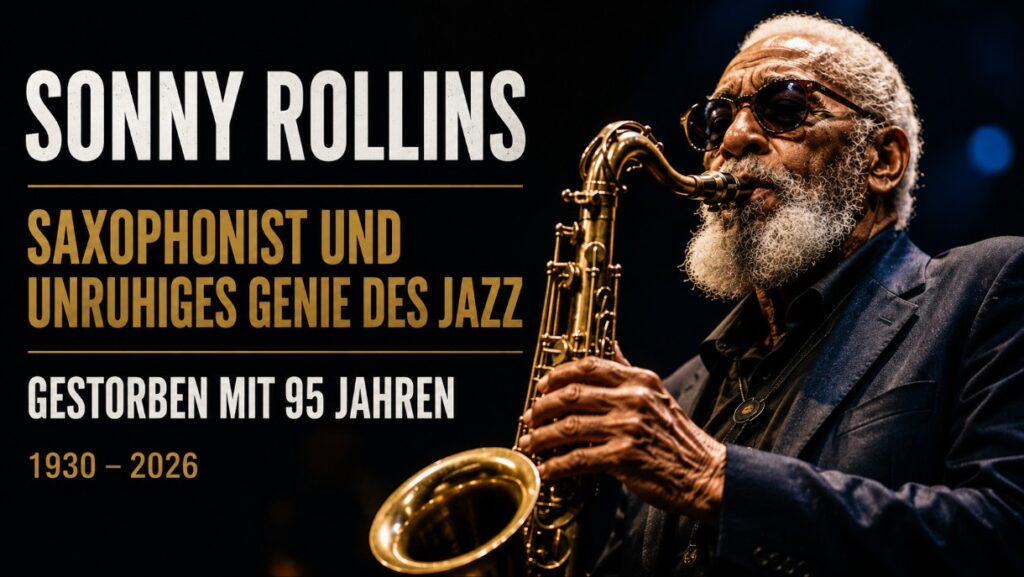
Jazz loses one of its last great figures. The American tenor saxophonist Sonny Rollins has died at the age of 95 in his home in New York State. With him disappears not just an old-school musician, but an artist who reinvented jazz repeatedly over decades — restless, uncompromising, and full of self-doubt.
Rollins belonged to the generation that didn’t just play bebop, but breathed it. His tone was unmistakable: strong, edgy, sometimes almost rough, then playful and light-footed like a street musician in Harlem on a hot summer evening. Many jazz fans placed him alongside John Coltrane and Charlie Parker — a knighthood that carries more weight in the jazz universe than many awards.
And yet Rollins never felt settled.
He described himself into old age as a “work in progress,” an unfinished work. A phrase that says a lot about this man. While other artists eventually preserve their style like a family recipe, Rollins questioned everything — even his own masterpieces. Listening to old recordings often felt painful for him. Too many mistakes. Too much stagnation. Too little truth.
Perhaps that was exactly his greatness.
Born in 1930 in Harlem, Theodore Walter Rollins grew up in a musical household. His father played clarinet, his sister piano, his brother violin. At first, they wanted to put him on the piano, but the boy cared little for it. Baseball on the street — that was more his thing. Then he discovered the saxophone. A defining moment. At eleven, he held his first instrument, an alto saxophone. From then on, it began.
As a teenager, Rollins played with legends like Thelonious Monk, Miles Davis, and Bud Powell. The New York jazz scene of those years was a boiling cauldron of genius, drugs, and sleepless nights. Rollins early got caught in the vortex of heroin addiction. Prison stints followed, crashes, homelessness in Chicago. A career was on the verge of disappearing into nothingness.
In 1954, he pulled the emergency brake.
In a detox clinic in Kentucky, he fought his way back to life. Later Rollins spoke of a spiritual awakening. Life suddenly gained depth, he once said. So did jazz.
What followed were years that made him immortal. The album “Saxophone Colossus” from 1956 is still considered a milestone of hard bop. Pieces like “St. Thomas” still sound fresh today, as if Rollins had recorded them last night. His playing never possessed just technical brilliance. It had wit, irony, sometimes almost a cheeky touch. He could tell musical stories like others tell bar jokes.
And then he did something almost no one understood.
At the height of his fame, Rollins suddenly disappeared from the public eye. No concerts, no recordings. Instead, he practiced alone for hours on the Williamsburg Bridge in New York, high above the East River. There he searched for a new sound, for himself. Crazy? Maybe a little. But typical Sonny Rollins.
When he returned in the early sixties, jazz had changed. Free jazz pushed aside the clear structures of bebop. Many musicians were uncomfortable with the new chaos. Rollins was not. He plunged into it, experimented, irritated fans and critics alike. For him, stagnation seemed worse than failure.
Even people who had little interest in jazz eventually heard Sonny Rollins without realizing it. His longing saxophone solo in the song “Waiting on a Friend” by the Rolling Stones brought him closer to a million-strong audience in the early eighties.
Rollins remained active well into old age. Even in his eighties, he stood on stage, trained daily, and worked as disciplined as a top athlete. Only a lung disease forced him to withdraw. His last concert was in 2012.
In the end, his interviews often spoke of serenity. The eternal self-criticism remained, but also a peace with his own transience. About unreleased recordings, he once said in essence: After his death, he could no longer control anything anyway. And honestly — maybe that is a good thing.
Jazz loses with Sonny Rollins not a nostalgic figure.
But a seeker.
By C. Hatty