
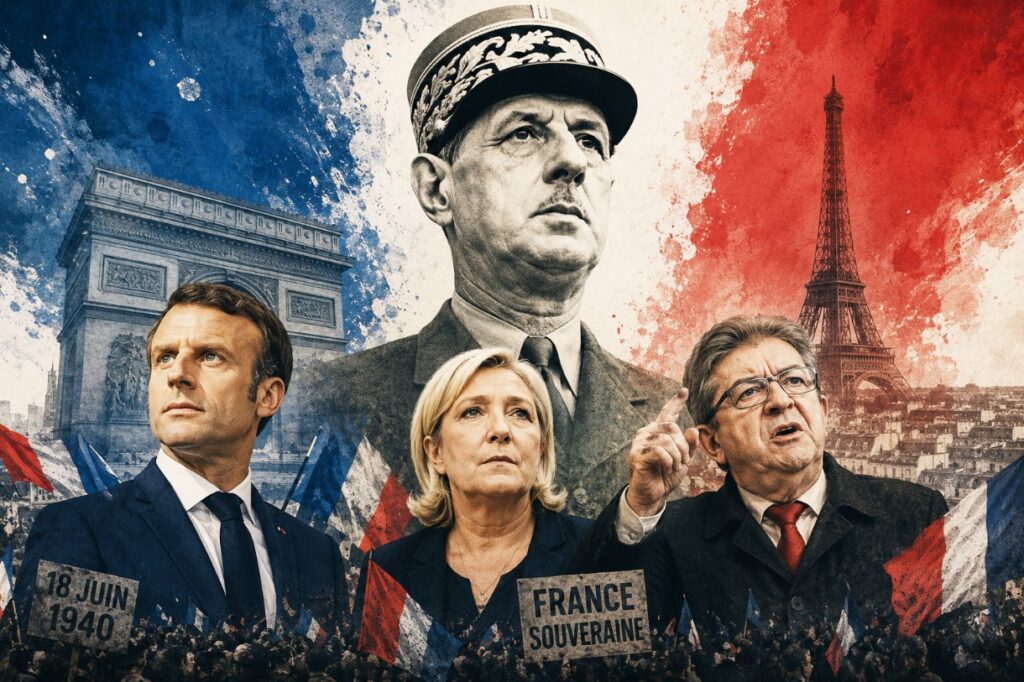
Charles de Gaulle as the Last Shared Myth of French Politics
There are few historical figures who achieve the feat of being claimed simultaneously by almost all political camps. In France, Charles de Gaulle is such an exceptional figure. More than five decades after his death, the founder of the Fifth Republic still shapes the political imagination of the country. The general is no longer just a historical personality; he has become a national cipher, a symbol that every politician can fill with their own meanings.
The political right sees in him the defender of the nation, the guardian of state authority, and the architect of a strong France. The political center recognizes him as the statesman who combined leadership with democratic legitimacy and secured an independent role for France between the power blocs. Even parts of the left find points of connection: the rebel of June 18, 1940, who refused defeat and stood against the current of history.
This remarkable polysemy explains why today politicians with fundamentally different programs can refer to de Gaulle. Emmanuel Macron evokes his idea of a sovereign European power and his understanding of strategic independence. Marine Le Pen points to the primacy of national interests and the importance of state sovereignty. Jean-Luc Mélenchon, in turn, sees in the general a man of historical rupture, even though he sharply criticizes his institutional legacy.
The Myth Outlives the Ideology
However, precisely this universal appropriation raises a crucial question: What does “Gaullist” even mean in 2026?
The answer is increasingly difficult. Classic Gaullism emerged in a very specific historical context. It was shaped by the experiences of World War II, decolonization, the Cold War, and the political instability of the Fourth Republic. From this, de Gaulle developed a political philosophy that combined national independence, state capacity, and democratic legitimacy.
Today, little remains of this ideological core. What remains are fragments. Some invoke his notion of national sovereignty, others his European vision, yet others his leadership style or his role as a crisis manager. What was once a political doctrine has become a symbolic toolbox.
The paradoxical consequence: the more often politicians refer to de Gaulle, the less binding his political legacy becomes.
Macron and the Longing for Grandeur
This phenomenon is particularly visible with Emmanuel Macron. Hardly any president of recent decades has relied as intensely on the symbolism of the Fifth Republic. Macron stages himself as a president above the parties, as the embodiment of national capability, and as the architect of European sovereignty.
The parallels to de Gaulle are obvious and by no means accidental. Yet they remain limited. The general gained his legitimacy from war, resistance, and national crisis. Macron owes his rise to institutions, elite networks, and the mechanisms of modern democracy.
Above all, he lacks the historical distance that distinguished de Gaulle. While the general often seemed to rise above day-to-day conflicts, Macron often appears as their most active participant. Where de Gaulle was a monument, Macron seems a permanent manager.
A Mirror of Contemporary France
Ultimately, the ongoing fascination with de Gaulle says less about the general himself than about today’s France.
French society is caught in a tension between the desire for strong leadership and mistrust of power. It demands national sovereignty but simultaneously lives in a world of close European and global interconnections. It longs for orientation while political and social fragmentation increases.
In this situation, de Gaulle offers something that hardly any other statesman embodies: historical clarity. He appears as a figure who made decisions, took responsibility, and had a vision of what France should be.
That is precisely why he serves so well as a projection surface. Every politician can discover in him the traits that suit their own narrative. The nationalist finds the patriot. The European finds the strategist. The reformer finds the man of rupture. The conservative finds the defender of state order.
Perhaps that is why Charles de Gaulle has become the last truly shared myth of French politics. In a country that argues about almost everything, there remains consensus that the general belongs among the founding figures of the modern nation.
The irony is that almost everyone can claim him—and that he would probably distance himself with polite determination from most of his heirs today.
Andreas M. Brucker