
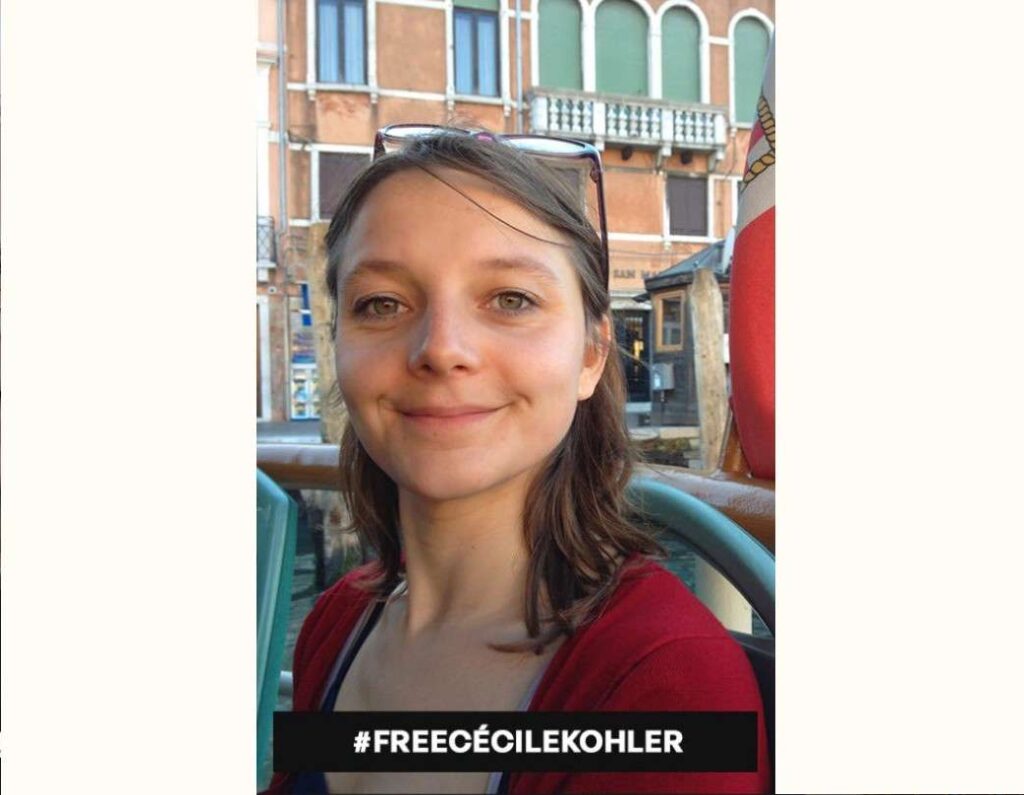
„I look death in the face. I can’t take it anymore.“ – When a person speaks like this, it’s no longer about politics. It’s about survival.
Since May 2022, Cécile Kohler and Jacques Paris have been held in Iranian custody. Three years of isolation, psychological wear-down, hopelessness. Now the verdict has come: long prison sentences on charges of alleged espionage and “collaboration with foreign services.” Paris calls the accusations, unsurprisingly, absurd. But words alone do not save lives.
What to do when time is working against you?
The relatives of the two French nationals are sounding the alarm. At a press conference in Paris, they speak plainly – with a mix of fear, anger, and urgent appeal. Cécile’s sister reports a phone call that carries more weight than any court document: Her sister is on the verge of giving up. Jacques’ daughter Anne-Laure quotes a message that could not cut deeper: He sees death in the face. This is not dramatization – this is reality in a cell, somewhere in Tehran.
France’s reaction: annoyed, but so far without consequences
The French government has sharply criticized the verdict: „completely unfounded“, „arbitrary“. The Foreign Ministry emphasizes that there is „no credible basis“ for the allegations. The International Jurisdiction has also been involved – a lawsuit before the Hague Court aims at violations of international law, especially against the Vienna Convention. France accuses Iran, among other things, of denying consular access – a fundamental right that can become a lifeline in such situations.
President Emmanuel Macron and Foreign Minister Jean-Noël Barrot assure that they are „fully mobilized“. Barrot even spoke of „solid prospects“ for a release. But what does that mean concretely?
A dark game with human fates
Unofficially, it is already clear: It is not just about two French citizens. It is about a perfidious diplomatic game. The accusation is: „hostage diplomacy“. States like Iran detain Western citizens to exert political pressure – or, as suspected in this case, to force a prisoner exchange. The name Mahdieh Esfandiari is mentioned, an Iranian woman imprisoned in France. Could her release be part of a deal?
For the relatives, this is a slap in the face. Their loved ones as bargaining chips? They are “not chess pieces, but people,” they say – and call on France not to engage in this logic. Clear boundaries instead of silent deals. That is their demand.
Torture Without Shackles
What happens behind the prison walls is hard to bear. Isolation, constant lighting, no access to books or writing materials, hardly any visits – this does not describe normal detention. This is psychological torture. Internationally, such conditions are considered a violation of human rights.
In May 2025, the families involved the UN Working Group on Arbitrary Detention. Even though this body has no executive power – it increases symbolic pressure. It reminds us that international law is at stake here, not just national criminal law.
And now?
France has so far relied on words: harsh condemnations, diplomatic complaints, lawsuits. But the time for explanations is over. The families are right – more is needed. More pressure. More consequences. More international mobilization.
How much longer will people watch as two individuals break down under a system that eludes the world’s public? How much suffering does it take before political rhetoric turns into action?
The answer no longer lies in Tehran. It lies in Paris.
Author: Andreas M. B.