
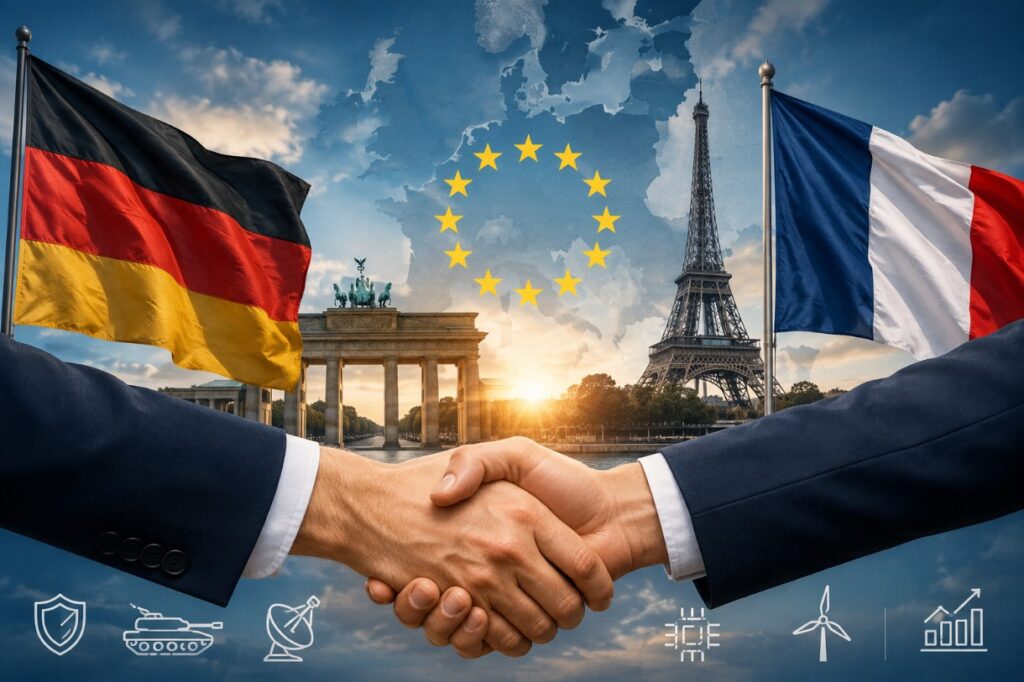
After years in which relations between Germany and France were repeatedly shaped by political differences, today’s summit meeting between Chancellor Friedrich Merz and French President Emmanuel Macron is set to usher in a new chapter of cooperation. With a joint ministerial council in the Rhineland, both governments aim to reinvigorate the German-French engine of the European Union and send a signal of greater unity in an increasingly geopolitically uncertain world.
Expectations for the meeting are high. As Europe faces security, economic and technological challenges, Berlin and Paris increasingly recognize that many of these tasks can only be tackled together. The summit is therefore intended to be far more than a symbolic meeting between two neighboring countries – it sees itself as a strategic stocktaking exercise for Europe’s future.
Historic venue with a political message
On the evening before, Friedrich Merz and Emmanuel Macron met at Bensberg Castle near Cologne for a confidential exchange. On Friday, the official program begins with a meeting of the German-French Defense and Security Council at Nörvenich Air Base. Ministers and state secretaries from ten ministries of both governments will then meet at Augustusburg Palace in Brühl for the German-French Ministerial Council.
The choice of venue is deliberate. In Brühl in 1962, French President Charles de Gaulle proposed the Elysee Treaty to Chancellor Konrad Adenauer. It was signed a year later and is still regarded as the foundation of the modern German-French partnership. At a time of growing international tensions, both governments are deliberately building on this historical legacy.
Security policy as a shared priority
European security and defense policy is at the center of the consultations. Russia’s war of aggression against Ukraine, ongoing tensions with Moscow and uncertainty about the long-term role of the United States in Europe have significantly changed the strategic priorities of both countries.
Germany and France therefore intend to significantly deepen their military cooperation. This includes closer coordination of their armed forces, joint air force exercises and more intensive cooperation in strategic planning.
Particular attention is being given to the issue of nuclear deterrence. France, the European Union’s only nuclear power, has its own nuclear weapons. Both governments are examining how France’s deterrent capability could be more closely integrated into a European security architecture in the future without calling existing NATO structures into question. This brings to the forefront a debate that would have been considered politically almost inconceivable only a few years ago.
Defense cooperation is to become more pragmatic
Cooperation among Europe’s defense industries is also under review. The multibillion-euro Future Combat Air System (FCAS), which was intended to produce a joint European fighter jet, has repeatedly stalled in recent years because of conflicts of industrial interests and differing political views.
Rather than focusing exclusively on this flagship project, Berlin and Paris intend to place greater emphasis on feasible initiatives in the future. The focus is in particular on the so-called “Combat Cloud,” a digital combat network intended to connect aircraft, drones, satellites and other weapons systems. At the same time, both defense ministries are working on a new list of priorities for joint defense projects in order to avoid duplicative development and strengthen Europe’s defense capabilities more quickly.
Technological sovereignty as an economic challenge
Alongside defense policy, Europe’s technological competitiveness occupies a prominent place on the agenda. Germany and France see the risk that Europe will fall further behind technologically in the global competition between the United States and China.
Both countries therefore intend to intensify cooperation on artificial intelligence, space exploration, satellite technology, semiconductors and key digital technologies. The aim is to strengthen European innovative capacity, reduce strategic dependencies and secure the continent’s industrial base over the long term.
In addition, the governments are discussing energy policy, the expansion of joint infrastructure, the European single market and measures to improve international competitiveness. Given high energy prices and growing global trade conflicts, closer economic policy coordination between the European Union’s two largest economies is becoming increasingly important.
A summit with special symbolic significance
The meeting also has a considerable political dimension. For Emmanuel Macron, it is likely to be one of his last German-French ministerial councils as French president. Under the French Constitution, he cannot run again in the 2027 presidential election. The Elysee Palace is therefore seeking to launch key bilateral cooperation projects while he is still in office.
The summit also marks an important foreign-policy milestone for Chancellor Friedrich Merz. Since taking office, he has repeatedly stressed that Germany wants to coordinate its leadership role within Europe more closely with France. The close alignment with Paris is also intended to send a signal to European partners that Berlin is once again placing greater emphasis on cooperation rather than unilateral national action.
Europe’s leading duo under pressure to deliver
For decades, the German-French engine was regarded as a decisive driving force behind European integration. Whether the single market, the introduction of the euro or a common foreign policy, many of the European Union’s key decisions only emerged through political consensus between Berlin and Paris.
In recent years, however, this partnership has noticeably lost momentum. Differing positions on energy policy, disputes over defense projects and divergent views on European industrial policy repeatedly led to tensions. At the same time, the war in Ukraine, the return of geopolitical power politics and economic competition from the United States and China fundamentally changed the framework conditions.
Against this backdrop, today’s summit takes on significance that extends far beyond bilateral relations. Both governments want to demonstrate that Germany and France remain ready to assume responsibility for Europe together and develop strategic responses to the major challenges of the coming years. Whether this will result in concrete political progress will only become clear in the months ahead. But the meeting is already sending the signal that Berlin and Paris are renewing their ambition to jointly shape Europe’s political and economic development.