
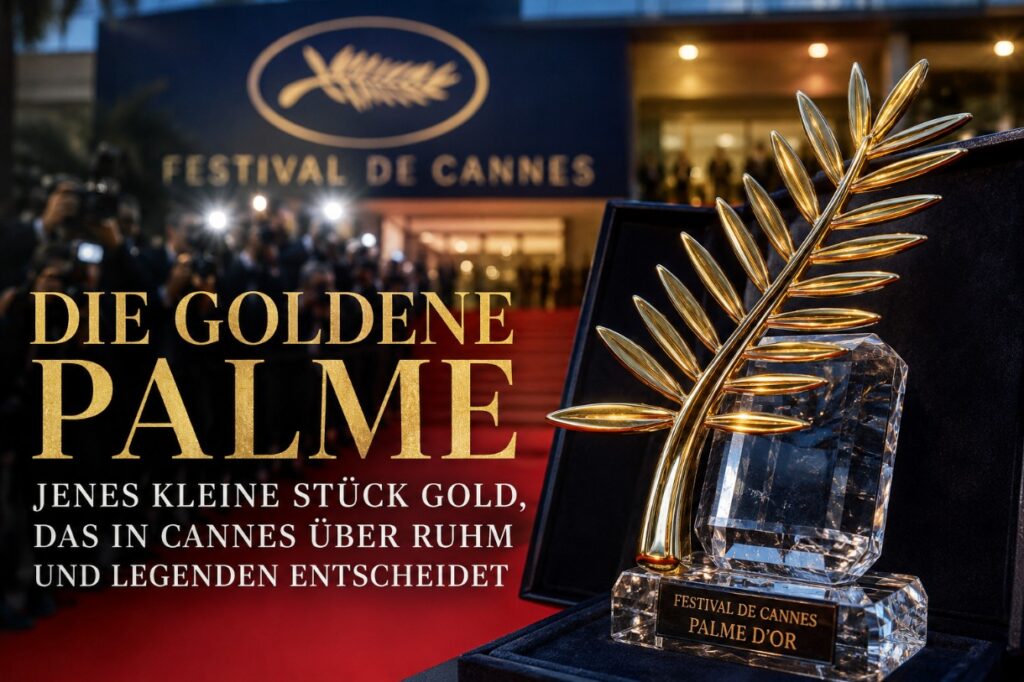
Every year the Croisette is governed by the same strange order of attention. Photographers chase after Hollywood stars, critics dissect films down to the smallest detail, producers negotiate millions behind closed doors. And yet in the end everything focuses on an object hardly larger than the palm of a hand: the Golden Palm.
It gleams behind glass showcases like a shrine.
Anyone who walks through the Palais des Festivals during the film festival quickly feels that this trophy is more than mere precious-metal jewelry. Guests stop, pull out their smartphones, whisper almost reverently. Some look at the Palm the way football fans look at the World Cup trophy – only more elegant, more French, a little more mysterious.
Since its introduction in 1955, the Golden Palm replaced the festival’s then “Grand Prize” and gradually developed into arguably the most prestigious award in international auteur cinema. Its name refers to the coat of arms of the city of Cannes, which shows a palm branch. From this local symbol, an icon of world cinema emerged over the decades.
And indeed: the Palm has an aura that reaches far beyond the glamour of the red carpet.
Since the 1990s the Swiss luxury house Chopard has been crafting the trophy by hand. 18-carat yellow gold, cut crystal, many hours of delicate work – each piece differs minutely from the previous one. Not a mass-produced item, then, but almost a work of art in its own right.
It is precisely this exclusivity that explains the almost emotional relationship many directors have with the award. In Hollywood the Oscar draws its appeal from market value, big studios and global marketing. Cannes, by contrast, cultivates a different self-image: here it is about cinema as an art form. Political. Brave. Challenging. Sometimes uncomfortable.
And that is exactly why a victory in Cannes often transforms careers overnight.
When Quentin Tarantino won in 1994 with Pulp Fiction, the Palm catapulted him definitively into the top tier of world cinema. Michael Haneke received international consecration with Das weiße Band. Bong Joon-ho wrote film history with Parasite. Julia Ducournau provoked heated debates with Titane – typical Cannes, really.
For hardly any award generates controversy as regularly.
Every year there are films considered too radical, too political, or simply the wrong choice. In the cafés around the Croisette journalists debate late into the night. Sometimes discussions arise there that seem almost more exciting than the films themselves. Well, Cannes loves drama not only on the screen.
The moment of the award ceremony feels particularly intense.
When on the festival’s final evening the jury president opens the envelope, a silence falls over the hall that is almost physically palpable. Directors freeze. Producers smile nervously. For a few seconds an entire film career hangs on a single name.
Then it appears — briefly in the spotlight.
The Golden Palm travels across the stage, is held aloft, photographed, celebrated. A few days later it usually disappears from public view again. Some winners put it in their office, others hide it discreetly in a library or a safe. But the myth remains.
And every May the same spectacle begins again.
Because at the Cannes Film Festival the leading role often remains reserved for this small palm branch of gold — a symbol that has sparked dreams in the film world for decades.
By C. Hatty