
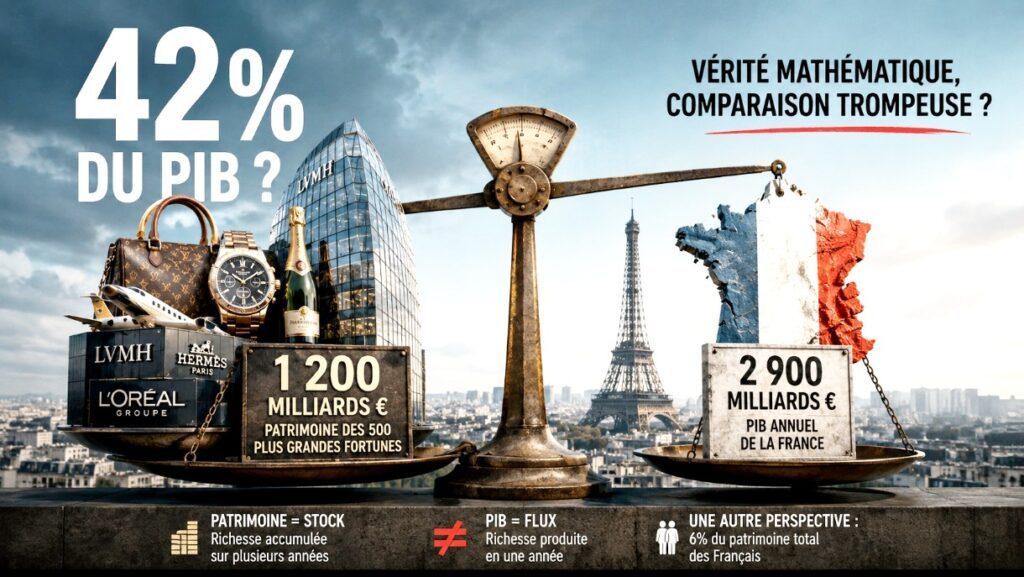
Hardly any number has shaped the French debate on inequality in recent years more than the “42 percent.” It stands for the claim that the 500 richest French people today own wealth equivalent to 42 percent of the French gross domestic product. The number feels monumental – almost obscene. It evokes a country whose economic substance is increasingly concentrated in the hands of a few families and corporations. It’s no wonder that economists like Gabriel Zucman or left-wing opposition politicians like to cite it.
And yet the real significance of this number lies less in its mathematical precision than in its political impact.
Strictly speaking, the statement is correct. The combined wealth of the 500 richest French families – led by dynasties such as Arnault, Bettencourt-Meyers, or Hermès – currently amounts to around 1,100 to 1,200 billion euros. The French gross domestic product, in turn, is nearly 2,900 billion euros annually. Mathematically, the ratio is indeed approximately 42 percent.
The error begins where an economic comparability is derived from this ratio.
A Methodological Shortcut
The problem lies in the nature of the quantities compared. Wealth is a stock; GDP is a flow. One measures accumulated values over decades, the other the economic output produced within one year.
Whoever compares the two directly is essentially comparing the total value of a savings account with an annual salary. The numbers may appear formally compatible but are not analytically so.
Especially in France, where economic debates are traditionally heavily morally charged, such indicators have a particular effect. They suggest not merely a concentration of wealth but almost a kind of appropriation of the national economy by a few players.
Liberal economists and business-related institutes have therefore been criticizing the methodological construction behind this depiction for years. They argue that a more meaningful comparison would be of the super-rich’s wealth with the total wealth of all French households. From this perspective, the number is considerably relativized: the roughly 1,200 billion euros would then correspond to about six percent of France’s total private net wealth, estimated at over 20,000 billion euros.
This does not make social inequality disappear. But its dimension appears less apocalyptic than the formula “42 percent of GDP” suggests.
The Real Story: The Historical Wealth Surge
Still, it would be a mistake to dismiss the debate as purely statistical misrepresentation. Behind the pointed formula lies a real and profound development: the spectacular rise of very large fortunes since the 1990s.
Back then, the wealth of the 500 richest French accounted for only about five to six percent of the annual economic output. Today, the share is many times higher. This shift marks not just a normal accumulation of wealth but a structural transformation of global capitalism.
France is a particularly instructive example for this. Hardly any other European country has benefited as strongly from the explosion of global luxury markets. Companies like LVMH, Hermès, or L’Oréal have become worldwide brand empires. Their stock market value multiplied with globalization, the rise of Asian consumers, and the expansive monetary policies of central banks.
As a result, the fortunes of their principal owners inevitably grew as well.
The concentration of wealth is therefore less an expression of a specifically French problem and more part of a global trend: returns on capital, especially in listed companies, developed over long periods far more dynamically than wages or general economic growth.
Thomas Piketty described this mechanism years ago. Gabriel Zucman politicizes it radically by deriving demands for global wealth taxes from it. Their opponents accuse them of rhetorically exaggerating statistical effects and thereby fostering resentment against entrepreneurs.
The Illusion of “Tangible” Wealth
Another aspect often overlooked in popular debates is that most of these billions do not exist as liquid cash. They are mostly shares in companies whose values fluctuate daily.
If LVMH’s stock drops ten percent in a few weeks, Bernard Arnault’s wealth shrinks by several billion euros on paper – without any physical money disappearing. Conversely, enormous wealth increases occur during stock rallies, which often remain purely balance sheet-based.
These “paper fortunes” remain politically relevant because they confer economic and social influence: access to capital, control over corporations, media power, and international networks. But they are not identical to freely available cash.
Precisely for this reason, public debate often fluctuates between two distortions. One side underestimates the real power of extreme wealth concentration. The other turns book values into a moral indictment of capitalism as a whole.
Numbers as Political Weapons
The formula of “42 percent of GDP” is ultimately less an economic figure than a rhetorical tool. It condenses complex developments into a catchy message. In times of growing social insecurity, it works brilliantly.
Modern democracies increasingly live off symbolic numbers. Debt ratios, deficit limits, CO₂ targets, or billionaire rankings often structure political perception more than the underlying facts.
The real challenge, therefore, is not to ban such numbers or condemn them morally. What matters is precisely contextualizing their significance.
Yes, the fortunes of the French super-rich have grown historically strong. Yes, the concentration of economic power raises legitimate political questions. But no: it does not automatically follow that a few hundred families “own 42 percent of France.”
The line between mathematical truth and political suggestion is sometimes a thin one.
Andreas M. Brucker