
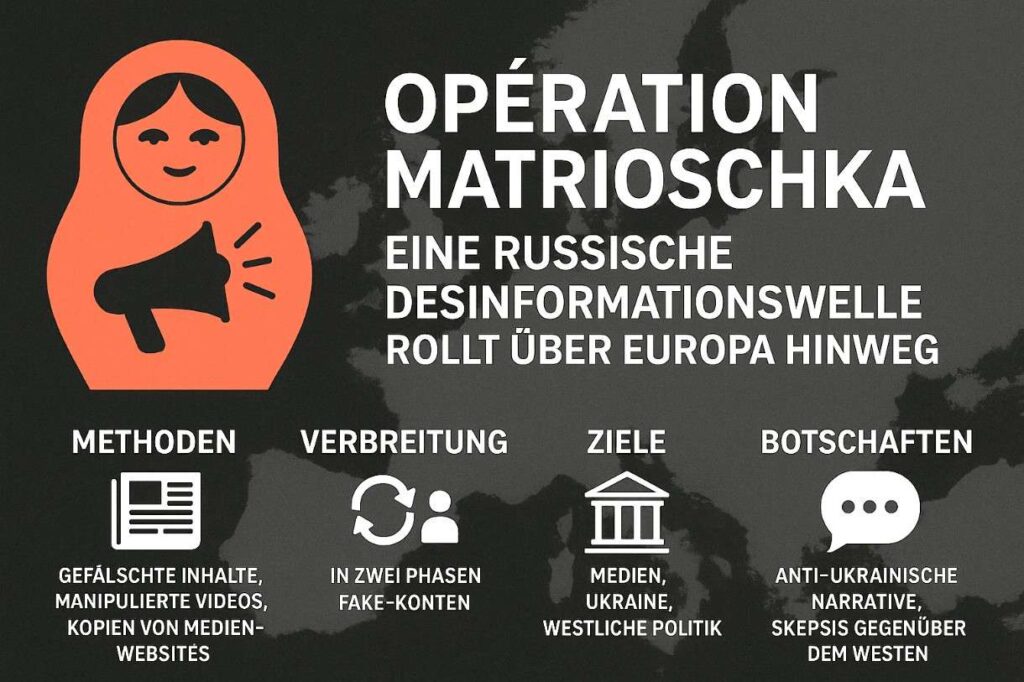
The disinformation campaign “Matrioschka” shows how systematically and internationally networked Russian actors today try to influence public opinion in Europe. France is at the center — but the entire West is affected.
Since late summer 2023, French authorities have been observing with growing concern a hybrid influence operation that sets new standards in its complexity and persistence. Under the cover name “Operation Matrioschka,” named after the nested Russian wooden dolls, a multi-layered campaign is unfolding with the aim of destabilizing Western societies, undermining trust in established media, and in particular weakening support for Ukraine.
The term is not chosen by chance. Behind every exposed manipulation new layers, new channels, new actors are revealed. What begins as a simple social media post develops — orchestrated, coordinated, precisely timed — into a polyphonic attack on the integrity of public discourse.
A new level of digital influence
The French authority VIGINUM, responsible for monitoring foreign digital influence operations, reveals the mechanics of this campaign in a recent report: at the center is a two-stage approach. First, content is spread by so-called “seeders” – mostly in the form of manipulated images, forged quotes, or deliberately distorted news. Then “quoters” appear, who introduce this content into debates with journalists or fact-checkers and thus aim to tie up their resources.
Particularly insidious is the professional presentation: the visual design deliberately follows the typical visual language of established media houses. Logos, color schemes, typography – everything appears authentic at first glance. Only on closer inspection does the deception become apparent.
The profiles used also follow a clear pattern: artificially generated photos, no history, minimal activity – they serve exclusively the purpose of campaign dissemination. In many cases these are purchased or previously inactive accounts. The content itself is multilingual: French, English, German, Italian and Ukrainian.
France in focus – but not alone
The operation does not target France alone, even if it is currently particularly visible there. The country is being attacked on multiple levels: the media landscape, political institutions, social trust – everything is in the crosshairs.
Concrete narratives of the campaign include, for example, portraying Ukrainian refugees as a burden on the host country or spreading the impression that Ukraine is a thoroughly corrupt system that does not deserve Western support. It is also suggested that Western democracies are losing legitimacy overall — a narrative that appears in similar form in other contexts as well.
A particularly current example: On the occasion of the commemorative events on November 13 in Paris — the anniversary of the 2015 terrorist attacks — fabricated images circulated on social networks suggesting riots allegedly caused by Ukrainian citizens. The content was quickly spread by automated accounts before it could be identified as fake by media outlets such as France24.
Transnational dimension
The operation is not limited to France. Similar mechanisms emerged in Moldova — a country with close ties to the EU — in the run-up to elections. The aim there was to portray the government as pro-Western and incompetent, while strengthening pro-Russian forces.
The overarching pattern is always the same: destabilizing public discourse through targeted disinformation, media overstimulation, and systematic skepticism toward fact-based information sources.
A new challenge for democracies
The campaign “Matriochka” marks a turning point in the way hybrid threats operate in the digital space. It is no longer about isolated false reports or sporadic troll actions. Rather, it is a long-term, technically sophisticated and internationally coordinated strategy aiming to shift the power of interpretation in the digital public sphere.
The means used are all the more dangerous the subtler they appear. Many of the contents hover on the edge of falsehood, tie into real events or play with half-truths. This not only makes clarification more difficult, but also makes classification by the public harder.
What does this mean for a German-speaking audience?
Readers living in Germany or Switzerland who follow France closely should also be sensitized. Operation Matriochka is not exclusively directed against French media or institutions – it is testing mechanisms that could work elsewhere as well.
In particular, the increasing pressure on fact-checking organizations, the targeted exploitation of media routines and the emotionalization through seemingly authentic images pose new challenges for democracies across Europe. The relevance for a wider public is obvious: those who inform themselves about France could unknowingly encounter manipulated content – even if it appears formally correct.
Conclusion
The “Matryoshka Operation” is not an isolated phenomenon, but an expression of a strategic reorientation of Russian influence in the digital sphere. It combines classic propaganda with the technical capabilities of artificial intelligence and social media — and from this develops a new form of asymmetric communication.
The answer does not lie solely in technical upgrading or state regulation. It begins with the media-critical competence of the individual — and with the ability to distinguish between opinion and manipulation.
Author: Andreas M. Brucker