
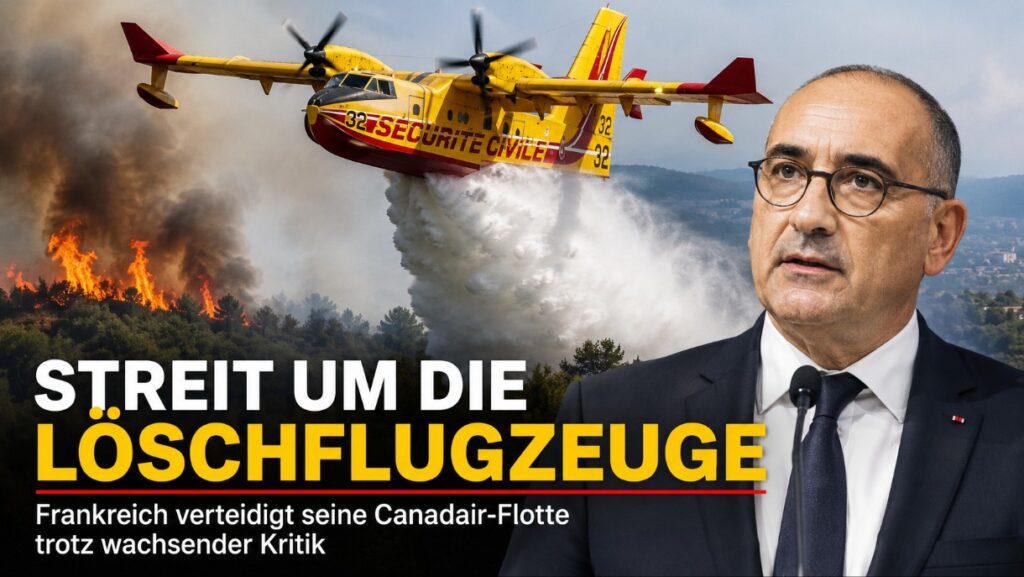
The severe wildfires of recent days have sparked a political debate in France about the operational capacity of the civilian aerial firefighting fleet. While the opposition accuses the government of shortcomings in modernizing firefighting aircraft, the Ministry of the Interior firmly rejects the criticism. Interior Minister Laurent Nuñez emphasizes that France continues to have one of the most efficient firefighting aircraft fleets in Europe. However, the discussion shows that the challenges now go far beyond mere budgetary issues.
The opposition criticizes cuts and delayed modernization
The controversy originated from several parliamentary questions in the National Assembly. Members of the Rassemblement National and La France insoumise accused the government of weakening civil protection resources. At the center of the criticism is the decision to cancel the order for two new Canadair firefighting aircraft in 2024, following cuts of more than 50 million euros to the Sécurité civile budget.
In addition, opposition parties point to the modernization program for the French firefighting aircraft fleet, announced by President Emmanuel Macron as early as 2022. However, the renewal of the outdated aircraft is progressing much more slowly than expected. In light of growing wildfire risks, critics accuse the government of postponing necessary investments.
The Interior Minister firmly rejects the accusations
During government question time, Interior Minister Laurent Nuñez described the allegations as a “completely sterile controversy.” According to the minister, France currently has twelve Canadair firefighting aircraft and eight Dash aircraft, specifically equipped to fight wildfires. Depending on the operational situation, this fleet is supplemented by leased aircraft and firefighting helicopters.
According to the Ministry of the Interior, investments in civil protection air capabilities have actually increased in recent years. France would therefore continue to have one of the largest and most effective aerial fleets in Europe for fighting forest fires. What is decisive is not only the number of aircraft, but also their operational readiness and the ability to rapidly mobilize additional resources.
The real problem: an aging Canadair fleet
However, the focus of the debate is less on the current size of the fleet than on its future sustainability. A significant part of the French Canadair CL-415 fleet is now approaching around three decades of service. Although the aircraft are still considered reliable, they require increasingly complex maintenance work and entail rising operating costs.
The planned replacement with the new DHC-515 is proving more difficult than expected. The Canadian manufacturer has been facing delays in development and production for years. As a result, delivery of the new firefighting aircraft is expected to be postponed until the beginning of the next decade. Until then, France will remain dependent on its modernized but now aging Canadairs.
These delays are fueling criticism from the opposition, which fears that the available capabilities may no longer be sufficient in the long term if extreme weather events continue to increase.
Climate change is changing the area of operations
The political debate is taking place at a time when the risk of forest fires in France is changing significantly. Longer periods of heat, persistent drought, and more frequent extreme weather events mean that major vegetation fires are no longer confined solely to the Mediterranean region.
A particularly symbolic episode was the deployment of several Canadairs in Île-de-France. That firefighting aircraft would have to be used in the region around Paris would have been difficult to imagine just a few years ago. The episode highlights how the danger zone is expanding ever further north and how new regions must prepare for forest and surface fires.
As a result, the demands on civil protection are also increasing. Aircraft must be deployed more flexibly, operational concepts must be adapted, and cooperation between national and regional emergency services must be further developed.
The challenges go far beyond new aircraft
Experts emphasize that the effectiveness of the French air fleet does not depend solely on the number of available firefighting aircraft. Equally crucial are sufficiently trained crews, efficient maintenance infrastructure, and a reliable supply of spare parts. This is becoming increasingly important, especially for older aircraft types.
There is also a need to make additional firefighting capabilities available flexibly and to adapt civil protection as a whole to the consequences of climate change. The growing number of large-scale vegetation fires is increasing pressure on both emergency services and resources. At the same time, preventive measures, early warning systems, and cooperation with European partner states must be consistently expanded.
The current debate thus highlights a fundamental conflict of objectives: while the government points to the French air fleet’s current high operational capacity, the opposition is looking to the years ahead and asking whether the existing fleet will still be able to meet the growing demands of the future. As the wildfire season progresses, this debate is likely to gain further importance.
P. Tiko