
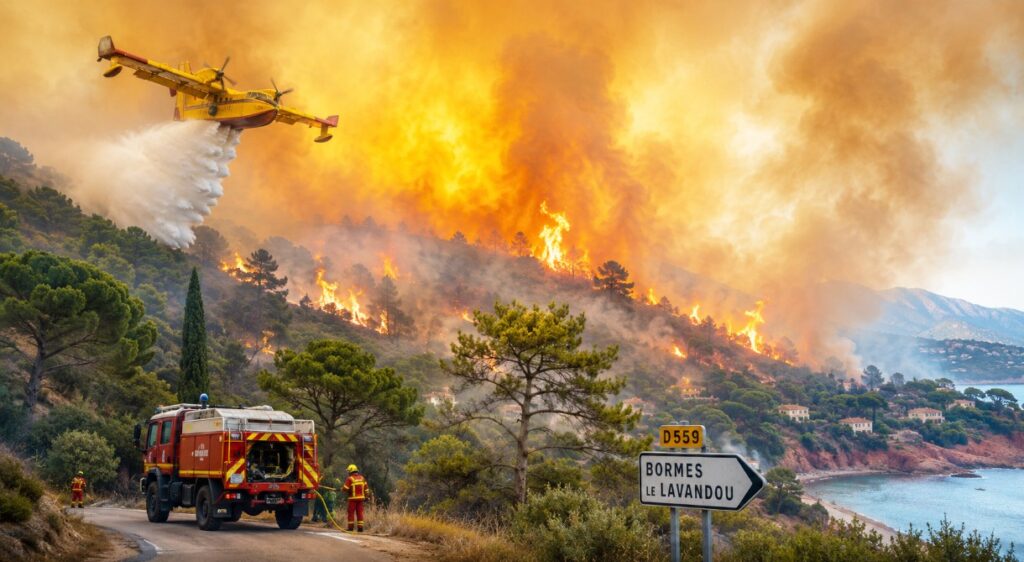
Summer is showing its most dangerous side in France. Weeks without significant rainfall, persistently high temperatures and dry winds are drastically intensifying the wildfire risk in the south of the country. The department of Var on the Cote d’Azur and the Mediterranean island of Corsica are currently particularly affected. There, emergency crews are battling several fires that have developed into large-scale blazes within a short period of time.
In Var, the situation escalated within a matter of hours. What initially began as a single fire source quickly tore through the parched vegetation and destroyed several hundred hectares of forest and scrubland. For firefighters, every minute counts in such moments. Numerous emergency personnel arrived with fire engines, while firefighting aircraft and helicopters attempted to contain the flames from the air. Roads had to be closed, residential areas at risk were placed under special observation, and authorities urged the public to exercise the utmost caution.
A similar picture is emerging in Corsica. The island has been suffering from severe drought for weeks. The dense maquis vegetation that shapes the landscape in many places, in particular, turns into highly flammable material in hot weather. A single small spark is enough for a fire to spread rapidly. Firefighters are therefore working continuously at several locations at once, trying to bring blazes under control as early as possible. If they fail to do so, the flames often spread across large areas in a very short time.
The current development comes as little surprise to experts. For years, meteorologists and climate researchers have observed that prolonged dry spells are becoming increasingly common. When rain is absent for weeks, soils and plants lose their natural moisture. Forests, shrubs and meadows literally dry out, creating ideal conditions for fires. If strong winds are added to the equation, a dangerous combination emerges that poses enormous challenges even for experienced emergency crews.
Especially in southern France, strong downslope winds such as the Mistral or the Tramontane often play a decisive role. They drive the flames forward at high speed and can carry glowing plant debris over long distances. This repeatedly creates new fire sources, making firefighting operations considerably more difficult. Sometimes a brief gust is enough for the fire to jump across roads or natural barriers.
It is also striking that the wildfire season now begins significantly earlier than it did a few decades ago. In the past, the hottest weeks in August were considered particularly critical. Today, major fires occur as early as the beginning of summer and affect many regions well into autumn. This development increases pressure on fire services and civil protection agencies, which must remain ready to respond for months at a time.
In addition to climatic conditions, human behavior also plays a decisive role. According to the authorities, a large proportion of all wildfires can be traced back to human actions. Discarded cigarette butts, open flames or barbecuing outside designated areas are enough in the current situation to trigger a disaster. Even technical faults in vehicles or machinery can produce sparks that ignite dry grass or undergrowth. Authorities are therefore urgently appealing to residents and holidaymakers to comply consistently with all safety regulations. Especially during periods of extreme drought, caution is considered the most effective protection for people, nature and property.
The fires in Var and Corsica once again illustrate how vulnerable Mediterranean landscapes have become to heat and drought. As long as rain fails to arrive and temperatures remain high, the risk of further wildfires is likely to persist. For emergency crews, this means a summer full of challenges – and for the public, the realization that a single careless moment can have serious consequences.