
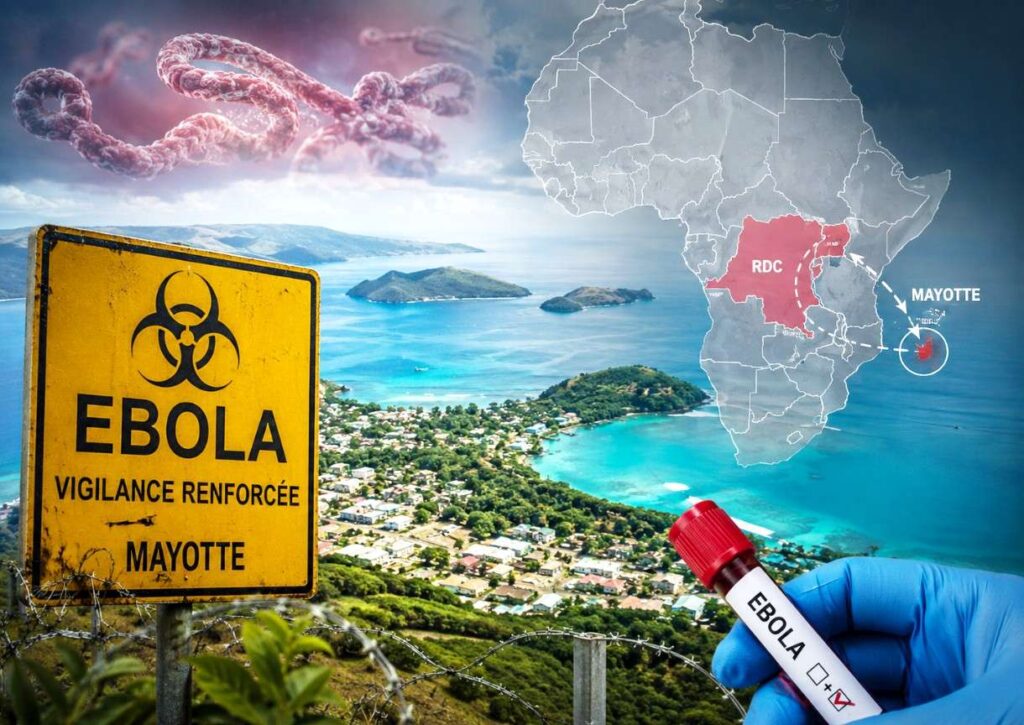
The French health authorities are watching the Ebola epidemic in Central Africa with increasing attention. Special focus is on the overseas territory of Mayotte, which according to several experts could be vulnerable due to its geographic location and structural weaknesses. Although not a single case has been recorded on the island so far, the debate about prevention, border controls, and the resilience of the local health system has gained new political relevance.
The trigger for concerns is the current wave of Ebola in parts of Central Africa, particularly in the Democratic Republic of the Congo and in Uganda. The World Health Organization considers the situation serious and is monitoring the spread with greater attention. Behind this is the circulation of a particularly dangerous viral variant, which according to virologists has a higher epidemic potential.
A fragile health system on the edge of Europe
Mayotte holds a particular position among the French overseas territories. The archipelago in the Indian Ocean is legally part of France and therefore of the European Union, but has been struggling for years with serious infrastructure problems. The health system is considered chronically overburdened, the water supply is unstable, and in many informal settlements, poor hygienic conditions prevail.
These structural deficits now fuel fears that an imported case of Ebola could be difficult to control. The French infectious disease specialist Xavier Lescure publicly warned against underestimating the danger. The decisive factor is to interrupt possible chains of infection already “at the source” and to detect suspected cases early.
Meanwhile, the French government is trying to avoid alarmism. The Ministry of Health emphasizes that there is currently no acute threat to Mayotte. However, it remains “in constant exchange with experts” and continuously reviews the risk of virus introduction.
Migration and health risks
The geographical situation of Mayotte sharpens the authorities’ sensitivity. The island is located between the East African coast and the Comoros and lies along important migration routes in the western Indian Ocean. For years, the French department has recorded high irregular migration, especially from the neighboring islands of the Comoros.
In Paris, concern is growing that public health risks may be more strongly linked to migratory movements. However, experts warn against hastily presenting Ebola as a “migratory disease.” Experiences from previous epidemics show that the greatest danger rarely comes from isolated travelers, but from late diagnosis, insufficient medical infrastructure, and lack of international coordination.
The Ebola outbreaks in West Africa between 2014 and 2016 remain a warning. At that time, according to international organizations, more than 11,000 people died, primarily in Guinea, Liberia, and Sierra Leone. The epidemic highlighted dramatic deficiencies in the healthcare systems of many African states, but also the slowness of international responses to the crisis.
Political pressure from Mayotte
Politically, the issue is also gaining importance. Deputy Estelle Youssouffa harshly criticized France’s prior preparation. Mayotte “must not be left on the front line” against such a dangerous virus, she declared in reference to the already tense situation on the island.
In fact, Mayotte has been immersed for months in the crossing of several simultaneous crises: high poverty, strong population growth, water scarcity, and an overwhelmed public administration. Issues of security and health increasingly intertwine there with social conflicts and migration policy debates.
For the government in Paris, it is a delicate matter. President Emmanuel Macron has already promised in previous years to expand Mayotte’s infrastructure and strengthen state presence. Nevertheless, progress remains barely visible in many areas.
France between prevention and containment of panic
French authorities are currently pursuing a dual strategy: on the one hand, intensifying surveillance and early detection; on the other, avoiding causing unnecessary panic. Health checks, epidemiological monitoring, and the preparation of medical centers are at the core of the current measures.
The likelihood of a major Ebola outbreak in France is still considered low according to many experts. Modern isolation procedures, improved diagnostics, and international early warning systems have significantly increased response capabilities compared to previous epidemics. However, the debate about Mayotte shows how much global health issues are today intertwined with geopolitical, social, and migration policy challenges.
Moreover, the COVID-19 pandemic has heightened awareness that even geographically distant health crises can quickly have international repercussions. Consequently, authorities now respond with greater sensitivity to potential epidemic risks, especially in regions with fragile infrastructures.
The discussion about Ebola and Mayotte is still mainly about a prevention scenario. But the current warnings make clear how vulnerable Europe’s peripheral regions remain to global health crises. For France, the island in the Indian Ocean is not only a focal point of migration policy but increasingly a test case for the resilience of state health prevention in the 21st century.
P.T.