
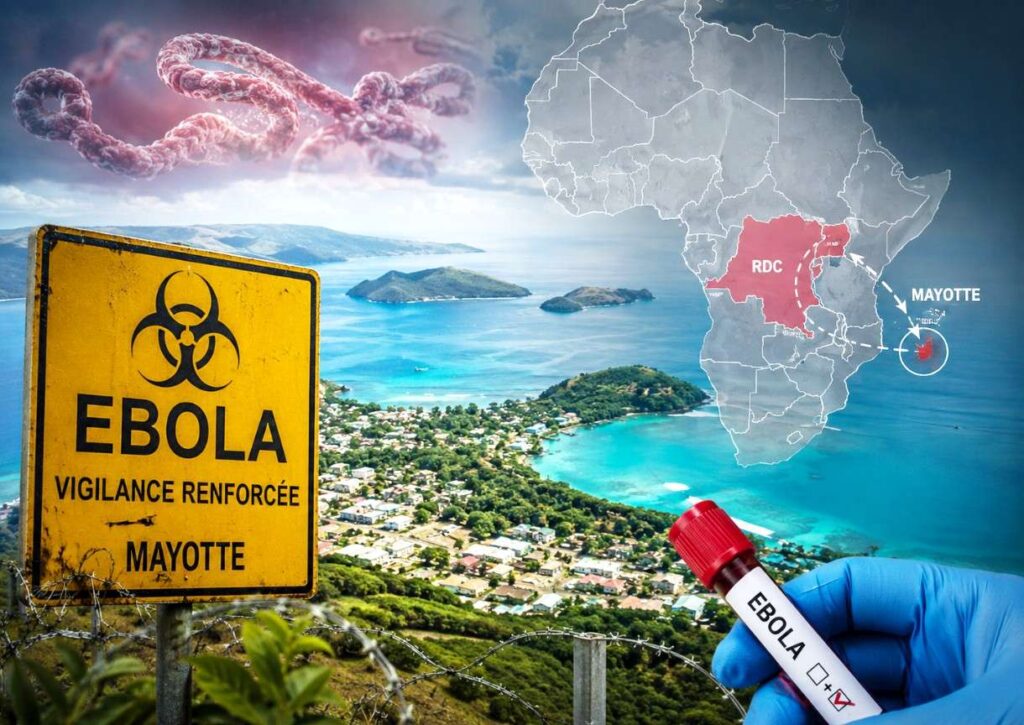
French health authorities are closely monitoring the Ebola epidemic in Central Africa. The overseas territory of Mayotte is particularly at the center of concerns: according to several experts, its geographical location and structural weaknesses could make it vulnerable. Although no cases of Ebola have yet been reported on the island, the debate over prevention, border controls, and the resilience of the local health system has taken on new political urgency.
The trigger for the concerns is the current wave of Ebola in certain regions of Central Africa, notably in the Democratic Republic of Congo as well as in Uganda. The World Health Organization describes the situation as serious and is following the progression with increased attention. In the background, a particularly dangerous variant of the virus is circulating, which virologists believe has an increased epidemic potential.
A fragile health system at the gates of Europe
Mayotte holds a special place among the French overseas territories. The archipelago in the Indian Ocean legally belongs to France and, therefore, to the European Union, yet it has been struggling for years with significant infrastructure problems. The health system is considered chronically overloaded, water supply is unstable, and many slums suffer from precarious sanitary conditions.
These structural deficits now fuel fears that an imported case of Ebola could be difficult to control. The French infectious disease specialist Xavier Lescure has publicly warned against underestimating the danger. According to him, it is essential to interrupt possible chains of transmission “at the source” and to quickly identify suspected cases.
The French government, for its part, tries to avoid alarmism. The Ministry of Health emphasizes that there is currently no acute threat to Mayotte. However, it is “in constant exchange with experts” and the ministry continuously reassesses the risk of virus introduction.
Migration and health risks
The geographical situation of Mayotte increases the sensitivity of the authorities. The island is located between the East African coast and the Comoros and lies along important migration routes in the western Indian Ocean. For years, the French department has recorded significant irregular migration, particularly from the neighboring islands of the Comoros.
In Paris, the fear is growing that health risks will increasingly be linked to migratory movements. However, experts caution against the hasty classification of Ebola as a “migratory disease.” Experiences from previous epidemics show that the greatest danger usually does not come from isolated travelers, but from late detection, insufficient medical infrastructure, and a lack of international coordination.
The Ebola outbreaks in West Africa between 2014 and 2016 remain a warning. At that time, more than 11,000 people died according to international organizations, mainly in Guinea, Liberia and Sierra Leone. The epidemic revealed dramatic deficits in the health systems of many African states – but also the slowness of international responses to the crisis.
Political pressure from Mayotte
Politically as well, the topic is gaining importance. Deputy Estelle Youssouffa has expressed strong criticism of the preparations made so far by France. Mayotte must “not be on the front line” against such a dangerous virus, she declared, emphasizing the already tense situation on the island.
Indeed, Mayotte has for months been at the crossroads of several simultaneous crises: severe poverty, high demographic growth, water shortages and overwhelmed public administration. Security and health issues are increasingly mixing with social conflicts and debates on migration policy.
For the government in Paris, it is a delicate issue. President Emmanuel Macron had already promised several times in recent years to improve Mayotte’s infrastructure and to strengthen the presence of the state. However, progress often remains barely visible on the ground.
France between prevention and appeasement
The French authorities are currently following a dual strategy: on the one hand, strengthening surveillance and early detection; on the other hand, avoiding causing unnecessary panic. Health checks, epidemiological monitoring, and the preparation of medical facilities are at the heart of the ongoing measures.
The likelihood of a widespread Ebola outbreak in France remains, according to many experts, low. Modern isolation procedures, improved diagnostics, and international alert systems have significantly enhanced the ability to respond compared to previous epidemics. Nevertheless, the debate around Mayotte shows how closely global health issues are now linked to geopolitical, social, and migration challenges.
The Covid-19 pandemic has also raised awareness that health crises geographically distant can quickly have international repercussions. Authorities now respond more sensitively to potential epidemic risks — especially in regions with fragile infrastructures.
For now, the debate about Ebola and Mayotte is mostly a precautionary scenario. But the current alerts highlight the vulnerability of Europe’s peripheral regions to global health crises. For France, the island in the Indian Ocean is therefore no longer just a hotspot of migration policy, but increasingly a test case for the resilience of public health systems in the 21st century.
P.T.