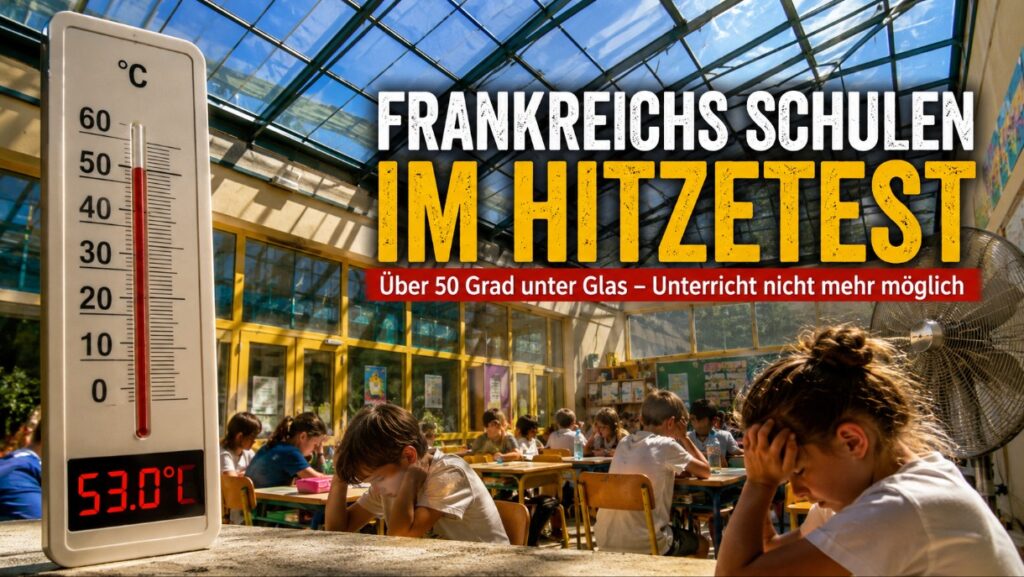
“I call it a tropical greenhouse.” That is how an official described the situation in a primary school in Soustons, in the southwest of France. What first seemed like an exaggeration turned out to be terribly accurate. At Isle-Verte school in Landes, temperatures above 50 degrees were measured under a large glass roof. As a result, the school closed its doors on Thursday and Friday.
Several children complained of fatigue, some felt unwell, others had to vomit. Teaching in such conditions? Barely imaginable. The school dates back to the 1980s, still partially has single glazing, and accommodates around 350 students. Ironically, the architectural elements that once symbolized light and openness have turned into genuine heat traps.
However, the incident in Soustons is much more than just a local news story from the southwest of France. It illustrates a trend affecting the entire country. France is currently experiencing an exceptionally early and intense heat wave. Meteorologists describe it as a historic climate event for the month of May. Already at the end of May, temperatures more reminiscent of mid-summer than spring were recorded. In Angoulême-La Couronne, the thermometer climbed to 37.8 degrees – a new record for this month.
This situation highlights a question long discussed theoretically: are public buildings in France prepared for the climate of tomorrow?
Many schools were built at a time when extreme heat episodes were rare. Large glazed surfaces were considered modern, and complex shading systems often seemed superfluous. Today, the downside of this design is revealed. As soon as the sun beats down for several days in a row on the glazed surfaces, classrooms and inner courtyards turn into heat reservoirs.
In the short term, municipalities adopt pragmatic solutions. Windows remain open at night, fans run at full speed, water sprayers provide a bit of freshness. But these measures often resemble a band-aid on a wound that is widening.
The real challenge lies in architectural adaptation. More shade through trees and shading sails, better insulation, natural ventilation, greened schoolyards, and less paved surfaces are considered key elements. All this costs money – and not little. Small communities are particularly faced with the difficult task of adapting their infrastructure to changing climatic conditions, while simultaneously having to manage other investments.
The school of Soustons thus appears as a warning signal. Children are part of groups particularly sensitive to intense heat. When classrooms reach temperatures that resemble more a greenhouse than a place of learning, it is no longer a matter of comfort, but of health and safety.
What is happening today in the Landes region could become the norm tomorrow elsewhere. French schools are thus unintentionally transforming into an early warning system for climate adaptation. The question is no longer whether public buildings should respond to more frequent heat waves, but how quickly this will be possible.
Andreas M. B.