
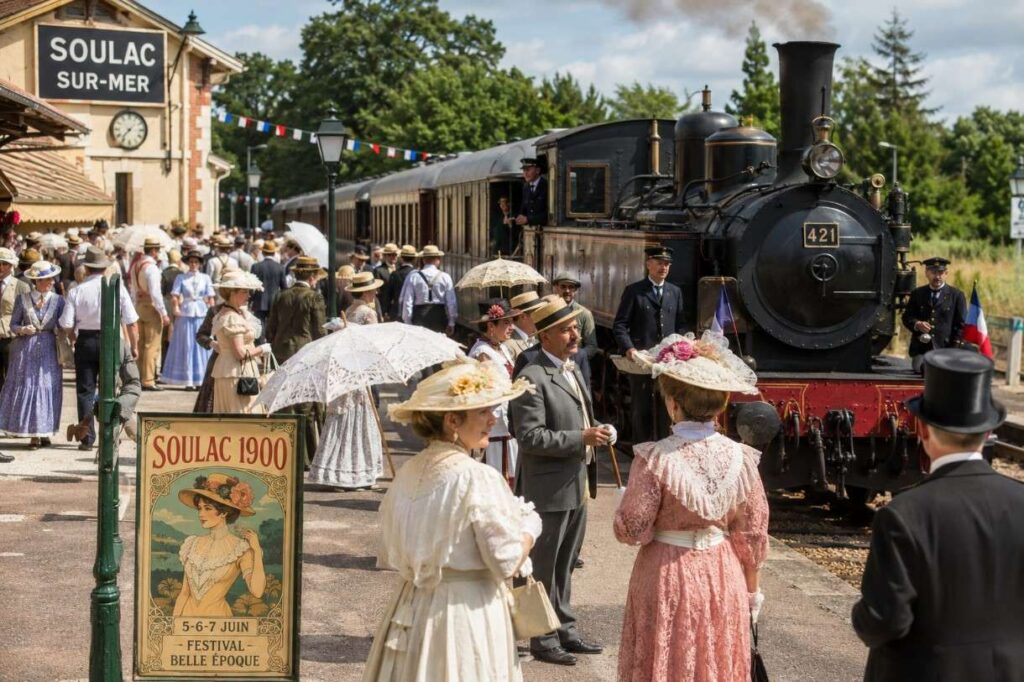
Anyone strolling through the streets of Soulac-sur-Mer in early June probably r믭 their eyes in surprise. Suddenly, elegant ladies in lace dresses dominated the streetscape, gentlemen strolled along the promenade with straw hats and canes, and instead of modern everyday clothing, garments from a long-gone era shaped the scene. For three days, the charming seaside resort on the French Atlantic coast once again transformed into a lively backdrop of the Belle Époque.
The traditional festival “Soulac 1900” is one of the largest historical events in France. Year after year, it attracts thousands of visitors to the north of Médoc. And it’s not just about observing history. The guests dive right into it.
From the moment of arrival, one gets the impression that someone has turned the clock back more than a hundred years. Everywhere you encounter ladies with parasols, children in nostalgic sailor suits, and gentlemen in stylish suits. Many visitors invest weeks or even months preparing their costumes. The result is astonishingly authentic.
But clothing alone does not make a time travel experience.
The real magic lies in the many little details. Horse-drawn carriages roll through the streets, historic vehicles gleam in the sunlight, and melodies that once filled the ballrooms of Europe can be heard from every corner. Musicians, street artists, and actors ensure that the past stays alive.
Especially impressive each year is the arrival of the historic steam train. The journey from Bordeaux to Soulac is like a trip to another world. While the locomotive puffs through the Médoc landscape, the typical smell of coal and steam rises in the air. For railway enthusiasts, this is a true highlight. And for many others too.
After all, nowadays it’s rare to see a steam locomotive arrive at a station with a loud whistle.
Upon arriving in Soulac, passengers are greeted by a spectacle that envelops the entire town. More than three hundred artists transform squares, streets, and promenades into a large open-air stage. Dance groups perform Charleston, Swing, and French Cancan. Brass bands parade through the alleys. Acrobats amaze with their feats. There is something to discover everywhere.
Sometimes just a brief glance at a square is enough to feel like you’ve landed right inside an old postcard motif.
It is precisely this lively character that gives the festival its special charm. Visitors are not just spectators. They become part of the event. Those who wish can participate in elegance contests, attend historical picnics, or simply mingle with the numerous costumed guests.
And that is the secret of Soulac 1900’s success.
While many events merely present history, this festival lets you experience it. You talk with people in historic costumes, dance to music from past decades, or enjoy a ride in a carriage. The boundary between performer and audience almost completely blurs.
In doing so, the festival also tells a piece of regional history. Around the turn of the century, Soulac-sur-Mer developed into a popular vacation spot for wealthy citizens from Bordeaux. With the expansion of the railway, the Atlantic coast suddenly became within reach. Beach holidays became fashionable. Fresh sea air was considered healthy. The first holidaymakers flocked to the coast.
The Belle Époque was a time of optimism. Technical innovations changed life, cities grew rapidly, and people looked to the future with confidence. The festival tries to capture exactly this spirit of life.
With remarkable success.
Anyone walking through the festively decorated streets quickly understands why the event attracts new visitors year after year. It’s not just about nostalgia. It’s about the joy of shared experience, the desire to slow down, and the opportunity to escape the hectic everyday life for a moment.
Because honestly: when else do you get the chance to board a steam locomotive and feel like a traveler from the year 1900?
Soulac 1900 offers exactly this rare experience. Amid steam, music, lace dresses, and nostalgic flair, an atmosphere arises that delights visitors of all generations. For some, it’s a historical festival; for others, a family outing. Many return again and again.
And when at the end of the weekend the last clouds of steam drift over the station and the costumes slowly disappear back into closets, one thing remains above all: the memory of a journey that didn’t require a passport.
A journey into the past.
An article by M. Legrand