
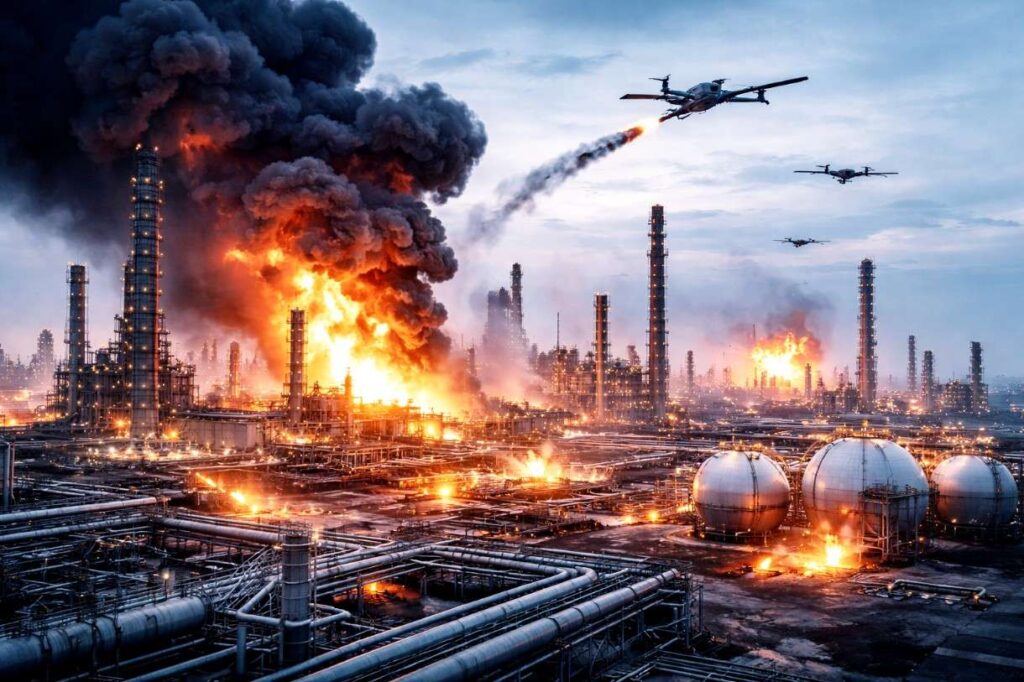
The images from the Gulf are as impressive as they are disturbing: burning refineries, destroyed loading terminals, interrupted supply chains. What has escalated in recent weeks is more than a regional escalation. It is a stress test for the global energy order – and possibly the beginning of a new phase of structural uncertainty.
Attacks on the Heart of Energy Supply
For about six weeks, coordinated attacks on central oil and gas facilities in the Gulf region have increased. Drones and rockets are targeting infrastructure that is essential for global supply. According to current estimates, around 75 facilities have been damaged, a third of them severely. Affected are refineries, storage facilities, and especially liquefied gas terminals – those critical points where fossil energy is brought into a tradable form.
The statements from the International Energy Agency and its director Fatih Birol leave no room for reassurance. Birol speaks of a potentially “the most severe energy crisis in history.” Such words are rare in the traditionally sober energy policy discourse – and they mark the magnitude of the current development.
Ras Laffan and the Vulnerability of Global Hubs
Particularly severe is the failure of the facility in Ras Laffan in Qatar, the world’s largest center for liquefied natural gas (LNG). Not only peripheral equipment was affected there, but – as experts emphasize – the technical heart of production: the liquefaction units. These are highly complex, difficult to replace, and can only be repaired with considerable time investment.
Forecasts expect several years before full capacity can be restored. In a globalized energy economy that increasingly relies on LNG, such a failure acts like a systemic shock. Europe, for example, which has become more dependent on liquefied gas since the decline of Russian pipeline deliveries, is likely to feel the consequences immediately.
Individual companies are also affected. The French energy group TotalEnergies confirmed damage to production lines in Saudi Arabia. Such isolated failures may seem manageable when considered alone, but in total they exert a significant leverage effect on prices and supply security.
More than a classic oil price shock
The current situation differs in key respects from previous energy crises. The oil price shocks of the 1970s were politically motivated supply shortages. The current situation, however, is characterized by physical destruction of infrastructure – a form of risk that is difficult to calculate and barely compensable in the short term.
Added to this is the changed structure of the energy markets. The diversification of supply sources, long praised as a guarantee of stability, reaches its limits when several critical nodes fail simultaneously. At the same time, demand—especially in Asia—remains high, further limiting adaptability.
The gas market reacts particularly sensitively. Unlike oil, gas cannot easily be redirected globally; it is more tied to infrastructure. Liquefied gas forms a bridge here, but this very bridge is now damaged. The result is increased volatility, which is already evident in the futures markets.
Geopolitical Dimensions and Strategic Calculations
The attacks also raise geopolitical questions. The targeted sabotage of energy facilities suggests an escalation beyond classical military confrontation. Energy is once again becoming a strategic weapon—not through embargoes or sanctions, but through direct physical intervention.
For the affected states in the Gulf, the challenge is to better protect their infrastructure. For import-dependent economies, however, the question is how resilient their supply systems really are. Strategic reserves can cushion short-term bottlenecks, but do not replace sustainable stability.
Europe, for example, is in an ambivalent position: The departure from Russian energy sources has increased dependence on other, sometimes equally fragile regions. The current crisis could expose this vulnerability – and reignite the energy policy debate.
Between Market Mechanisms and Political Control
In the past, markets have responded to energy shortages with price increases, which in turn incentivized investments and expansions of supply. But this mechanism requires time – time that is lacking in acute crises. When infrastructure is destroyed, even high prices help only to a limited extent.
Political interventions are therefore becoming more likely: price caps, subsidies, strategic releases. Such measures can stabilize in the short term but carry long-term risks of market distortions and investment incentives.
At the same time, the crisis could accelerate the transition to renewable energies. But here too, the same applies: the restructuring of energy systems is a long-term project. In the short term, the world remains dependent on fossil energy sources – and thus vulnerable to their disruptions.
What is currently emerging is less a classic crisis and more a transition into a new phase of structural uncertainty. The vulnerability of global infrastructures, the political instrumentalization of energy, and the limited adaptability of markets form a complex web that makes simple answers difficult. The coming months will show whether this is a temporary shock – or the beginning of a new energy policy reality.
Author: P. Tiko