
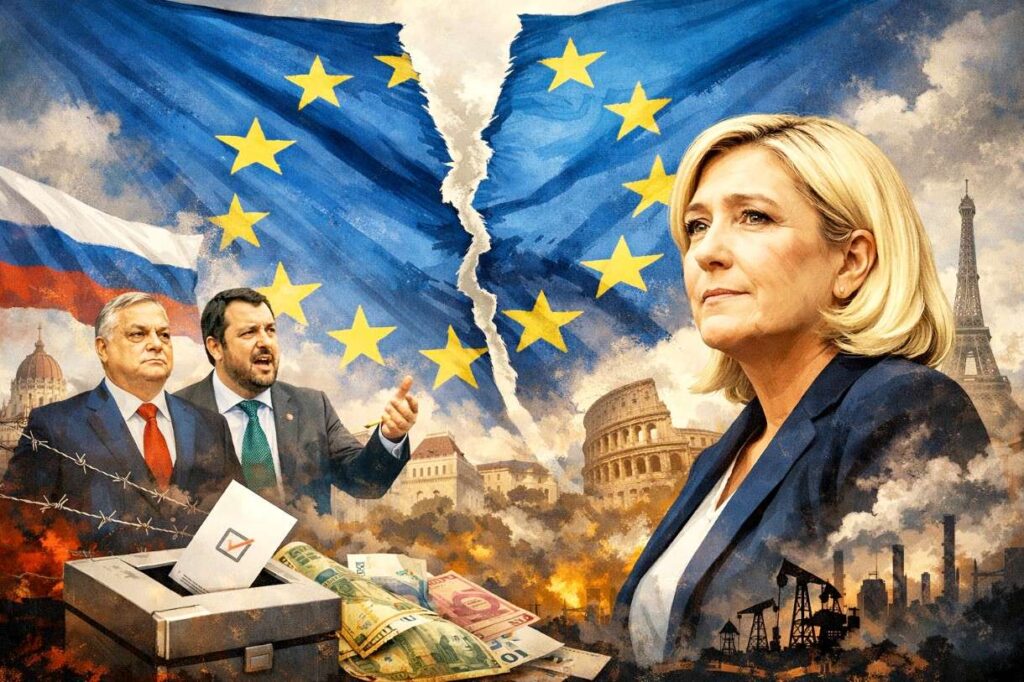
The European Union has been under pressure for years – due to geopolitical tensions, economic divergences, and domestic political polarization. But one of the more subtle challenges does not arise at its external borders, but within its political dynamics: the increasing instrumentalization of Europe for national party-political purposes. This development is particularly evident in the strategy of Marine Le Pen, whose European policy course is exemplary of a deeper structural tension.
The Change in the European Policy Discourse
Just a decade ago, the European fault line was comparatively clearly drawn: on one side were supporters of deeper integration, and on the other opponents who often demanded exit from the Union or at least from the Eurozone. This binary opposition has since dissolved. In its place, a more complex network of political strategies has emerged, in which even declared EU skeptics are aware that an open break with the Union is politically hardly viable.
Marine Le Pen recognized this change early on. Her political project no longer aims at France’s withdrawal from the EU, but at its fundamental transformation. The rhetoric has become more moderate, but the goals remain ambitious: a re-shifting of competences back to nation states, a limitation of supranational institutions, and a stronger emphasis on national sovereignty within European structures.
The “Europe of Nations” Strategy and Its Contradictions
At the center of this strategy is the idea of a “Europe of Nations” – an association of sovereign states that cooperate loosely without substantially sharing their political decision-making powers. In theory, this model appears as a counterproposal to a Brussels integration perceived as technocratic. In practice, however, significant contradictions become apparent.
Because the implementation of this vision requires close cooperation between political forces whose national interests often diverge. Alliances with figures like Viktor Orbán or Matteo Salvini illustrate this problem. While these actors share a fundamental skepticism towards supranational integration, their political priorities sometimes differ considerably.
Hungary, for example, pursues an independent energy policy with strong ties to Russia, while Italy regularly struggles with Brussels over budget discipline issues. France, meanwhile, traditionally has an interest in a strong European industrial policy. These differences make a coherent common line difficult – especially regarding concrete political decisions.
Opportunism instead of Coherence
The consequence is an increasing fragmentation within those forces that claim to want to reshape Europe. In place of a consistent political vision, a pragmatic, sometimes opportunistic coalition logic often emerges. European institutions are not understood as independent political levels, but rather as arenas in which national interests are to be enforced.
This development is not new but is gaining intensity. It shifts the institutional balance of the EU by undermining the idea of a common European interest. Instead of long-term political projects, short-term party-political calculations dominate, oriented towards national election cycles.
This is where the real volatility lies: If Europe is primarily used as a means of domestic political profiling, it loses its function as a stabilizing framework for cooperation. The Union becomes a variable factor – adaptable to national needs but thereby also more vulnerable to political instrumentalization.
Resonance in the Public
However, it would be reductive to interpret this development solely as strategic inconsistency. It also reflects a real shift in public opinion in many member states. In France, Italy, and also Germany, trust in European institutions has noticeably declined, especially due to the migration debates.
Marine Le Pen succeeds in politically mobilizing this skepticism. Her strategy is based on the assumption that a fundamental reform of the EU is only possible if Eurosceptic forces gain influence within the institutions. In this sense, her approach is quite rational: it combines institutional participation with systemic criticism.
But it is precisely this dual strategy – participation and rejection at the same time – that creates tensions. It demands a balance between cooperation and confrontation, which is difficult to maintain in political practice.
The Limits of the Political Project
The crucial question is therefore: Can a political movement that primarily defines itself by national interests develop a viable European project? Past experiences suggest that this is only successful to a limited extent.
European politics requires the ability to compromise, institutional reliability, and the willingness to place national priorities in a larger context. These prerequisites conflict with a strategy that deliberately relies on difference and national autonomy.
Moreover, the fragmentation of Eurosceptic forces amplifies the Union’s inability to act in central policy fields. Whether in common foreign policy, energy supply, or migration regulation – everywhere it becomes clear that a lack of coherence undermines the effectiveness of European policy.
Europe Between Fragmentation and Necessity
The development points to a fundamental tension that has accompanied the European Union since its founding, but which today emerges with new intensity: the conflict between national sovereignty and supranational cooperation.
While economic and geopolitical realities require closer cooperation – such as in competition with the USA or China – domestic political dynamics drive many actors in the opposite direction. Europe thus becomes a stage for conflicting expectations: it should provide protection without claiming competences; it should be capable of action without deepening political integration.
This ambivalence shapes not only Marine Le Pen’s strategy but the entire European party system. It explains why reform debates often end in institutional deadlock and why even far-reaching crises – from the financial crisis to the war in Ukraine – lead to only limited structural changes.
The future of the European Union will therefore depend less on programmatic designs than on the ability of its political actors to manage this tension productively. However, as long as Europe is primarily understood as an instrument of national politics, it remains vulnerable to those forces that simultaneously utilize and challenge it.
Author: P. Tiko