
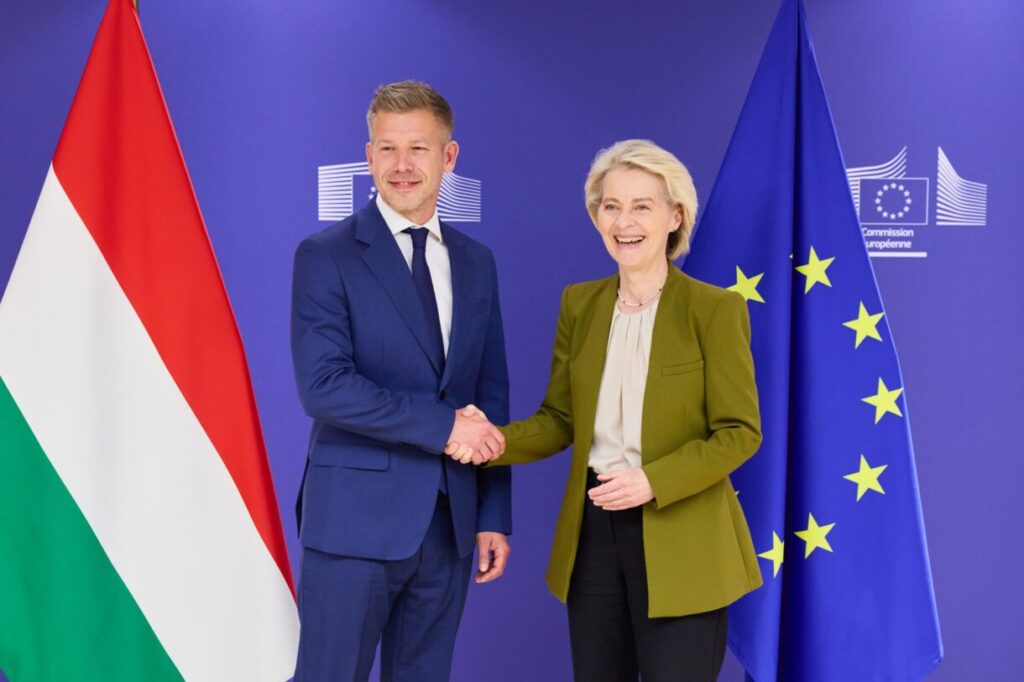
The EU Rolls Out the Red Carpet for Péter Magyar
For many years, Hungary was considered a political disruptor within the European Union. Under Prime Minister Viktor Orbán, the country shifted from being a model example of post-communist transformation to a frequent source of conflict in Brussels. Disputes over the rule of law, media freedom, migration, and support for Ukraine have long strained relations between Budapest and European institutions. With the change of power in spring 2026, a new phase now seems to have begun.
Since Péter Magyar’s electoral victory, Hungary has experienced remarkable diplomatic elevation. Senior European officials compete in invitations, friendly gestures, and public statements of support. This enthusiasm focuses less on the person of the new head of government than on the end of an era that many European decision-makers considered paralyzing.
The End of a Particular Political Role
Viktor Orbán marked Hungarian politics for sixteen years like no other government leader in Europe. His constant insistence on national sovereignty earned him considerable support in the country but led to growing tensions with European partners.
Particularly since the Russian aggression against Ukraine, Budapest is often perceived in many European capitals as an unpredictable actor. On several occasions, the Hungarian government has used its veto right to delay or block European decisions. The release of financial aid to Kyiv, sanctions against Russia, or institutional reforms of the European Union have become recurring negotiation points in the conflicts between Budapest and Brussels.
The electoral victory of Péter Magyar was thus seen in much of Europe as a strategic relief. Many heads of government immediately after the elections spoke of Hungary’s return to the heart of Europe. The relief was tangible.
A diplomatic offensive full of charm
The new Prime Minister consciously encouraged these expectations. Barely in office, he began an intense diplomacy of European visits. Stops in Warsaw, Vienna, Brussels, Berlin, and Paris aimed to signal that Hungary wishes to become a constructive partner again.
His visit to Germany was particularly symbolic. There, Magyar was welcomed not only as the new head of government but as the representative of a political renewal. The message coming from Berlin was clear: Hungary must be more integrated into European decision-making.
The tone differs markedly from that of his predecessor. While Orbán often conducted his conflicts publicly and made confrontation with Brussels a central element of his political strategy, Magyar relies on cooperation and negotiation. He speaks of reliability, partnership, and shared responsibility within Europe.
Ukraine as a Touchstone
The change of course is most evident in Ukrainian policy. Budapest’s position towards Kiev and Moscow has been one of the most controversial topics in European politics in recent years. Orbán maintained a relatively pragmatic relationship with the Kremlin and remained skeptical towards many European initiatives.
Péter Magyar does not radically break with all the positions of his country. His government continues to emphasize the rights of the Hungarian minority in Western Ukraine and requests corresponding guarantees from Kiev.
However, the difference is notable. For the first time in years, Budapest expresses its willingness to resolve existing conflicts through diplomatic means. At the same time, the new government has facilitated the release of significant European aid to Ukraine, thereby removing one of the main obstacles in European decision-making processes.
For Brussels, this development is of strategic importance. In the face of the persistent war and uncertainties about the future role of the United States, European unity has become a central geopolitical resource. Any reduction in internal tensions is therefore being observed with particular attention.
The rise of a political “outsider”
Péter Magyar’s career is among the most remarkable political developments in Europe in recent years. For a long time, he was himself part of Viktor Orbán’s political circle. A lawyer and civil servant, he operated within the system he later publicly criticized.
His break with the government gradually turned into a political revolt. Through a fierce critique of corruption, concentration of power, and nepotism, he struck a chord with segments of Hungarian society. In a short time, he succeeded in forming a broad opposition movement.
The success of his Tisza alliance in the legislative elections surprised even experienced observers. Even more remarkable is the magnitude of his mandate. The new government holds a two-thirds majority, thus offering extensive possibilities for reforming state institutions.
Between reform and concentration of power
This comfortable majority now raises the first doubts. While European governments welcome the political change in Budapest, they are closely watching the first steps of the new leadership.
Magyar has already announced his intention to reform the central institutions created during the Orbán years. This includes personnel changes in the public administration as well as possible constitutional amendments.
His supporters argue that a profound institutional transformation is necessary to correct the political structures of past years. Critics, on the other hand, warn of the risk that the new government might adopt the instruments of power it had itself denounced.
This debate recalls a fundamental dilemma of democratic transformations: how far can a new government go to reform an existing system without itself overstepping democratic boundaries?
Europe’s High Expectations
The current euphoria in European capitals is mainly explained by experiences of past years. After a long phase of confrontation, the prospect of a cooperative partner in Budapest is attractive.
However, political honeymoon periods are rarely lasting. Soon, concrete decisions will have to demonstrate the real extent of the change in direction. Issues of migration, European integration, economic and energy policy, as well as national sovereignty remain central themes of Hungarian domestic politics under Péter Magyar.
The new Prime Minister is neither a classical liberal nor a convinced federalist. He still defends conservative positions and regularly emphasizes the importance of national interests. The differences with many Western European governments have therefore not disappeared.
It will be crucial to see whether Budapest will choose confrontation or negotiation in the future. The European Union has learned in recent years that political conflicts do not necessarily result from divergent interests, but often from the way they are conducted.
Péter Magyar currently enjoys an exceptional credit of trust. Europe sees in him a chance for renewal in relations with Hungary. The question of whether this will lead to a lasting partnership will arise when the first major conflicts of interest appear. It will then be an opportunity to decide whether Hungary really returns to the European center or whether it has simply taken a new diplomatically more skillful path of national assertion.