
For decades the Eurovision Song Contest has presented itself as a celebration of music, cultural diversity and European understanding. But behind catchy refrains, spectacular stage shows and the points awarded by national juries there has always been a highly political event. The 2026 edition in Vienna makes this clearer than ever.
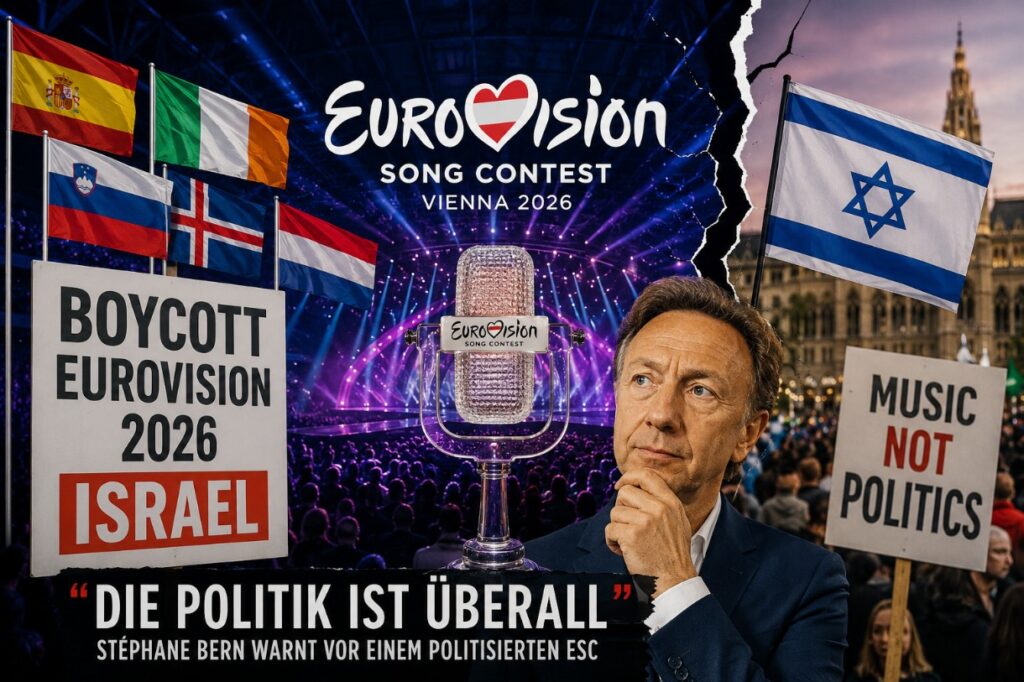
Several European countries have announced that they will boycott the contest or suspend broadcasts because of Israel’s participation. Spain, Ireland, Slovenia, the Netherlands and Iceland reacted to the decision of the European Broadcasting Union (EBU) to keep Israel in the competition despite international controversies surrounding the Gaza war. This places the ESC once again at the center of a debate that goes far beyond music.
In France, Stéphane Bern has also voiced concern about the development of the contest. The presenter and long-time Eurovision commentator for France Télévisions said in several interviews that he regretted the increasing politicization of the event. For Bern, the ESC risks losing its original cultural function and becoming a permanent field of diplomatic conflict.
The presenter refers to the historical idea behind the contest. The Eurovision Song Contest was created in the years after the Second World War with the aim of bringing the European nations culturally closer together again. Music was meant to unite where politics had divided. Artists, Bern says, should not become proxies for geopolitical conflicts.
Yet the reality of the contest has always been more complicated. For decades political tensions have regularly been reflected in the ESC. Noticeable voting patterns between neighboring states, historical rivalries or hidden political messages in song lyrics have long been an integral part of the event.
Israel’s participation in particular repeatedly causes controversy. The country has taken part in the Eurovision Song Contest since the 1970s and has several times been the target of political protests. With the war following the Hamas attacks of 7 October 2023, however, the dimension of these tensions has significantly intensified.
The countries calling for a boycott argue that Israel’s participation sends the wrong signal given the humanitarian situation in the Gaza Strip. Critics also accuse the EBU of applying a double standard. While Russia was quickly excluded after the attack on Ukraine in 2022, the organization is now standing by Israel.
The European Broadcasting Union, by contrast, points to its official neutrality. Participants are not governments but public broadcasters. Israel is represented by the broadcaster Kan, whose journalists sometimes express criticism of the Israeli government themselves.
Nevertheless, it is becoming increasingly difficult for the organizers to credibly maintain political neutrality. Even before the Vienna edition, demonstrations by both pro-Palestinian and pro-Israeli groups have been announced. Boycott calls against the event are also circulating in several European countries.
For Stéphane Bern this development is an expression of a deeper European crisis. The ESC was for a long time one of the few symbolic spaces in which politically estranged countries nonetheless stood together on a single stage. It is precisely for that reason that he views the current tensions with concern.
Indeed, the Eurovision Song Contest has never been merely a music event. For decades the contest has acted as a mirror of European sensibilities — from geopolitical conflicts and questions of identity to societal debates. Each edition tells not only about musical trends but also about the political state of Europe.
The event in Vienna could thus become one of the most symbolically charged editions in recent ESC history. Because while love, freedom and unity will continue to be sung about on stage, behind the scenes a Europe is emerging that is increasingly politically polarized.
Author: Andreas M. Brucker