
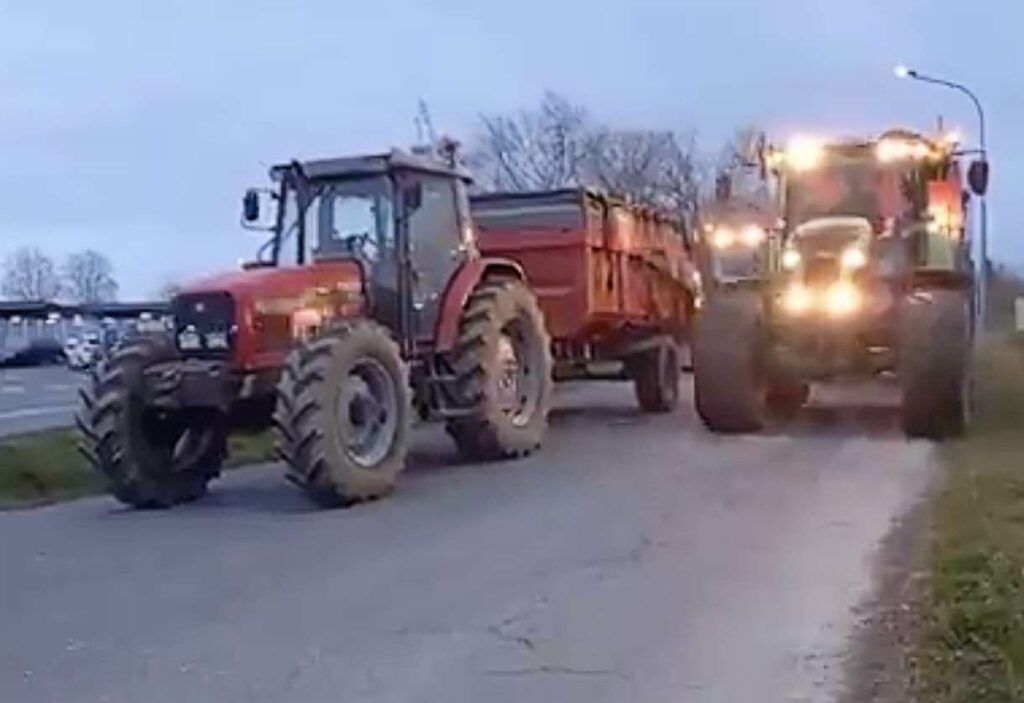
Under gray skies and accompanied by strong winds, several dozen farmers positioned their tractors in front of the refinery in Feyzin south of Lyon. Banners on trailers, symbolic barricades made of straw bales, and repeatedly blaring horns characterized the scene of the protest action in the Rhône department. The demonstration was mainly directed against the persistently high fuel prices – but behind the mobilization lies a much deeper unease within French agriculture.
For many of the farmers present, the price of the so-called “gazole non routier” – the tax-privileged agricultural diesel – has become an almost unbearable burden. In conversations among the demonstrators, the feeling of being increasingly abandoned by politics prevailed. A livestock breeder from Beaujolais summed up the mood: people had expected the state to support agriculture more strongly. Instead, many farmers see themselves squeezed between inflation, environmental regulations, price pressures from trade, and exploding operating costs.
The Refinery as a Political Symbol
The choice of protest location was deliberate. The Feyzin refinery not only represents France’s energy policy dependence but also the high profits of the major oil companies in recent years. This, in particular, causes bitterness among many farmers. While energy companies reported record results, many agricultural businesses struggle with declining margins and rising financing costs.
Especially affected are highly mechanized production sectors such as crop farming or intensive animal husbandry. Modern agriculture is heavily dependent on diesel, electricity, and energy-intensive infrastructure. Tractors, irrigation systems, heated greenhouses, or supply chains cause significant operating costs that can only be reduced to a limited extent.
Many farmers therefore argue that political expectations for a rapid ecological transformation encounter economic limits in practice. Alternative propulsion technologies have so far been either technically immature or financially unviable. Especially smaller and medium-sized farms often do not have the investment capacity to switch to new systems in the short term.
A deeper structural problem
The protests in the Rhône region exemplify a broader crisis in French agriculture. For months, dissatisfaction has been growing over stagnant incomes, international competition, and increasing regulatory density. Many farmers complain that they are expected to produce in a more environmentally friendly, cheaper, and more competitive way at the same time – a balancing act that many farms can hardly manage any longer.
Added to this is the strong volatility on international agricultural markets. Fluctuating energy prices, rising fertilizer costs, and geopolitical uncertainties have an immediate impact on production conditions. The war in Ukraine and global tensions on the commodity markets have further exposed the fragility of the European agricultural system.
In France, agriculture also has a special political and cultural significance. Unlike in many other European countries, the farming world remains a central part of national identity. Accordingly, governments respond sensitively to protest movements from rural areas. Earlier mobilizations have already shown that farmers are capable of blocking transport routes and quickly increasing political pressure.
Conflict between Ecology and Competitiveness
The current debate also highlights a fundamental conflict of objectives in European agricultural policy. On the one hand, climate goals, biodiversity protection, and social pressure call for more environmentally friendly agriculture. On the other hand, French farmers compete with producers from countries where lower environmental and social standards apply.
Free trade agreements and imports from third countries are therefore causing significant tensions. Many farmers perceive European regulation as asymmetrical: while domestic producers have to meet stricter requirements, this often only applies to a limited extent for imported agricultural products.
The energy issue further exacerbates this conflict. Rising diesel prices impact not only immediate production costs but also the transport, storage, and processing of agricultural goods. In an industry with already low profit margins, even moderate price increases can have existential effects.
Political pressure on the government is increasing
The situation is increasingly becoming a political challenge for the French government. Social sentiment in rural areas is considered tense in many places, and distrust towards state institutions is growing. Before important political and European elections, Paris will likely try to avoid further escalation.
Until now, the protest actions have remained comparatively controlled and symbolic. But behind the outward calm lies a deep frustration. Many farmers see the dispute over fuel prices as merely another symptom of a broader crisis that questions the future of the French agricultural model.
It is no longer just about individual subsidies or tax benefits. At its core is the question of how a modern European agriculture can remain economically viable while at the same time meeting the demands of climate protection, supply security, and global competitiveness.
The demonstration in front of the refinery in Feyzin therefore shows much more than short-term discontent over high diesel prices. It reveals the growing nervousness of a sector that feels economically pressured, politically misunderstood, and increasingly alienated from society. French agriculture is at a turning point – and the government knows that tensions in the fields can quickly turn into a national political crisis.
Author: P. Tiko