
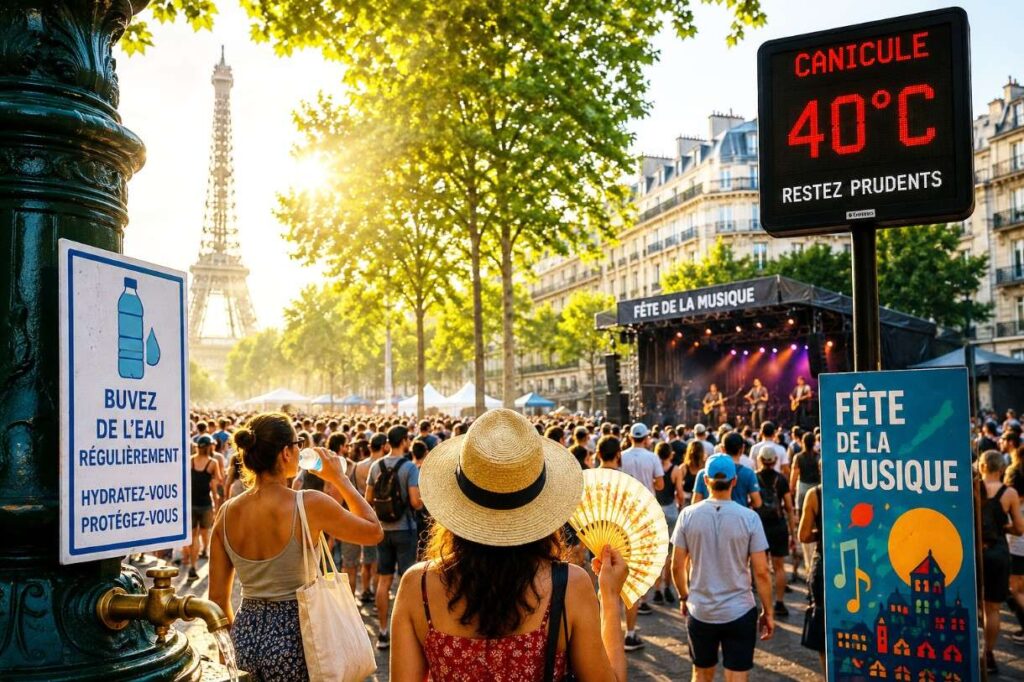
The Fête de la Musique has been a fixed part of the French start of summer for decades. Streets, squares, and parks usually transform into large open-air stages where amateur musicians and professionals create a unique atmosphere together. This year, however, the popular folk festival is marked by special circumstances: An exceptionally early and intense heatwave is affecting large parts of France, posing significant challenges for organizers and visitors alike.
Temperatures between 38 and 41 degrees Celsius are expected on June 21 in numerous regions. Days before, weather forecasts already sparked discussions in town halls and prefectures. Many municipalities had to decide whether concerts and events could take place under these conditions at all.
A nationwide cancellation is, however, not being considered. The French authorities insist on holding the music festival. Even in Paris, where traditionally hundreds of thousands of people celebrate late into the night, the events are planned to proceed as scheduled.
Nonetheless, many cities are responding with precautionary measures. Some communities have canceled or postponed individual open-air concerts. Others are moving events to indoor venues or adjusting times to avoid the peak heat. The situation remains dynamic and depends on current weather warnings.
The country is especially watching the capital closely. Paris expects more than two million visitors. The city administration is therefore preparing for a state of emergency—albeit a musical one. Additional water points, more sanitary facilities, reinforced emergency services, and extensive information campaigns aim to ensure the celebrations proceed safely. The city’s numerous public fountains are likely to be as in-demand this day as the concert stages.
The current heatwave ranks among the most remarkable weather events France has ever experienced so early in the year. In many regions, values significantly above 35 degrees Celsius are expected. Locally, the 40-degree mark could even be exceeded—temperatures that were once considered extraordinary but are now occurring increasingly often.
In this lies a development that goes far beyond the music festival. Major cultural events must increasingly adapt to extreme weather conditions. What was once a rare exception is becoming more and more the new reality. Organizers face the task of combining safety with festive spirit.
For visitors, therefore, one simple rule applies: celebrate yes, but with common sense. Plenty of water, light clothing, shady places to stay, and regular breaks are as much part of the equipment this time as good cheer and enthusiasm for music. Those who avoid the hottest hours of the day and heed their body’s warning signals can enjoy the festival despite the extreme conditions.
This is likely how the Fête de la Musique 2026 will be remembered—less for mild summer evenings and more for the search for shade and cool drinks. The music continues to play, but climate change is increasingly setting the rhythm.
By C. Hatty