
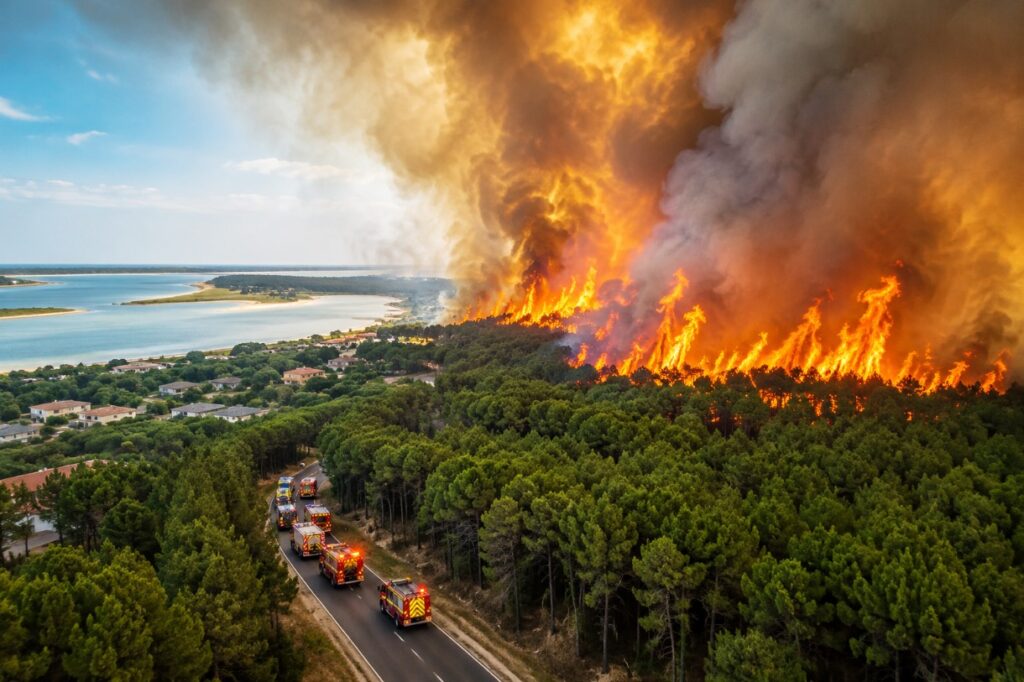
Southwestern France smells of smoke once again.
Four years after the devastating fires of summer 2022, the Gironde is once again battling a blaze that has eaten its way into the forest north of the Bassin d’Arcachon. What initially appeared to be a regional operation quickly developed into a large-scale emergency. According to the latest update, around 3,100 hectares of vegetation had already gone up in flames or lay charred behind the fire front. Around 20,000 residents, holidaymakers and campers had to leave their homes, holiday rentals and pitches as a precaution.
The Bassin d’Arcachon, normally a place of oysters, the scent of pines, bicycle trips and sunscreen on children’s arms, is once again experiencing the state of emergency that many here are unlikely ever to forget. Sirens, road closures, firefighting aircraft, smoke above the treetops – the script sounds painfully familiar.
The fire is not yet under control. The flames came within a few hundred metres of residential areas. No injuries or deaths were initially reported, but the situation remains tense. High temperatures and shifting winds are making life difficult for emergency crews. Anyone who has seen how a gust of wind accelerates a fire in a pine forest understands why firefighters speak not of hours but of minutes in such moments.
The area north of the Bassin d’Arcachon, one of the most popular holiday regions on France’s Atlantic coast, has been particularly affected. There, where motorhomes stand bumper to bumper in summer and families set off for the beach in the morning with swimming bags, more than 10,000 people from eight campsites and surrounding towns initially had to be brought to safety from Wednesday evening onward. Nine municipalities set up reception centres and emergency shelters.
The next wave of evacuations followed on Thursday. In Claouey alone, a village on the access road to the Cap Ferret peninsula, around 8,800 people had to leave as a precaution. Cap Ferret is a place of longing for many French people: dunes, pines, Atlantic surf on one side, the calm basin on the other. Now, it was not beach chairs and oyster bars setting the pace, but announcements, fire engines and the question: Where do we go now?
According to the authorities, the evacuations proceeded in an orderly manner overall. And yet, in such situations, “orderly” does not mean “easy.” Anyone who has to leave a campsite does not pack their bags calmly. You grab documents, medication, a few items of clothing, perhaps a child’s favourite st■ animal. The rest is left behind. Quite bitter, honestly.
For many families, the situation brings back memories of the disaster summer of 2022. At that time, fires near La Teste-de-Buch and Landiras destroyed more than 30,000 hectares of forest. Tens of thousands of people had to flee. Campsites near the Dune du Pilat were destroyed, clouds of smoke hung over the coast, and even far away the air smelled of burnt resin. The images from that time have been seared into the region’s memory.
The cause of the current fire has not yet been conclusively established. Initial indications point to a possibly unintentional trigger. In wildfire areas, sometimes a spark is enough: a carelessly discarded cigarette, a technical defect, a machine throwing sparks at the wrong time in the wrong place. Investigators must now determine whether human error, work in the forest or another technical cause started the fire.
The forest itself provides the flames with ample fuel.
The Landes de Gascogne are among the largest contiguous forest areas in Western Europe. Their landscape is defined by endless rows of maritime pines, straight-growing, economically valuable and visually distinctive. The forest is a source of raw materials for timber, paper and resin products, as well as a protected area, recreational landscape and part of the identity of southwestern France. Yet this very pine landscape poses an enormous risk in hot summers.
Maritime pines contain a great deal of resin. Dry needles cover the ground like tinder. Dense undergrowth, dead branches and sandy soils that retain water poorly intensify the danger. When drought and heat come together, the forest turns into a combustible mosaic. Add wind, and the fire leaps. It no longer creeps; it runs.
That sounds dramatic, but it can be explained in sober physical terms. Flames heat their surroundings, dry out still-moist vegetation further and generate their own air movements. Sparks can be carried several hundred metres. This creates new fire fronts ahead of the main fire line. For firefighters, that means the enemy is not only in front of them, but suddenly behind them too.
Emergency crews are therefore working under extremely difficult conditions. On the ground, the task involves firebreaks, water lines and protecting homes and campsites. From the air, firefighting aircraft and helicopters provide support whenever visibility, wind and safety permit. Every metre gained counts. Every shift in the wind can rewrite the situation.
The fact that the fire broke out during peak season worsens the situation. The region is full of people in July, many of them unfamiliar with the area. Access roads are limited, and the Cap Ferret peninsula cannot be evacuated at any speed one chooses. Anyone travelling there in summer already knows the long traffic queues on normal days. During an evacuation, stress is added to the equation. It takes nerves of steel.
But behind the immediate danger lies a larger question. How can an economically used, ecologically valuable and at the same time highly flammable forest be protected in a climate that is becoming hotter and drier?
Wildfires have always been part of the risk landscape in southwestern France. What is new is the increasing frequency of extreme conditions. Longer dry spells, earlier heatwaves and later ends to summer are extending the fire season. What was once considered exceptional is moving closer to everyday reality. Fire services are expanding their capabilities, municipalities are drawing up evacuation plans, and campsites are reviewing their safety procedures. But prevention begins long before the first smoke appears.
Firebreaks must be maintained, undergrowth reduced, access routes kept clear and warning levels taken seriously. During particularly dangerous periods, strict rules are needed for work in the forest, traffic on forestry roads and recreational use. It sounds unromantic, almost bureaucratic. But fire protection is rarely spectacular as long as it works. You usually notice it only when it is missing.
The fire at the Bassin d’Arcachon is therefore more than a local disaster. It is a warning signal for all of southwestern France. The region lives from its forest, its coast, its tourism and its landscape. This very combination makes it beautiful – and vulnerable.
For people on the ground, only one thing matters in these hours: safety. Houses can be repaired, campsites rebuilt, forests replanted over decades. Human lives cannot.
When the flames are extinguished, the blackened ground remains. And with it, a task that will take longer than any firefighting operation: shaping the forest so that it does not become the fuse for an entire region with every future heatwave.
By C. Hatty