
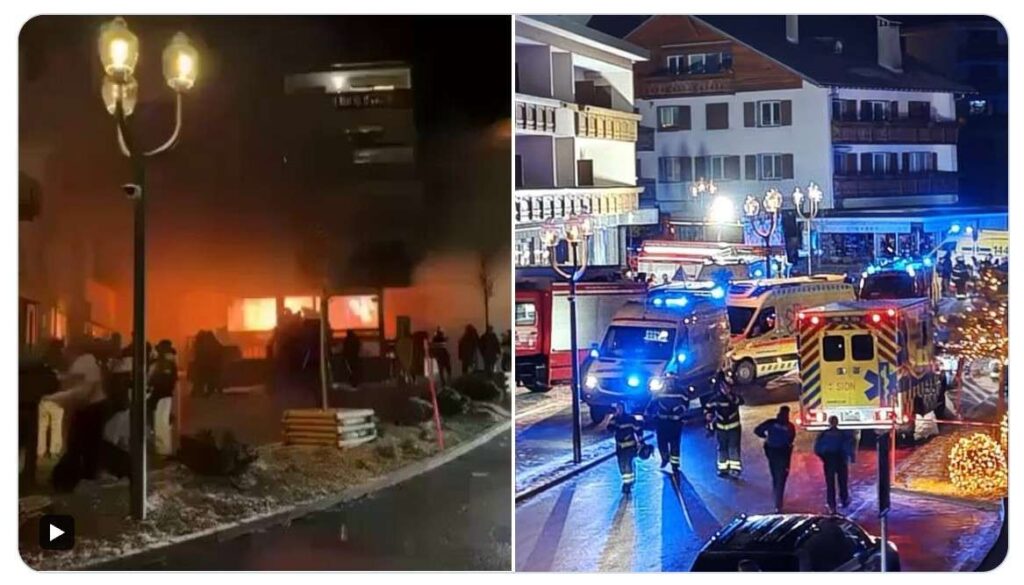
It begins, as so many tragedies begin: with music, laughter, glasses clinking. And ends in smoke, darkness, and a silence that weighs heavier than any previous noise. On New Year’s Eve 2026, the popular bar and nightclub “Le Constellation” in the Crans-Montana winter sports resort was transformed within minutes into a place of horror. A fire of exceptional violence claimed, according to initial figures, around forty lives; more than a hundred people were injured, many of them seriously. It is one of the worst civilian disasters Switzerland has experienced in recent years.
At around 1:30 a.m., at a time when the transition to the new year had already been celebrated and the venue was particularly crowded, the fire is believed to have started in the basement. Initial investigations indicate that highly flammable materials may have come into contact with an open flame. The emerging picture is that of a sparkler, decoratively placed in a champagne bottle: one of those seemingly harmless gestures that can have fatal consequences within seconds. What followed was an explosive spread of smoke and fire, turning the crowded room into a trap.
Eyewitnesses reported scenes of panic. People desperately tried to break windows. Others lost all sense of direction in the thick smoke. Emergency exits, evidently too few in number or obstructed, became bottlenecks where seconds decided between life and death. Many of the injured suffered not only severe burns, but also smoke inhalation, which further complicated medical treatment and delayed identifications. That night, the cruelty of a fire in an enclosed space revealed itself — silent, suffocating, relentless.
By the early hours of the morning, it was clear that the capacities of the surrounding hospitals in the canton of Valais would be pushed to their limits. Intensive care units were filling up, and specialized beds for severely burned patients were becoming scarce. Switzerland reacted quickly and pragmatically: it asked its neighbors for help. France immediately promised its assistance. An act of solidarity that, in those hours, meant more than mere diplomatic courtesy.
In the days following the fire, the first injured people were transferred to French clinics, mainly in Lyon and Paris, where highly specialized burn centers are available. Further transfers were prepared, additional beds reserved, and medical teams placed on standby. It is a logistical achievement that requires precision and trust — and shows how closely European healthcare systems can come together in times of crisis. For those affected and their families, only one thing matters in these moments: the best possible care, regardless of which side of the border they are on.
The human scale of the disaster nevertheless remains difficult to express in figures. Behind every injured person is a story, behind every death a life abruptly cut short. Uncertainty about the final scale of the tragedy weighs as heavily on relatives as it does on rescue workers. A crisis helpline has been set up, and emergency chaplains have been mobilized to support people facing a situation for which one cannot prepare. People wait for news, hope, worry — and suddenly feel how long the hours can become.
The tragedy has not gone unnoticed politically either. In Paris, President Emmanuel Macron expressed his deep compassion and assured Switzerland of France’s full support. In moments like these, such words are not mere formalities, but a signal: you are not alone. In Bern and French-speaking Switzerland, mourning and reflection prevail. In Crans-Montana itself, people are laying flowers, lighting candles, and standing silently in front of a building that until recently was a place of carefree nights.
The investigation into the cause of the fire is progressing rapidly. For now, the authorities are ruling out a criminal act, but questions are being raised about safety standards, fire protection, and evacuation plans. How safe are places where many people celebrate in a confined space? Are the regulations sufficient, or are stricter checks needed? Such debates will follow, and must follow, even if they do not ease the pain.
And then there are those quiet moments, beyond press conferences and columns of figures. A doctor who has been on duty for 36 hours and keeps going nonetheless. A caregiver holding an injured person’s hand because words fail. A French hospital spontaneously freeing up beds because someone somewhere is fighting for their life. That is the other face of this night: human solidarity, which does not proclaim itself, but is simply there.
Perhaps more will remain of this New Year in Crans-Montana than the memory of fire and loss. Perhaps also the realization that, in the event of a catastrophe, borders lose their importance and responsibility is shared. A meager comfort, certainly. But amid suffering, a thought one can hold on to.
Andreas M. Brucker