
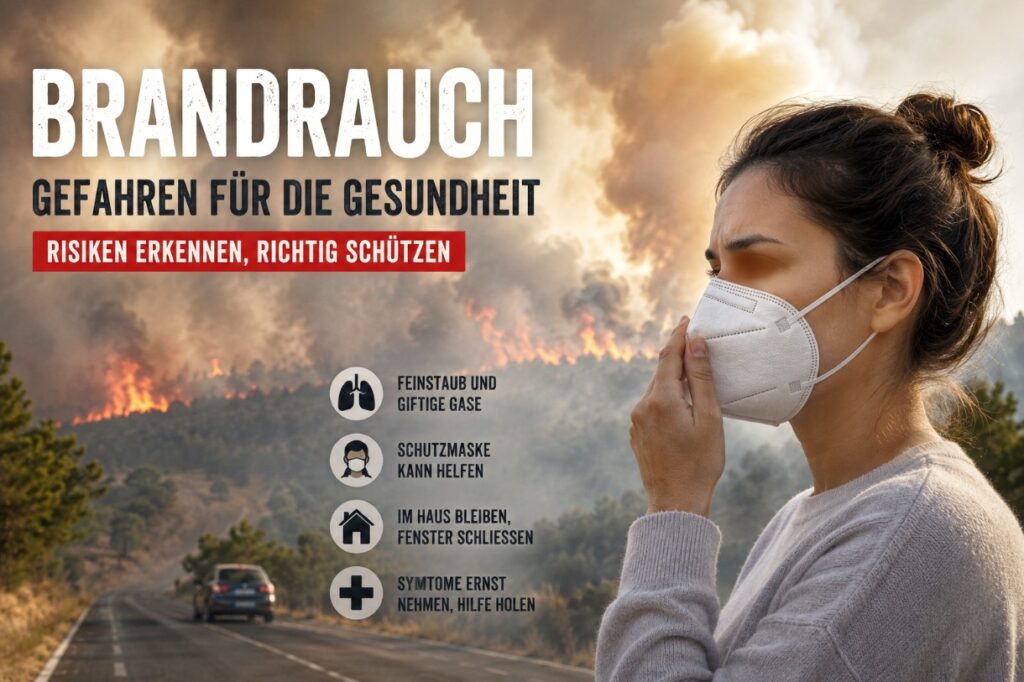
When forests, fields or buildings burn, attention is usually focused on the flames. But the real danger often drifts invisibly through the air. Smoke from fires can worsen air quality over many kilometres and reach regions that are far from the actual source of the fire. The tricky part is that a barely noticeable smell by no means indicates clean air. Even almost odourless air may already contain high concentrations of pollutants harmful to health.
Fire smoke consists of a complex mixture of particulate matter and various gases. The tiny particles known as PM10 and, above all, PM2.5 are particularly problematic. They are joined by carbon monoxide, nitrogen oxides, volatile organic compounds and polycyclic aromatic hydrocarbons. Which substances ultimately end up in the air depends on the materials being burned, the intensity of the fire and weather conditions. If houses, vehicles, plastics or industrial facilities are also burning, additional toxic substances are released into the atmosphere.
It is primarily the finest particles that concern medical professionals. They penetrate deep into the lungs and can even partly enter the bloodstream. Even relatively brief exposure is enough to trigger symptoms. Typical signs range from irritated eyes and a burning nose to coughing, hoarseness or an unpleasant feeling of pressure in the chest. Headaches, nausea and dizziness are also common. People with asthma or chronic lung diseases often experience a significant worsening of their symptoms. At the same time, sensitive individuals face an increased risk of cardiovascular problems.
Carbon monoxide is particularly dangerous in the immediate vicinity of a fire. The colourless, odourless gas displaces oxygen in the blood and initially causes headaches, weakness or confusion. In severe cases, it can lead to loss of consciousness or even life-threatening poisoning.
In general, everyone reacts differently to polluted air. However, some groups require particular caution. These include infants and young children, whose lungs are still developing. Older people also face a higher risk because heart and lung diseases are more common with age. Pregnant women, people with asthma, people with chronic respiratory or heart conditions, and those with diabetes or weakened immune systems should also pay close attention to warnings. Those who spend long periods outdoors for work or sport naturally inhale larger amounts of polluted air.
In an emergency, one rule applies without exception: the instructions of authorities and emergency services take top priority. If an evacuation is ordered, no one should attempt to protect their own house or property on their own. Smoke clouds can change direction within minutes and cut off escape routes surprisingly quickly.
If smoke reaches a residential area without an evacuation being necessary, it is advisable to spend as much time as possible indoors. Doors and windows should remain closed to prevent as much polluted outdoor air as possible from entering. If technically possible, air-conditioning systems should be set to recirculation mode. The same applies in the car: close the windows and switch on air recirculation.
Physical exertion significantly increases the amount of pollutants absorbed. It is therefore worth temporarily postponing sports, gardening or other strenuous activities. At the same time, additional air pollution inside the home should be avoided. Smoking, candles, fireplaces or incense sticks further worsen indoor air quality. Even extensive frying or using a vacuum cleaner stirs up fine particles.
Once the smoke cloud has cleared and air quality has improved, briefly opening windows wide is usually sufficient. During a heatwave, however, this recommendation requires careful judgment so that living spaces do not overheat excessively.
Anyone who owns an air purifier with a genuine HEPA filter can also achieve a noticeable reduction in particulate matter indoors. However, such a device offers only limited protection against toxic gases.
The question of how effective respiratory masks are comes up repeatedly. A properly fitted FFP2 mask can significantly reduce the intake of fine particles during unavoidable time spent outdoors. A tight fit over the nose, mouth and chin remains crucial. However, it provides no protection against carbon monoxide and many other toxic gases. Surgical masks and cloth masks do not filter particulate matter sufficiently. No commercially available mask can therefore replace an ordered evacuation or provide reliable protection in the immediate vicinity of a fire.
People with asthma or other chronic conditions should keep their medication and emergency inhalers within easy reach at all times. Changes to treatment should only be made under medical supervision.
If severe shortness of breath, chest pain, confusion, fainting, bluish lips or unusual drowsiness occur, every minute counts. A rapid worsening of existing symptoms also requires immediate medical help. Even after intense smoke exposure with initially seemingly harmless symptoms, a medical examination is advisable, as some effects may only become apparent after a delay.
By C. Hatty