
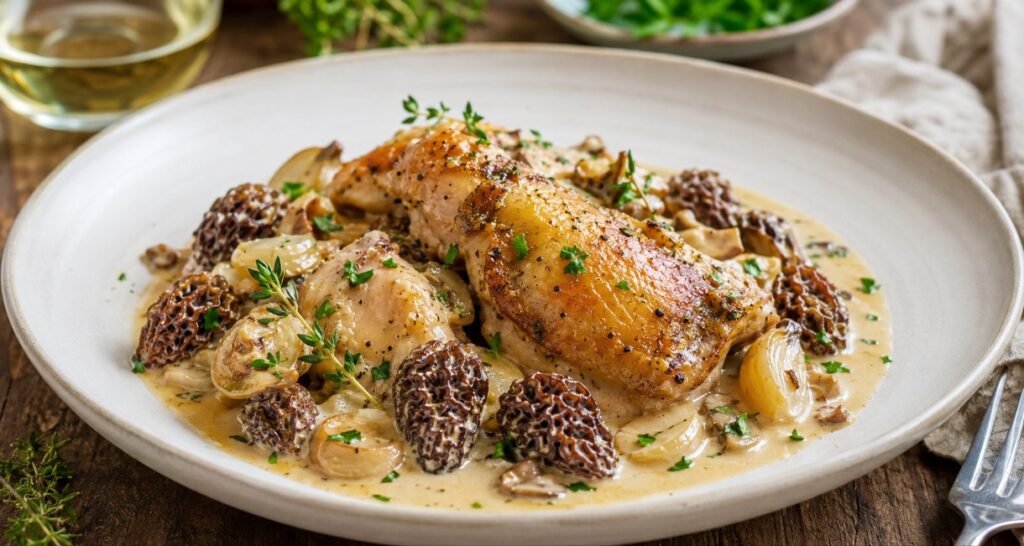
French spring cuisine between tradition and modernity
French cuisine lives from its ability to create great elegance from simple ingredients. Few dishes embody this philosophy as impressively as Coq au Vin. While the classic version is braised with robust red wine from Burgundy, the modern spring interpretation is noticeably lighter, more delicate and aromatic: Coq au Vin Blanc with morels.
This dish combines gently braised poultry with the subtle acidity of a good white wine, fresh herbs, shallots and the earthy aroma of morels. The sauce appears lighter and silkier than in the traditional Coq au Vin Rouge, without losing depth. Especially in spring and for festive occasions like Pentecost this variant unfolds its special charm.
Morels have been regarded as a delicacy in French cuisine for centuries. Their nutty-spicy flavor harmonizes excellently with poultry and creamy white-wine sauces. Together they create a dish that perfectly connects rustic origins with refined bistro cooking.
The idea behind the dish
The original Coq au Vin emerged from rural French cooking. Tough roosters were slowly braised in wine until the meat became tender and flavorful. Modern versions usually use chicken or poularde, which significantly shortens cooking time and refines the texture.
The white variant is often inspired by the kitchens of Burgundy and the Jura, where white wine traditionally plays a major role. Instead of heavy roasted flavors, herbs, butter, poultry stock and mushrooms are central. Morels give the dish a seasonal sophistication and make it particularly suitable for spring and holiday menus.
Recipe: Coq au Vin Blanc with Morels
Ingredients for 4 people
For the poultry
- 1 poularde or large corn-fed chicken, cut into 8 pieces
- salt
- black pepper
- 2 tbsp butter
- 1 tbsp olive oil
For the sauce
- 250 g fresh morels or 40 g dried morels
- 4 shallots
- 2 garlic cloves
- 200 g small button mushrooms
- 150 ml cream
- 500 ml dry white wine
- 300 ml poultry stock
- 2 sprigs thyme
- 1 bay leaf
- 1 small bunch parsley
- 1 tsp Dijon mustard
- 1 tbsp cold butter
Optional as garnish
- small glazed carrots
- green asparagus
- new potatoes or mashed potatoes
Preparing the morels
Fresh morels must be cleaned very thoroughly, as sand often hides in the honeycombs. To do this, halve the mushrooms lengthwise and rinse gently under cold water.
For dried morels:
- Soak for about 20 minutes in lukewarm water.
- Then lift them out carefully.
- Filter the soaking liquid through a fine sieve or cloth and later use part of it for the sauce.
Morels should never be eaten raw, as they only become digestible through cooking.
Preparation
1. Brown the poultry
Pat the chicken pieces dry and season generously with salt and pepper.
Heat butter and olive oil in a large braising pot. Brown the poultry pieces in batches until golden. This creates the basis for the later sauce.
Remove the meat afterwards.
2. Sauté shallots and mushrooms
Dice the shallots finely, lightly crush the garlic.
First roast the button mushrooms in the fond, then add the morels and shallots. Gently sauté everything for a few minutes until an intense aroma develops.
Add garlic, thyme and bay leaf.
3. Deglaze with white wine
Pour in the white wine and carefully deglaze the fond. Let the liquid reduce by about one third.
Then add the poultry stock.
Return the meat to the pot.
4. Braise slowly
With the lid closed, let simmer gently for about 35 to 45 minutes. The sauce should only barely simmer, not boil vigorously.
The meat becomes especially juicy and absorbs the flavors of the white wine and herbs.
5. Finish the sauce
Carefully remove the poultry pieces and keep warm.
Remove bay leaf and thyme.
Stir cream and Dijon mustard into the sauce and reduce for a few minutes until the consistency becomes velvety.
Finally, whisk in cold butter. This gives the sauce its fine sheen and an elegant binding.
Season with salt, pepper and chopped parsley.
Return the meat to the sauce.
The right choice of wine
For Coq au Vin Blanc, dry, mineral white wines with a good acidity structure are suitable. Particularly fitting are:
- Chardonnay from Burgundy
- Pinot Blanc
- Jura wines
- Sauvignon Blanc with moderate fruit
- dry Chenin Blanc
The wine should be of sufficient quality to be served by the glass. A wine that is too sweet or strongly aromatic would disturb the delicate balance of the dish.
Side dish recommendations
Mashed potatoes
A classic, creamy mash takes up the sauce excellently and provides rustic elegance.
Green asparagus
Briefly blanched or sautéed asparagus underscores the spring character.
Glazed carrots
Their light sweetness harmonizes wonderfully with the earthy morels.
Fresh baguette
Indispensable for fully enjoying the aromatic sauce.
Modern interpretation
In contemporary French cuisine, Coq au Vin Blanc is often served lighter and more precise:
- deboned chicken breast instead of whole poultry pieces,
- intensively reduced sauce,
- small vegetable elements instead of heavy side dishes,
- fresh herb oils or pickled shallots as accents.
This creates a dish between bistro tradition and fine dining.
Tips for perfect results
Do not overcook the sauce
Gentle heat preserves the delicate aromas of white wine and morels.
Season morels sparingly
Their aroma is subtle and should not be overwhelmed by too much garlic or spices.
Give it time
Like many braised dishes, this dish benefits from resting. After a few minutes of resting the sauce often becomes even more harmonious.
Add butter only at the end
This keeps the sauce glossy and creamy.
Why this dish is perfect for Pentecost
Pentecost marks the culinary transition from spring to early summer. Heavy winter dishes give way to lighter, fresher compositions. Coq au Vin Blanc with morels fits ideally into this season:
- aromatic but not heavy,
- festive but not overloaded,
- traditional but open to modern interpretation.
It is suitable both for a relaxed family meal and for an elegant menu with guests.
Serving recommendation
The dish looks particularly stylish in deep, warmed plates:
- first a little sauce,
- then the poultry,
- beside it spring vegetables,
- finally fresh parsley or chervil.
With a glass of chilled white wine and crusty bread — not much more is needed for French spring cuisine.