
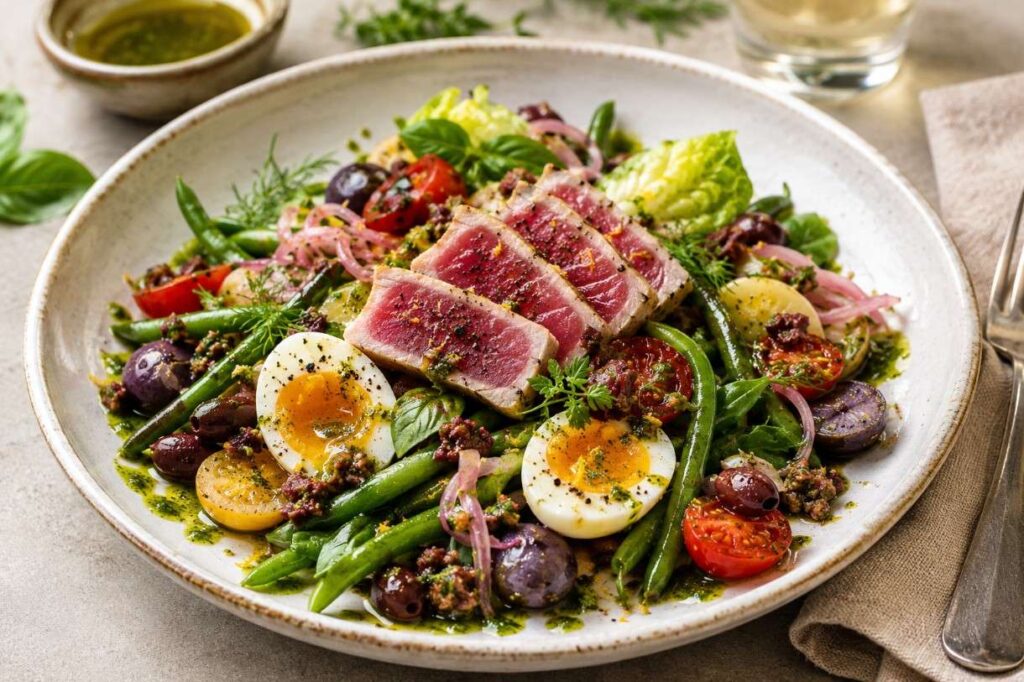
Salade Niçoise is one of the most famous dishes of French Mediterranean cuisine. Originally from Nice – a city where sun, sea, and market vegetables have shaped the cuisine for centuries. For a long time, the salad was regarded as a symbol of simple French bistro cuisine: tomatoes, olives, anchovies, tuna, green beans, and hard-boiled eggs arranged on a plate, seasoned with good olive oil and little else.
But modern French cuisine has further developed the dish. Today, it results in elegant compositions that are noticeably lighter, richer in texture, and more aromatically complex. Top chefs deconstruct the classic ingredients, working with raw and seared fish, fermented components, herb oils, or different temperatures on one plate. The new Salade Niçoise is less a “mixed salad” and more a culinary play of freshness, acidity, umami, and Mediterranean lightness.
This modern recipe follows exactly that approach: respectful of tradition, but clearly more contemporary in technique, presentation, and aroma.
The Idea Behind the Modern Version
The Mediterranean profile remains central:
- Tomato
- Olive
- Fish
- Beans
- Egg
- Herbs
- Olive oil
But instead of heavy cans and rustic cuts, every element is treated with care:
- Half confit tomatoes for concentrated sweetness
- Briefly seared tuna instead of canned fish
- Green beans with lemon oil
- Creamy onsen egg instead of hard-boiled egg
- Olive crumble for texture
- Basil oil as a fresh aroma layer
- Pickled shallots for acidity
The result is lighter, more elegant, and clearly more modern.
Modern Salade Niçoise with Seared Tuna, Confit Tomatoes, and Basil Oil
Ingredients for 4 People
For the Tuna
- 400 g sushi-quality tuna
- 1 tbsp olive oil
- Fleur de Sel
- Black pepper
- Grated zest of an organic lemon
For the Confit Tomatoes
- 300 g small date tomatoes
- 2 garlic cloves
- 2 sprigs of thyme
- 3 tbsp olive oil
- Some sea salt
For the Beans
- 200 g fine green beans
- Ice water
- 1 tbsp lemon oil or olive oil
- Sea salt
For the Basil Oil
- 1 bunch of basil
- 120 ml mild olive oil
- Some lemon juice
For the Pickled Shallots
- 2 shallots
- 50 ml white wine vinegar
- 50 ml water
- 1 tsp sugar
- 1 tsp salt
For the Olive Crumble
- 80 g pitted black olives
- 40 g panko or coarse breadcrumbs
- 1 tsp lemon zest
For the Eggs
- 4 eggs
Additionally
- Young Romaine lettuce hearts
- Small purple potatoes or baby potatoes
- Fresh herbs such as chervil, dill, and basil
- Taggiasca olives or Niçoise olives
Preparation of Components
1. Confit Tomatoes
Preheat the oven to 120 degrees Celsius.
Halve the tomatoes and place them cut side up on a baking sheet. Drizzle with olive oil, lightly salt, and flavor with thyme and crushed garlic.
Cook slowly for about 90 minutes. The tomatoes should become concentrated but remain juicy.
This creates an intense sweetness that gives the dish depth.
2. Basil Oil
Briefly blanch the basil leaves and immediately chill in ice water. Squeeze out well.
Puree finely with olive oil and strain through a fine sieve.
The oil turns bright green and brings freshness and modern restaurant aesthetics to the plate.
3. Pickled Shallots
Slice shallots into thin rings.
Bring vinegar, water, sugar, and salt briefly to a boil and pour over the shallots. Let marinate for at least 30 minutes.
The acidity replaces the often dominant classic vinaigrette with more precise freshness.
4. Olive Crumble
Finely chop the olives and dry lightly in the oven.
Mix with panko and lemon zest, then toast briefly.
The crumble provides the salty Mediterranean character of classic olives – but with additional crispiness.
5. Beans
Blanch the green beans briefly in heavily salted water and immediately shock in ice water.
This keeps their bright color and firm bite.
Then marinate with a little lemon oil.
6. The Eggs
For a modern texture, use an onsen egg or a very soft-boiled egg.
Cook the eggs for about 6 minutes 30 seconds, then briefly cool.
The yolk should be creamy and runny.
7. Tuna
Dry the tuna very well.
Heat a pan very strongly. Sear the fish sharply for about 20 seconds on each side or lightly flame with a kitchen torch.
Inside, the tuna remains raw and tender.
Finally, season with Fleur de Sel, black pepper, and lemon zest.
Plating
The modern Salade Niçoise lives from structure and intentional composition.
Do not mix everything together.
Instead:
- Place small lettuce hearts loosely
- Arrange beans and potatoes distributed
- Place confit tomatoes strategically
- Cut tuna into thick slices
- Halve the eggs
- Sprinkle shallots loosely on top
- Add fresh herbs
- Drizzle basil oil in small circles
- Sprinkle olive crumble last
The presentation should appear airy and architectural – almost like a Mediterranean landscape painting.
Why This Version Feels More Modern
Variety of Textures
The classic version is often soft and homogeneous.
Here, contrast is created through:
- Creamy yolk
- Crispy crumbs
- Tender fish
- Firm beans
- Juicy tomatoes
More Precise Acidity
Instead of a heavy vinaigrette, targeted acidic elements are used:
- Pickled shallots
- Lemon oil
- Fresh herbs
This keeps the dish lighter.
More Freshness
Modern cuisine reduces heaviness and emphasizes herbs, temperature, and naturalness.
As a result, the dish tastes distinctly more summery.
Drink Recommendations
Pairs especially well with:
- A mineral rosé from Provence
- A cool Vermentino
- A dry cassis white wine
- Or alcohol-free: tonic with lemon thyme and cucumber
Variations
Vegetarian Version
Replace the tuna with grilled artichokes or smoked eggplant.
Fine-Dining Version
Complement with bottarga, finger lime, or fermented lemon peel.
Nordic Fusion
Replace tuna with lightly smoked trout and use dill oil.
Conclusion
The modern Salade Niçoise exemplifies how French classics can evolve further without losing their identity. The dish remains Mediterranean, elegant, and straightforward – but gains lightness, precision, and depth.
Especially in early June, when tomatoes become more aromatic, herbs are in full season, and the overall cuisine becomes fresher, this reinterpretation is one of the most exciting ways to present French summer cuisine in a contemporary style.