
But therein lies a structural risk. Digital platforms do not function as linear distribution channels but as spaces of appropriation. Content is not simply consumed but transformed — through memes, parodies, and ironic ruptures. The original message often recedes into the background.
The “For sure” case exemplifies this principle. What was intended as a spontaneous, possibly calculated relaxation in an international context became in the digital public sphere an autonomous symbol. It now represents less Macron’s positions on economic policy and more a certain habit: the globally connected, Anglophile, and somewhat technocratic president.
This transformation largely escapes the control of the political actor. The communication political scientist here speaks of “recontextualization”: a process in which content is inserted into new frames of meaning. On social networks, this happens in real time and on a potentially global scale.
Between the loss of authority and a new closeness
From a political point of view, what is interesting is the ambivalence of this dynamic. The ironic reference of the students is neither an open criticism nor an unequivocal approval. It lies in an intermediate area, which has become typical of the digital public sphere: a form of “soft irony” that creates distance without necessarily expressing rejection.
For the dignity of the presidential office, which in France is traditionally marked by institutional authority and republican dignity, this poses a challenge. The so-called “Jupiterian presidency” that Macron advocated at the start of his term aimed at a clear hierarchy between political leadership and the citizenry. The memetic appropriation undermines this model.
At the same time, it opens new forms of connection. A president who becomes the subject of memes becomes part of everyday communication. He is quoted, imitated, varied — and thus remains present. In a media environment marked by attention, this can be an advantage.
Political science speaks in this context of the “popculturalization” of political actors. This development is not new, but it has accelerated considerably due to digital platforms. While previous generations of politicians were conveyed through television or print media, current perception increasingly occurs through fragmented and user-generated content.
The irony of disconnection
Particularly revealing is the discrepancy between the motive and the reception of the scene in Villers-Cotterêts. Macron wanted to talk about reading and concentration: about the need to step away from the permanent overload of digital stimuli. But precisely that overload of stimuli determined the perception of his intervention.
The students did not primarily react to his current statements, but rather to a digital echo from the past. The meme moment overlaid the real message. This disconnection is characteristic of the present: political communication is no longer received linearly, but is filtered through a multitude of parallel references.
The temporal structure also plays a role. While classical political communication is oriented towards the present and immediate effect, memes operate according to a different logic. They can reappear weeks or months later, be reinterpreted, and generate resonance in completely different contexts.
For political strategists, this means a fundamental uncertainty. Any statement, any gesture can potentially become a “secondary event” of this kind — with its own dynamics and scope.
Politics in the era of circulating images
The “For sure” episode is therefore more than an anecdote. It points to a profound transformation of the political public sphere. Images, short sequences, and linguistic fragments gain greater importance compared to complex arguments. They are easier to share, quicker to understand, and emotionally more relatable.
At the same time, the role of the public changes. Citizens — especially younger generations — are no longer just receivers, but active co-participants in political communication. They select, comment on, decontextualize, and disseminate content. The boundary between producer and consumer becomes blurred.
For a president like Macron, who relies heavily on communicative control, this creates a field of tension. On the one hand, the digital public sphere offers new opportunities to address the citizenry directly. On the other hand, it escapes centralized control and follows its own rules, often difficult to predict.
The scene in Villers-Cotterêts condenses this development into a single moment. A student shouts two words—and with that expresses an entire system of meanings, expectations, and media practices. It is a brief exchange, seemingly insignificant, that nevertheless reveals the mechanisms of modern political communication.
In this sense, the “For sure” is less a slip or curiosity and more a symptom. It shows how political authority today is shaped not only through programs and decisions but also by its reflection in a digital culture that privileges irony, condensation, and repetition. Those who communicate in this space must accept that their own message will not have the final word.
Author: P. Tiko
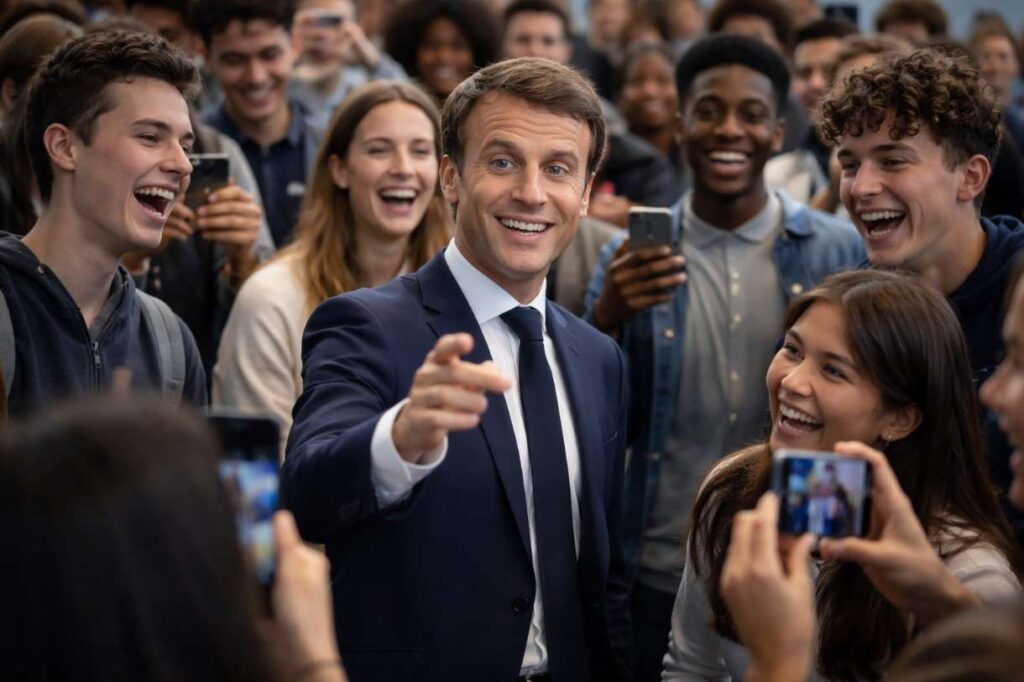
The scene seems at first glance casual, almost charming: a student shouts two words in English at the French president that he had pronounced months earlier in a completely different context. But it is precisely in that lightness that its political significance lies. Because it reveals how much political communication has changed in the digital age—and how difficult it is even for a media-savvy head of state to maintain control over his own public image.
A president in the mirror of youth culture
When Emmanuel Macron visited the Cité internationale de la langue française in Villers-Cotterêts on April 16, 2026, the central topic was actually a classic issue in educational policy: reading, concentration, and managing digital media. Macron advocated for a conscious limitation of screen time, proposed the idea of a regular “day without connection,” and reaffirmed his stance to ban social networks for under-15s.
But the dynamics of the encounter soon escaped the planned agenda. A student picked up the already viralized expression “For sure” — a spontaneous intervention in English by Macron during the World Economic Forum in Davos. The reaction in the room was eloquent: laughter, recognition, a collective agreement that these two words are already part of a daily digital culture.
Here a shift is shown that goes far beyond the individual case. Political figures are no longer mainly remembered for their programs or speeches, but for fragmented moments, often with humorous nuances. Those moments circulate independently of the original context and precisely because of their reduction they gain impact.
The blurring of political messages
Macron belongs to that generation of politicians who not only use social media but also try to employ it strategically. Whether through short videos on TikTok, direct interventions on Instagram, or deliberate informal appearances: his communication style is designed to generate closeness and overcome traditional distance.
But therein lies a structural risk. Digital platforms do not function as linear distribution channels but as spaces of appropriation. Content is not simply consumed but transformed — through memes, parodies, and ironic ruptures. The original message often recedes into the background.
The “For sure” case exemplifies this principle. What was intended as a spontaneous, possibly calculated relaxation in an international context became in the digital public sphere an autonomous symbol. It now represents less Macron’s positions on economic policy and more a certain habit: the globally connected, Anglophile, and somewhat technocratic president.
Author: P. Tiko
Author: P. Tiko
But therein lies a structural risk. Digital platforms do not function as linear distribution channels but as spaces of appropriation. Content is not simply consumed but transformed — through memes, parodies, and ironic ruptures. The original message often recedes into the background.
The “For sure” case exemplifies this principle. What was intended as a spontaneous, possibly calculated relaxation in an international context became in the digital public sphere an autonomous symbol. It now represents less Macron’s positions on economic policy and more a certain habit: the globally connected, Anglophile, and somewhat technocratic president.
This transformation largely escapes the control of the political actor. The communication political scientist here speaks of “recontextualization”: a process in which content is inserted into new frames of meaning. On social networks, this happens in real time and on a potentially global scale.
Between the loss of authority and a new closeness
From a political point of view, what is interesting is the ambivalence of this dynamic. The ironic reference of the students is neither an open criticism nor an unequivocal approval. It lies in an intermediate area, which has become typical of the digital public sphere: a form of “soft irony” that creates distance without necessarily expressing rejection.
For the dignity of the presidential office, which in France is traditionally marked by institutional authority and republican dignity, this poses a challenge. The so-called “Jupiterian presidency” that Macron advocated at the start of his term aimed at a clear hierarchy between political leadership and the citizenry. The memetic appropriation undermines this model.
At the same time, it opens new forms of connection. A president who becomes the subject of memes becomes part of everyday communication. He is quoted, imitated, varied — and thus remains present. In a media environment marked by attention, this can be an advantage.
Political science speaks in this context of the “popculturalization” of political actors. This development is not new, but it has accelerated considerably due to digital platforms. While previous generations of politicians were conveyed through television or print media, current perception increasingly occurs through fragmented and user-generated content.
The irony of disconnection
Particularly revealing is the discrepancy between the motive and the reception of the scene in Villers-Cotterêts. Macron wanted to talk about reading and concentration: about the need to step away from the permanent overload of digital stimuli. But precisely that overload of stimuli determined the perception of his intervention.
The students did not primarily react to his current statements, but rather to a digital echo from the past. The meme moment overlaid the real message. This disconnection is characteristic of the present: political communication is no longer received linearly, but is filtered through a multitude of parallel references.
The temporal structure also plays a role. While classical political communication is oriented towards the present and immediate effect, memes operate according to a different logic. They can reappear weeks or months later, be reinterpreted, and generate resonance in completely different contexts.
For political strategists, this means a fundamental uncertainty. Any statement, any gesture can potentially become a “secondary event” of this kind — with its own dynamics and scope.
Politics in the era of circulating images
The “For sure” episode is therefore more than an anecdote. It points to a profound transformation of the political public sphere. Images, short sequences, and linguistic fragments gain greater importance compared to complex arguments. They are easier to share, quicker to understand, and emotionally more relatable.
At the same time, the role of the public changes. Citizens — especially younger generations — are no longer just receivers, but active co-participants in political communication. They select, comment on, decontextualize, and disseminate content. The boundary between producer and consumer becomes blurred.
For a president like Macron, who relies heavily on communicative control, this creates a field of tension. On the one hand, the digital public sphere offers new opportunities to address the citizenry directly. On the other hand, it escapes centralized control and follows its own rules, often difficult to predict.
The scene in Villers-Cotterêts condenses this development into a single moment. A student shouts two words—and with that expresses an entire system of meanings, expectations, and media practices. It is a brief exchange, seemingly insignificant, that nevertheless reveals the mechanisms of modern political communication.
In this sense, the “For sure” is less a slip or curiosity and more a symptom. It shows how political authority today is shaped not only through programs and decisions but also by its reflection in a digital culture that privileges irony, condensation, and repetition. Those who communicate in this space must accept that their own message will not have the final word.
Author: P. Tiko