
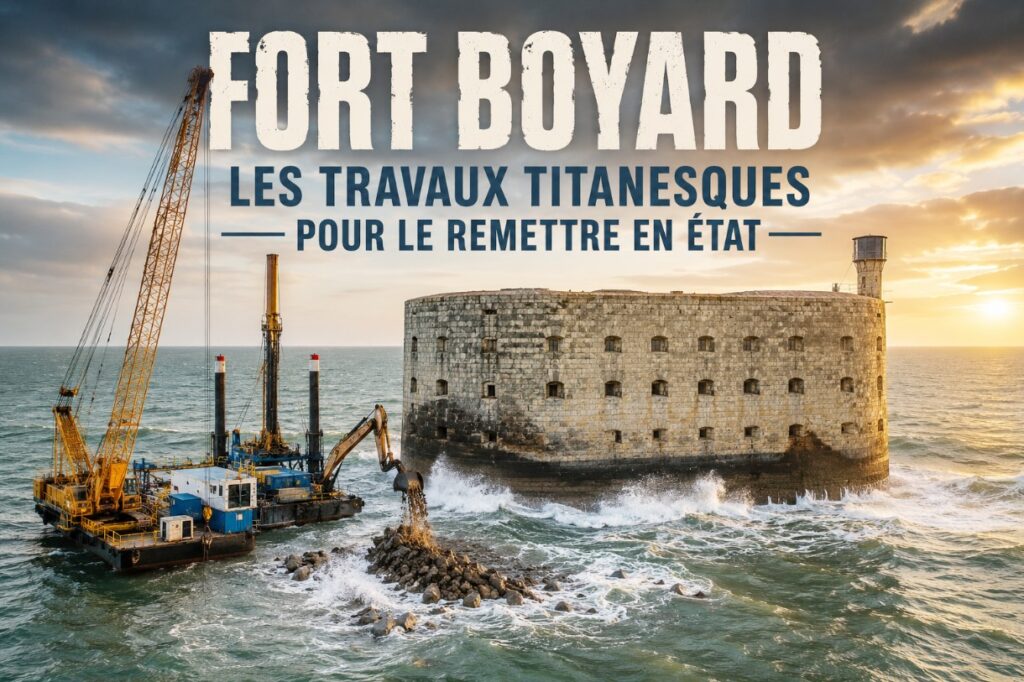
Standing amid the waters of the Atlantic between the islands of Oleron and Aix for more than 160 years, Fort Boyard is known to millions of television viewers as the setting of the legendary adventure show of the same name. But behind its thick stone walls lies a serious reality: France’s most famous sea fort is suffering from the forces of the sea. Without extensive restoration work, the historic site faced the threat of severe long-term damage. One of the largest restoration projects in French heritage conservation is therefore now under way.
At first glance, Fort Boyard appears almost indestructible. Its massive walls seem to have defied wind and waves for centuries. But appearances are deceptive. Storms, strong currents and the daily surf have eroded its foundations for decades. The stone protective belt surrounding the fort, originally intended to absorb the force of the waves, has been particularly affected. Today, the masses of water strike the structure almost unchecked. Visible cracks and damaged sections of masonry clearly show that time has left its mark.
This is precisely where the ambitious rescue project begins.
By 2028, around 44 million euros will be invested in restoring the historic fortress. The aim is not only to secure the existing walls, but also to provide lasting protection against the increasingly severe pressures of the sea. The work is considered a technical feat, as every construction measure takes place in the middle of the Atlantic – far from any harbor and dependent on weather, wind and tides.
The first phase began with extensive underwater work. Specialized excavators are removing several thousand cubic meters of rubble and loose stones around the foundation. The machines operate at depths of several meters. Only after this preparation can a stable base for the new protective structures be created.
This is followed by the real Herculean task. The damaged protective wall around the fort is receiving a complete reinforcement. At the same time, two historic structures are being rebuilt: a landing area for boats and a massive breakwater. Both were part of the original complex in the 19th century, but over the decades they almost completely disappeared beneath the force of the Atlantic. Their reconstruction is intended to absorb much of the wave energy in the future and provide lasting relief for the structure.
The logistics behind the project are especially impressive. The huge concrete elements are not produced directly at the fort, but in a dry dock on France’s Atlantic coast. Specialized ships then transport the multi-ton components across the sea. There, cranes place each individual element in its designated position with millimeter precision. This process alone requires perfect planning and the utmost precision. Anyone who has ever tried to keep their balance on a boat in heavy seas can imagine the challenge involved in such work.
The well-known television production is also adapting to the construction work. Filming continues during the summer months. The construction companies and production team coordinate their schedules closely so that both projects can proceed in parallel. It is a balancing act that works surprisingly well. After all, Fort Boyard has long been one of Europe’s best-known television backdrops.
But the restoration has another goal as well.
Once the work is complete, the fortress is expected to welcome visitors regularly for the first time. Until now, its interior has been reserved almost exclusively for film crews and a small number of specialists. In the future, interested visitors may be able to experience the legendary structure up close. Would that not be a unique opportunity to enter a place that millions of people have so far known only from the screen?
The history of Fort Boyard extends far beyond television entertainment. Napoleon had the fortress built to protect the naval port of Rochefort from possible attacks by the British fleet. By the time construction was finally completed in the mid-19th century, military technology had already advanced. The fort lost its strategic value and later served, among other purposes, as a prison. It then fell into disrepair for many decades until television gave it an entirely new life.
It could hardly be more ironic.
Of all things, an entertainment show made the historic structure famous around the world. Today, that popularity plays a decisive role in justifying the enormous restoration costs. What began as a military prestige project developed into one of France’s best-known landmarks.
The coming years will determine its future. If the restoration s쳮ds as planned, Fort Boyard will continue to withstand wind, waves and time for decades to come. The famous sea fort will remain not only a symbol of French engineering, but also an impressive example of how history and modern technology can go hand in hand. And honestly, what other fortress in the middle of the sea tells such an extraordinary story?
An article by M. Legrand