
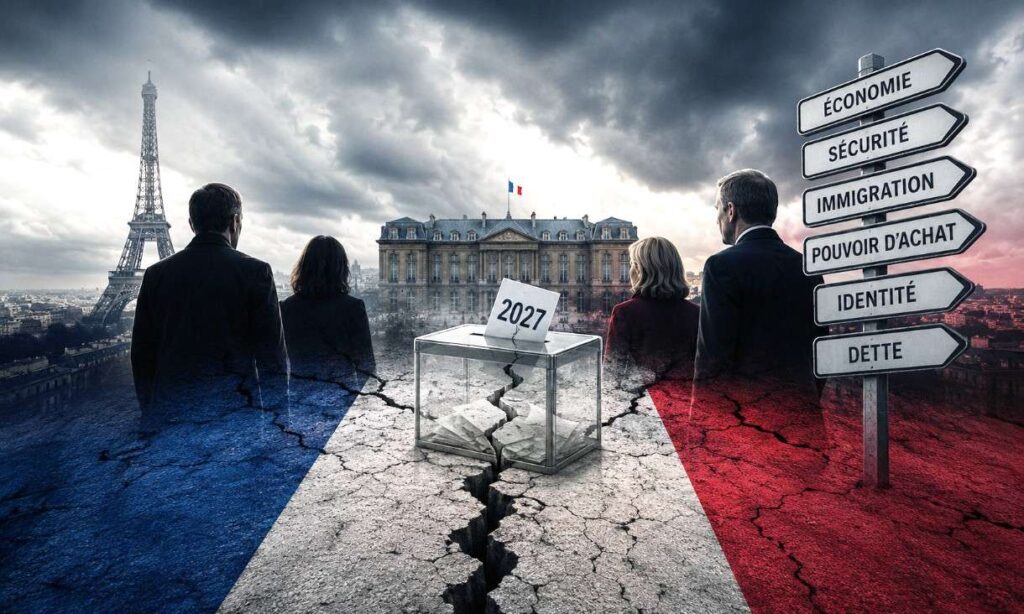
Less than a year before the French presidential elections of 2027, one impression dominates public debate: the upcoming campaign could become the election of all French crises. Rarely in the history of the Fifth Republic has a presidential duel been announced in a climate so charged with geopolitical, economic, social, and identity politics uncertainties.
France is gradually entering the pre-primary phase, accompanied by an accumulation of tensions that profoundly transform the political balance. The war in the Middle East, concerns about energy policy, Europe’s economic slowdown, high public debt, housing shortages, migration issues, urban violence, and growing democratic fatigue are intertwined. Each crisis seems to aggravate the next. In this context, the 2027 elections seem less like an ordinary partisan contest and more like a referendum on the country’s ability to remain stable in an increasingly hostile world.
The End of the Macron Era and Political Reordering
A singular feature of this presidential election is the absence of an incumbent president as a candidate. Emmanuel Macron cannot, by constitutional imperative, run for a third consecutive term. He leaves behind a political system that has been profoundly transformed since 2017 but at the same time has become strongly fragmented.
The historic collapse of the traditional popular parties — the socialists on the left and the republicans on the right — has not yet been replaced by a new stable balance. The political center, which Macron has dominated for almost a decade, seems increasingly exhausted. Many French people today associate Macronism with a technocratic form of governing that, while it may seem efficient, is perceived as distant from the social and territorial tensions of the country.
The protest movements of recent years — from the “yellow vests” to the intense clashes over pension reform — have highlighted this disenchantment. Trust in institutions, parties, and the media has noticeably declined. The political center is revealed to many voters less as a solution and more as a symbol of a system that has lost control over social developments.
The Rise of the Rassemblement National
While the political center loses cohesion strength, the Rassemblement National (RN) presents itself stronger than ever. Jordan Bardella embodies a new generation of nationalist politicians who connect far beyond the traditional far-right electorate.
Its carefully softened image, professional use of social networks, and the constant normalization of the party have changed political perception. Today, an RN victory is no longer considered a marginal hypothesis but a realistic scenario.
The success of the RN is fueled by several dynamics at once: concern about migration, insecurity in the face of global crises, the feeling of economic decline, and a deep distrust of European institutions. Especially in regions with structural problems and small towns, the party increasingly manages to present itself as a protective force against globalization and the loss of control.
At the same time, Bardella benefits from the fact that the classic republican right is still struggling with its political identity. The conservative forces, situated between the liberal-economic tradition and a shift towards national conservatism, have yet to formulate a convincing alternative.
A fragmented left despite favorable issues
On the left, the picture remains contradictory. Although social inequality, inflation, climate change, and the crisis of public services initially offer favorable topics for mobilization, the French left remains deeply divided.
Among socialists, ecologists, the radical left, and various citizen movements, there are significant differences regarding Europe, migration, security policy, and economic models. To date, no common candidate or dominant leadership is in sight.
There is also a cultural conflict within the progressive camp itself. While one part of the left places greater emphasis on identity and sociocultural issues, others demand a return to classic socioeconomic matters such as purchasing power, industrial policy, and social protection. These tensions make the formation of a broad political coalition difficult.
At the same time, it is observed that sectors of the traditional working class and the lower middle class no longer automatically vote for the left. Especially in places where economic insecurity and security concerns prevail, the influence of the left has been declining for years.
Foreign policy and security issues come to the fore
The international situation could influence the 2027 presidential elections more than many previous campaigns. The French observe the geopolitical tensions with growing concern: the strategic competition between the United States and China, conflicts in the Middle East, cyber threats, and the return of classic power politics.
Thus, the question of presidential authority gains importance again. In French political culture, the head of state traditionally plays a central role as guarantor of national stability and international capacity for action. In times of crisis, this expectation usually intensifies.
The next candidates will therefore have to present not only economic or social reform programs. They will also have to provide answers on how France wants to secure its sovereignty, its industrial base, and its strategic position in Europe.
In particular, the topics of defense, energy supply, and economic independence will likely gain importance. France is increasingly confronted with the question of how much national control is possible in a globalized and geopolitically fragmented world.
A society in a state of permanent exhaustion
The perhaps deepest uncertainty concerns the psychological state of the country. For years, France seems marked by collective fatigue: fear of social decline, distrust towards the elites, tax fatigue, media polarization, and a growing radicalization of public debates shape the social climate.
Social media amplify this dynamic. Political controversies spread faster, debates become charged with emotion, and the capacity for compromise decreases. Public discussion is increasingly subjected to waves of short-term indignation.
Therefore, the 2027 presidential elections might be less dominated by classic party programs and more by emotional moods: fear, anger, exhaustion, the need for security, or the desire for a radical political break.
Several central questions thus come together: Can France continue to shape its economic future independently? How can the welfare state be financed without public debt soaring even further? How far should migration control go? What balance between security and individual freedoms is socially acceptable? And what role should France assume in a world that is geopolitically changing at great speed?
The 2027 presidential elections, therefore, will probably not only decide who governs France. They could reveal what the French still believe is possible for their country—and what concept of stability, identity, and future capacity they wish to preserve in a time of permanent crisis.
Author: Andreas M. Brucker