
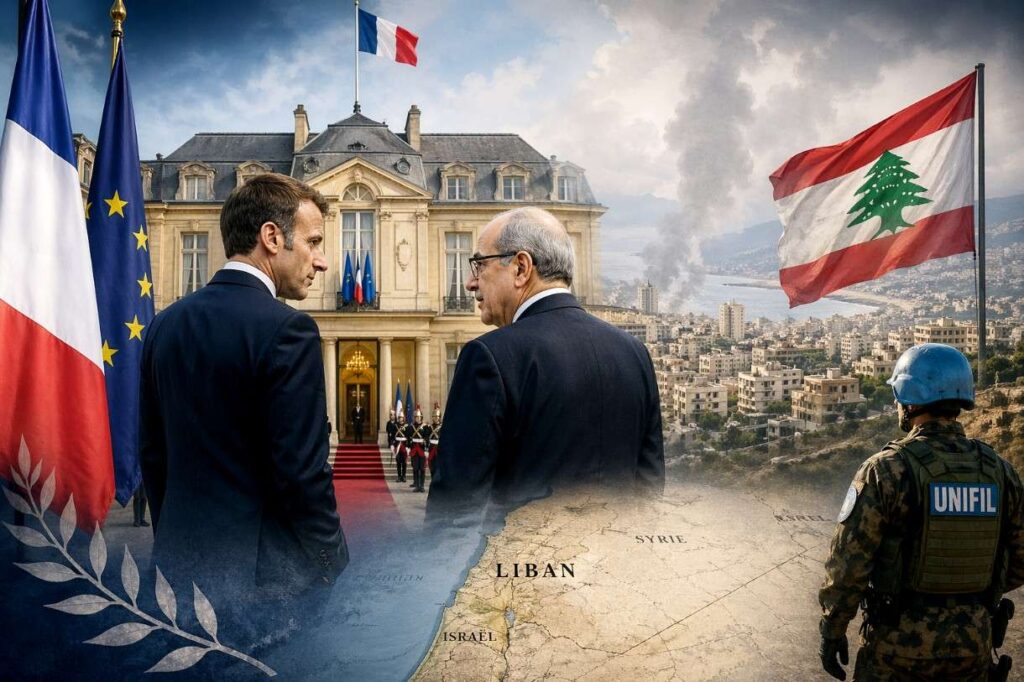
When Emmanuel Macron meets Lebanese Prime Minister Nawaf Salam today at the Élysée Palace, it is more than just a diplomatic appointment on the Republic’s calendar. It is a moment of self-assurance for French foreign policy – and at the same time a test of its effectiveness.
Lebanon is once again on the brink of escalation. The fragile ceasefire with Israel is less a sign of stability than an expression of mutual deterrence. In this arena, France is trying to assert its role as an ordering force. The question, however, is whether it can still fulfill this role.
The Illusion of Controllability
Paris formulates clear goals: securing a ceasefire, strengthening state sovereignty, restoring the monopoly on violence. This agenda is rational – and yet largely aspirational. Because it presupposes a functioning state, which hardly exists in this form in Lebanon anymore.
The presence of Hezbollah is not just a security problem, but an expression of a deeper political reality: The Lebanese state is fragmented, its authority divided, its institutions weakened. Anyone talking about sovereignty here necessarily moves in the tension between normative claim and factual powerlessness.
France knows this. Yet it clings to its rhetoric – not least because it lacks alternatives.
Historical Closeness as a Strategic Burden
The special relationship between France and Lebanon has often been described as an advantage. In fact, today it is just as much a burden. It creates expectations that are politically hardly fulfillable.
Paris sees itself in a role that it historically shaped: as a protector, as a mediator, as a guarantor of a certain order. But the geopolitical coordinates have shifted. Actors like Iran or Saudi Arabia now significantly determine the dynamics of the region. France remains a relevant, but not a decisive factor.
This is precisely the dilemma: The historical closeness obliges engagement – but it does not grant enforcement power.
Multilateralism as a necessity, not a choice
The involvement of international actors is not an option for Paris, but a necessity. UNIFIL is exemplary for this approach: it symbolizes international presence without being able to solve the structural conflicts.
The same applies to the European Union. It can mobilize financial support and demand reforms. But it also remains dependent on the willingness of local elites to cooperate – and on the security policy developments on site.
Salam’s visit to Europe is therefore less an expression of diplomatic initiative than a sign of structural dependency.
France’s role in the shadow of greater powers
The reality of the Middle East is one of power politics. In it, France acts as a medium power with limited means. It can mediate, appeal, and support – but not decide.
The strategic lines run elsewhere: between Tehran and Tel Aviv, between regional rivalries and global interests. France moves within this framework more as a catalyst than as an actor with independent shaping power.
This does not diminish the importance of its engagement. However, it does relativize its scope.
The Limits of Political Ambition
Macron’s Lebanon policy is characterized by a tension: the claim to exert influence and the recognition of its own limits. Experiences since 2020 have shown how difficult it is to initiate reforms from the outside.
The Lebanese crisis is not only a result of external factors but the outcome of a system of political patronage and institutional weakness developed over decades. Anyone who wants to achieve changes here needs more than diplomatic pressure – they need an internal dynamic that is currently barely visible.
France can accompany this process, but cannot decisively control or even replace it.
A Sober Assessment
The meeting at the Élysée is therefore neither a breakthrough nor mere symbolic politics. It is an expression of a policy that is aware of its limited means and yet acts.
For Lebanon, this represents an opportunity to mobilize international support. For France, it is another attempt to define its role in a complex region.
The crucial question remains open: Can a medium-sized power still have a shaping influence in an increasingly multipolar environment – or is its influence limited to managing crises?
The answer will not lie in a single meeting. But it will also be defined in such moments.
P.T.