
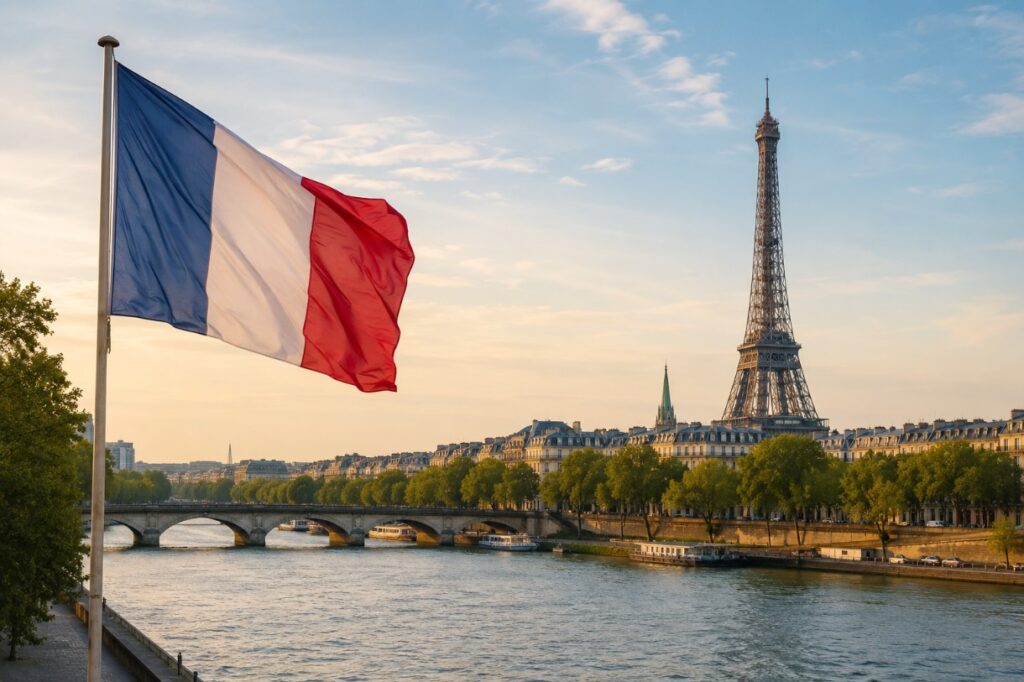
On May 27, 2026, France experienced a day in which political, social and international tensions intertwined into a single picture. The headlines at first glance seemed unrelated: heat wave, presidential election, immigration, the Middle East crisis and football. Together they told the story of a country in transition — a republic increasingly anxious about its future after years of persistent crises.
The French public appeared both weary and highly politicized. Many debates revolved around the same basic question: is the state gradually losing its ability to guarantee order, prosperity and security? This sense now runs through much of the media coverage.
The long shadow of the 2027 presidential election
Official campaigning has not yet begun, but in practice France is already in the primary phase. Since the parliamentary crises of recent years, the stable political center no longer exists. The old order of the Fifth Republic — once defined by clear majorities and a strong presidential image — is increasingly fragmenting.
Competition within the moderate center is currently especially fierce. Gabriel Attal is still trying to present himself as a dynamic symbol of modernization. By contrast, Édouard Philippe is seen by many conservative voters as a representative of political stability and administrative experience. Both understand that the political vacuum after Macron could be very large.
Meanwhile, Prime Minister Sébastien Lecornu is under growing pressure. Although his government appears to act effectively at the technocratic level, it seems politically fragile. Thus many editorials again invoke a historically weighty concept in France: “fin de règne” — a feeling that a political cycle is coming to an end.
At the same time, the National Rally occupies a strategic advantage. The party currently almost does not need to govern yet can dominate debates about immigration, purchasing power, insecurity and national identity. The right’s political gains come more from the erosion of trust in traditional institutions than from any surge of enthusiasm.
The situation on the left is also more strained. Jean-Luc Mélenchon still mobilizes radical urban youth, but faces strong resistance in the political center. France today is ideologically more divided than it was ten years ago.
The heat wave as a political omen
Few issues have dominated French media discussion more than this unusually early heat wave. End-of-May temperatures above 35°C are alarming even for southern France.
But the coverage went far beyond meteorology. The high temperatures are gradually becoming a political symbol. Many commentators describe France as a country whose infrastructure is not prepared for the new climatic reality.
Large cities are particularly affected. Paris, Lyon and Marseille face severe problems of hardened surfaces, lack of green spaces and overheated residential areas. Many schools still lack effective cooling systems. In the suburbs, the heat exacerbates social inequality: the wealthy escape the heat with second homes or air-conditioned housing, while the poor are trapped on concrete expanses.
The expression “France suffocating” not only describes the weather but also reflects the social mood. Many parts of France appear overwhelmed — administratively, infrastructurally and financially.
Water supply issues are increasingly prominent. Several regions have begun discussing water-use restrictions. Farmers warn that harvests will be affected, while municipal authorities discuss summer water security. Climate change in France is no longer an abstract future topic but part of the daily political agenda.
A long-term crisis of immigration and security
At present few political issues provoke such strong reactions from the French public as immigration and security. Justice Minister Gérald Darmanin’s remarks about possibly suspending some legal immigration further intensified the debate.
Conservative media frankly say France is reaching historical limits of capacity. Left-wing commentators warn that the rhetoric is increasingly tilting toward far-right narratives and seeping into mainstream politics.
It is notable that immigration, drug-related crime, urban violence and state authority are often discussed together in France.
The situation in Marseille is particularly emblematic. Violence between street drug gangs has preoccupied police and the judiciary for months. At the same time, public concern about safety in public spaces is increasing — whether or not overall crime rates are rising.
The key is not objective data but political perception. France is now deeply debating state control: border management, community safety, the monopoly on violence and judicial enforcement capacity.
Therefore, security issues are very likely to become a central theme of the upcoming presidential campaign.
France caught between global crises and European impotence
On foreign policy, Paris is likewise tense. France watches the escalation in the Middle East and tensions around Iran closely, especially worried about their potential impact on energy prices and inflation.
Concerns about another economic shock are evident. For years France has struggled with high public debt, weak economic growth and structural fiscal problems. A new energy shock could further undermine social stability.
The international situation also exposes Europe’s strategic dilemma. Many French commentators criticize the EU for still being heavily dependent on the United States in foreign and security policy, while China rises quickly economically and geopolitically.
This debate touches the core of French national reasoning: the demand for strategic autonomy. However, today’s domestic political weakness limits France’s capacity for diplomatic action.
The contrast is stark: as international crises escalate, France’s domestic politics are mired in pension issues, violent crime and heat-management plans.
Paris Saint-Germain and the search for national symbols
Even football has acquired political significance in France. Paris Saint-Germain is about to face Arsenal in the Champions League final, and the discussion goes well beyond sport.
For many fans, a European victory would be the ultimate proof of the club’s international legitimacy. Others see Paris Saint-Germain as an artificial brand still lacking historical depth — enormous finances and ongoing cultural controversy.
The state plays a notable role in this. Authorities are on high alert to prevent celebrations from triggering unrest. Given the spate of violent incidents in recent years, even sporting events are subject to highly securitized management in France.
This reflects the prevailing national mood: even moments of collective celebration are shadowed by social tensions.
On May 27, 2026, France seemed to be a republic between vital spectacle and fatigue. Cafés, festivals, travel and football still displayed that internationally admired French ease, but structural fragility was on the rise.
The major debates of the day — climate, immigration, state authority, geopolitical uncertainty and political polarization — all pointed to the same question: can France still deliver the republic’s promise of stability?
There is no clear answer yet, but it is precisely this uncertainty that shapes today’s French political atmosphere.